von Vietinghoff S et al. (MAY 2007)
Blood 109 10 4487--93
NB1 mediates surface expression of the ANCA antigen proteinase 3 on human neutrophils.
Antineutrophil cytoplasmic antibodies (ANCAs) with specificity for proteinase 3 (PR3) are central to a form of ANCA-associated vasculitis. Membrane PR3 (mPR3) is expressed only on a subset of neutrophils. The aim of this study was to determine the mechanism of PR3 surface expression on human neutrophils. Neutrophils were isolated from patients and healthy controls,and hematopoietic stem cells from cord blood served as a model of neutrophil differentiation. Surface expression was analyzed by flow cytometry and confocal microscopy,and proteins were analyzed by Western blot experiments. Neutrophil subsets were separated by magnetic cell sorting. Transfection experiments were carried out in HEK293 and HL60 cell lines. Using neutrophils from healthy donors,patients with vasculitis,and neutrophilic differentiated stem cells we found that mPR3 display was restricted to cells expressing neutrophil glycoprotein NB1,a glycosylphosphatidylinositol (GPI)-linked surface receptor. mPR3 expression was decreased by enzymatic removal of GPI anchors from cell membranes and was absent in a patient with paroxysmal nocturnal hemoglobinuria. PR3 and NB1 coimmunoprecipitated from and colocalized on the neutrophil plasma membrane. Transfection with NB1 resulted in specific PR3 surface binding in different cell types. We conclude that PR3 membrane expression on neutrophils is mediated by the NB1 receptor.
View Publication
产品号#:
09600
09650
产品名:
StemSpan™ SFEM
StemSpan™ SFEM
Vanneaux V et al. (JAN 2010)
Cell transplantation 19 9 1143--55
In vitro and in vivo analysis of endothelial progenitor cells from cryopreserved umbilical cord blood: are we ready for clinical application?
Umbilical cord blood (CB) represents a main source of circulating endothelial progenitor cells (cEPCs). In view of their clinical use,in either the autologous or allogeneic setting,cEPCs should likely be expanded from CB kept frozen in CB banks. In this study,we compared the expansion,functional features,senescence pattern over culture,and in vivo angiogenic potential of cEPCs isolated from fresh or cryopreserved CB (cryoCB). cEPCs could be isolated in only 59% of cryoCB compared to 94% for fresh CB,while CB units were matched in terms of initial volume,nucleated and CD34(+) cell number. Moreover,the number of endothelial colony-forming cells was significantly decreased when using cryoCB. Once cEPCs culture was established,the proliferation,migration,tube formation,and acetylated-LDL uptake potentials were similar in both groups. In addition,cEPCs derived from cryoCB displayed the same senescence status and telomeres length as that of cEPCs derived from fresh CB. Karyotypic aberrations were found in cells obtained from both fresh and cryoCB. In vivo,in a hind limb ischemia murine model,cEPCs from fresh and cryoCB were equally efficient to induce neovascularization. Thus,cEPCs isolated from cryoCB exhibited similar properties to those of fresh CB in vitro and in vivo. However,the low frequency of cEPCs colony formation after cryopreservation shed light on the need for specific freezing conditions adapted to cEPCs in view of their future clinical use.
View Publication
产品号#:
15026
15066
产品名:
RosetteSep™人造血祖细胞富集抗体混合物
RosetteSep™人造血祖细胞富集抗体混合物
Kurita R et al. (SEP 2006)
Stem cells (Dayton,Ohio) 24 9 2014--22
Tal1/Scl gene transduction using a lentiviral vector stimulates highly efficient hematopoietic cell differentiation from common marmoset (Callithrix jacchus) embryonic stem cells.
The development of embryonic stem cell (ESC) therapies requires the establishment of efficient methods to differentiate ESCs into specific cell lineages. Here,we report the in vitro differentiation of common marmoset (CM) (Callithrix jacchus) ESCs into hematopoietic cells after exogenous gene transfer using vesicular stomatitis virus-glycoprotein-pseudotyped lentiviral vectors. We transduced hematopoietic genes,including tal1/scl,gata1,gata2,hoxB4,and lhx2,into CM ESCs. By immunochemical and morphological analyses,we demonstrated that overexpression of tal1/scl,but not the remaining genes,dramatically increased hematopoiesis of CM ESCs,resulting in multiple blood-cell lineages. Furthermore,flow cytometric analysis demonstrated that CD34,a hematopoietic stem/progenitor cell marker,was highly expressed in tal1/scl-overexpressing embryoid body cells. Similar results were obtained from three independent CM ESC lines. These results suggest that transduction of exogenous tal1/scl cDNA into ESCs is a promising method to induce the efficient differentiation of CM ESCs into hematopoietic stem/progenitor cells.
View Publication
产品号#:
03434
03444
04435
04445
产品名:
MethoCult™ GF M3434
MethoCult™ GF M3434
MethoCult™ H4435 Enriched
MethoCult™ H4435 Enriched
Ma YD et al. (NOV 2009)
Blood 114 20 4402--10
Defects in osteoblast function but no changes in long-term repopulating potential of hematopoietic stem cells in a mouse chronic inflammatory arthritis model.
Recent studies support the notion that there is an intricate relationship between hematopoiesis and bone homeostasis in normal steady states. Using mice undergoing chronic inflammatory arthritis,we investigated the relationship between hematopoiesis and bone homeostasis in pathologic conditions. We demonstrate that mice undergoing chronic inflammatory arthritis displayed osteoporosis resulting from a severe defect in osteoblast function. Despite the defective osteoblast function,however,the hematopoietic stem cells from these mice exhibited normal properties in either long-term repopulation or cell cycling. Therefore,the bone-forming capacity of osteoblasts is distinct from their ability to maintain hematopoietic stem cells in chronic inflammatory conditions.
View Publication
产品号#:
03434
03444
产品名:
MethoCult™ GF M3434
MethoCult™ GF M3434
Capoccia BJ et al. (MAY 2009)
Blood 113 21 5340--51
Revascularization of ischemic limbs after transplantation of human bone marrow cells with high aldehyde dehydrogenase activity.
The development of cell therapies to treat peripheral vascular disease has proven difficult because of the contribution of multiple cell types that coordinate revascularization. We characterized the vascular regenerative potential of transplanted human bone marrow (BM) cells purified by high aldehyde dehydrogenase (ALDH(hi)) activity,a progenitor cell function conserved between several lineages. BM ALDH(hi) cells were enriched for myelo-erythroid progenitors that produced multipotent hematopoietic reconstitution after transplantation and contained nonhematopoietic precursors that established colonies in mesenchymal-stromal and endothelial culture conditions. The regenerative capacity of human ALDH(hi) cells was assessed by intravenous transplantation into immune-deficient mice with limb ischemia induced by femoral artery ligation/transection. Compared with recipients injected with unpurified nucleated cells containing the equivalent of 2- to 4-fold more ALDH(hi) cells,mice transplanted with purified ALDH(hi) cells showed augmented recovery of perfusion and increased blood vessel density in ischemic limbs. ALDH(hi) cells transiently recruited to ischemic regions but did not significantly integrate into ischemic tissue,suggesting that transient ALDH(hi) cell engraftment stimulated endogenous revascularization. Thus,human BM ALDH(hi) cells represent a progenitor-enriched population of several cell lineages that improves perfusion in ischemic limbs after transplantation. These clinically relevant cells may prove useful in the treatment of critical ischemia in humans.
View Publication
产品号#:
01700
01705
01701
01702
18058
18058RF
21000
20119
20155
产品名:
ALDEFLUOR™ 试剂盒
ALDEFLUOR™ DEAB试剂, 1.5 mM, 1 mL
ALDEFLUOR™检测缓冲液
RoboSep™- S
RoboSep™ 吸头组件抛光剂
RoboSep™分选管套装(9个塑料管)
Randrianarison-Huetz V et al. (APR 2010)
Blood 115 14 2784--95
Gfi-1B controls human erythroid and megakaryocytic differentiation by regulating TGF-beta signaling at the bipotent erythro-megakaryocytic progenitor stage.
Growth factor independence-1B (Gfi-1B) is a transcriptional repressor essential for erythropoiesis and megakaryopoiesis. Targeted gene disruption of GFI1B in mice leads to embryonic lethality resulting from failure to produce definitive erythrocytes,hindering the study of Gfi-1B function in adult hematopoiesis. We here show that,in humans,Gfi-1B controls the development of erythrocytes and megakaryocytes by regulating the proliferation and differentiation of bipotent erythro-megakaryocytic progenitors. We further identify in this cell population the type III transforming growth factor-beta receptor gene,TGFBR3,as a direct target of Gfi-1B. Knockdown of Gfi-1B results in altered transforming growth factor-beta (TGF-beta) signaling as shown by the increase in Smad2 phosphorylation and its inability to associate to the transcription intermediary factor 1-gamma (TIF1-gamma). Because the Smad2/TIF1-gamma complex is known to specifically regulate erythroid differentiation,we propose that,by repressing TGF-beta type III receptor (TbetaRIotaII) expression,Gfi-1B favors the Smad2/TIF1-gamma interaction downstream of TGF-beta signaling,allowing immature progenitors to differentiate toward the erythroid lineage.
View Publication
产品号#:
09850
产品名:
Twu Y-C et al. (MAR 2010)
Blood 115 12 2491--9
Phosphorylation status of transcription factor C/EBPalpha determines cell-surface poly-LacNAc branching (I antigen) formation in erythropoiesis and granulopoiesis.
The cell-surface straight and branched repeats of N-acetyllactosamine (LacNAc) units,called poly-LacNAc chains,characterize the histo-blood group i and I antigens,respectively. The transition of straight to branched poly-LacNAc chain (i to I) is determined by the I locus,which expresses 3 IGnT transcripts,IGnTA,IGnTB,and IGnTC. Our previous investigation demonstrated that the i-to-I transition in erythroid differentiation is regulated by the transcription factor CCAAT/enhancer binding protein alpha (C/EBPalpha). In the present investigation,the K-562 cell line was used as a model to show that the i-to-I transition is determined by the phosphorylation status of the C/EBPalpha Ser-21 residue,with dephosphorylated C/EBPalpha Ser-21 stimulating the transcription of the IGnTC gene,consequently resulting in I branching. Results from studies using adult erythropoietic and granulopoietic progenitor cells agreed with those derived using the K-562 cell model,with lentiviral expression of C/EBPalpha in CD34(+) hematopoietic cells demonstrating that the dephosphorylated form of C/EBPalpha Ser-21 induced the expression of I antigen,granulocytic CD15,and also erythroid CD71 antigens. Taken together,these results demonstrate that the regulation of poly-LacNAc branching (I antigen) formation in erythropoiesis and granulopoiesis share a common mechanism,with dephosphorylation of the Ser-21 residue on C/EBPalpha playing the critical role.
View Publication
产品号#:
02532
02832
02615
02855
09600
09650
产品名:
StemSpan™ SFEM
StemSpan™ SFEM
Nakagawa M et al. (NOV 2006)
Blood 108 10 3329--34
AML1/Runx1 rescues Notch1-null mutation-induced deficiency of para-aortic splanchnopleural hematopoiesis.
The Notch1-RBP-Jkappa and the transcription factor Runx1 pathways have been independently shown to be indispensable for the establishment of definitive hematopoiesis. Importantly,expression of Runx1 is down-regulated in the para-aortic splanchnopleural (P-Sp) region of Notch1- and Rbpsuh-null mice. Here we demonstrate that Notch1 up-regulates Runx1 expression and that the defective hematopoietic potential of Notch1-null P-Sp cells is successfully rescued in the OP9 culture system by retroviral transfer of Runx1. We also show that Hes1,a known effector of Notch signaling,potentiates Runx1-mediated transactivation. Together with the recent findings in zebrafish,Runx1 is postulated to be a cardinal down-stream mediator of Notch signaling in hematopoietic development throughout vertebrates. Our findings also suggest that Notch signaling may modulate both expression and transcriptional activity of Runx1.
View Publication
产品号#:
03434
03444
产品名:
MethoCult™ GF M3434
MethoCult™ GF M3434
Kriz V et al. (NOV 2006)
The Journal of biological chemistry 281 45 34484--91
The SHB adapter protein is required for normal maturation of mesoderm during in vitro differentiation of embryonic stem cells.
Definitive mesoderm arises from a bipotent mesendodermal population,and to study processes controlling its development at this stage,embryonic stem (ES) cells can be employed. SHB (Src homology 2 protein in beta-cells) is an adapter protein previously found to be involved in ES cell differentiation to mesoderm. To further study the role of SHB in this context,we have established ES cell lines deficient for one (SHB+/-) or both SHB alleles (SHB-/-). Differentiating embryoid bodies (EBs) derived from these ES cell lines were used for gene expression analysis. Alternatively,EBs were stained for the blood vessel marker CD31. For hematopoietic differentiation,EBs were differentiated in methylcellulose. SHB-/- EBs exhibited delayed down-regulation of the early mesodermal marker Brachyury. Later mesodermal markers relatively specific for the hematopoietic,vascular,and cardiac lineages were expressed at lower levels on day 6 or 8 of differentiation in EBs lacking SHB. The expression of vascular endothelial growth factor receptor-2 and fibroblast growth factor receptor-1 was also reduced in SHB-/- EBs. SHB-/- EBs demonstrated impaired blood vessel formation after vascular endothelial growth factor stimulation. In addition,the SHB-/- ES cells formed fewer blood cell colonies than SHB+/+ ES cells. It is concluded that SHB is required for appropriate hematopoietic and vascular differentiation and that delayed down-regulation of Brachyury expression may play a role in this context.
View Publication


 EasySep™小鼠TIL(CD45)正选试剂盒




 技术公告Identification of ALDH-Expressing Cancer Stem Cells Using ALDEFLUOR™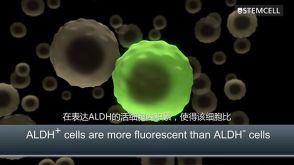

 沪公网安备31010102008431号