The megakaryocyte lineage originates from hemangioblast precursors and is an integral component both of primitive and of definitive hematopoiesis.
In the adult,platelets are derived from unipotential megakaryocyte colony-forming cells (Meg-CFCs) that arise from bipotential megakaryocyte/erythroid progenitors (MEPs). To better define the developmental origin of the megakaryocyte lineage,several aspects of megakaryopoiesis,including progenitors,maturing megakaryocytes,and circulating platelets,were examined in the murine embryo. We found that a majority of hemangioblast precursors during early gastrulation contains megakaryocyte potential. Combining progenitor assays with immunohistochemical analysis,we identified 2 waves of MEPs in the yolk sac associated with the primitive and definitive erythroid lineages. Primitive MEPs emerge at E7.25 along with megakaryocyte and primitive erythroid progenitors,indicating that primitive hematopoiesis is bilineage in nature. Subsequently,definitive MEPs expand in the yolk sac with Meg-CFCs and definitive erythroid progenitors. The first GP1bbeta-positive cells in the conceptus were identified in the yolk sac at E9.5,while large,highly reticulated platelets were detected in the embryonic bloodstream beginning at E10.5. At this time,the number of megakaryocyte progenitors begins to decline in the yolk sac and expand in the fetal liver. We conclude that the megakaryocyte lineage initially originates from hemangioblast precursors during early gastrulation and is closely associated both with primitive and with definitive erythroid lineages in the yolk sac prior to the transition of hematopoiesis to intraembryonic sites.
View Publication
产品号#:
04960
04902
04900
04963
04962
04970
产品名:
MegaCult™-C胶原和无细胞因子培养基
胶原蛋白溶液
MegaCult™-C无细胞因子培养基
双室载玻片套件
MegaCult™-C CFU-Mk染色试剂盒
MegaCult™-C无细胞因子全套试剂盒
Xiao W et al. (DEC 2010)
Blood 116 26 6003--13
Lyn- and PLC-beta3-dependent regulation of SHP-1 phosphorylation controls Stat5 activity and myelomonocytic leukemia-like disease.
Hyperactivation of the transcription factor Stat5 leads to various leukemias. Stat5 activity is regulated by the protein phosphatase SHP-1 in a phospholipase C (PLC)-β3-dependent manner. Thus,PLC-β3-deficient mice develop myeloproliferative neoplasm,like Lyn (Src family kinase)- deficient mice. Here we show that Lyn/PLC-β3 doubly deficient lyn(-/-);PLC-β3(-/-) mice develop a Stat5-dependent,fatal myelodysplastic/myeloproliferative neoplasm,similar to human chronic myelomonocytic leukemia (CMML). In hematopoietic stem cells of lyn(-/-);PLC-β3(-/-) mice that cause the CMML-like disease,phosphorylation of SHP-1 at Tyr(536) and Tyr(564) is abrogated,resulting in reduced phosphatase activity and constitutive activation of Stat5. Furthermore,SHP-1 phosphorylation at Tyr(564) by Lyn is indispensable for maximal phosphatase activity and for suppression of the CMML-like disease in these mice. On the other hand,Tyr(536) in SHP-1 can be phosphorylated by Lyn and another kinase(s) and is necessary for efficient interaction with Stat5. Therefore,we identify a novel Lyn/PLC-β3-mediated regulatory mechanism of SHP-1 and Stat5 activities.
View Publication
产品号#:
03134
产品名:
MethoCult™ M3134
Opalinska JB et al. (DEC 2010)
Blood 116 23 e128--38
MicroRNA expression in maturing murine megakaryocytes.
MicroRNAs are small noncoding RNAs that regulate cellular development by interfering with mRNA stability and translation. We examined global microRNA expression during the differentiation of murine hematopoietic progenitors into megakaryocytes. Of 435 miRNAs analyzed,13 were up-regulated and 81 were down-regulated. Many of these changes are consistent with miRNA profiling studies of human megakaryocytes and platelets,although new patterns also emerged. Among 7 conserved miRNAs that were up-regulated most strongly in murine megakaryocytes,6 were also induced in the related erythroid lineage. MiR-146a was strongly up-regulated during mouse and human megakaryopoiesis but not erythropoiesis. However,overexpression of miR-146a in mouse bone marrow hematopoietic progenitor populations produced no detectable alterations in megakaryocyte development or platelet production in vivo or in colony assays. Our findings extend the repertoire of differentially regulated miRNAs during murine megakaryopoiesis and provide a useful new dataset for hematopoiesis research. In addition,we show that enforced hematopoietic expression of miR-146a has minimal effects on megakaryopoiesis. These results are compatible with prior studies indicating that miR-146a inhibits megakaryocyte production indirectly by suppressing inflammatory cytokine production from innate immune cells,but cast doubt on a different study,which suggests that this miRNA inhibits megakaryopoiesis cell-autonomously.
View Publication
产品号#:
09600
09650
产品名:
StemSpan™ SFEM
StemSpan™ SFEM
Kriz V et al. (NOV 2006)
The Journal of biological chemistry 281 45 34484--91
The SHB adapter protein is required for normal maturation of mesoderm during in vitro differentiation of embryonic stem cells.
Definitive mesoderm arises from a bipotent mesendodermal population,and to study processes controlling its development at this stage,embryonic stem (ES) cells can be employed. SHB (Src homology 2 protein in beta-cells) is an adapter protein previously found to be involved in ES cell differentiation to mesoderm. To further study the role of SHB in this context,we have established ES cell lines deficient for one (SHB+/-) or both SHB alleles (SHB-/-). Differentiating embryoid bodies (EBs) derived from these ES cell lines were used for gene expression analysis. Alternatively,EBs were stained for the blood vessel marker CD31. For hematopoietic differentiation,EBs were differentiated in methylcellulose. SHB-/- EBs exhibited delayed down-regulation of the early mesodermal marker Brachyury. Later mesodermal markers relatively specific for the hematopoietic,vascular,and cardiac lineages were expressed at lower levels on day 6 or 8 of differentiation in EBs lacking SHB. The expression of vascular endothelial growth factor receptor-2 and fibroblast growth factor receptor-1 was also reduced in SHB-/- EBs. SHB-/- EBs demonstrated impaired blood vessel formation after vascular endothelial growth factor stimulation. In addition,the SHB-/- ES cells formed fewer blood cell colonies than SHB+/+ ES cells. It is concluded that SHB is required for appropriate hematopoietic and vascular differentiation and that delayed down-regulation of Brachyury expression may play a role in this context.
View Publication
产品号#:
03434
03444
产品名:
MethoCult™ GF M3434
MethoCult™ GF M3434
Naramura M et al. (SEP 2010)
Proceedings of the National Academy of Sciences of the United States of America 107 37 16274--9
Rapidly fatal myeloproliferative disorders in mice with deletion of Casitas B-cell lymphoma (Cbl) and Cbl-b in hematopoietic stem cells.
Casitas B-cell lymphoma (Cbl)-family E3 ubiquitin ligases are negative regulators of tyrosine kinase signaling. Recent work has revealed a critical role of Cbl in the maintenance of hematopoietic stem cell (HSC) homeostasis,and mutations in CBL have been identified in myeloid malignancies. Here we show that,in contrast to Cbl or Cbl-b single-deficient mice,concurrent loss of Cbl and Cbl-b in the HSC compartment leads to an early-onset lethal myeloproliferative disease in mice. Cbl,Cbl-b double-deficient bone marrow cells are hypersensitive to cytokines,and show altered biochemical response to thrombopoietin. Thus,Cbl and Cbl-b play redundant but essential roles in HSC regulation,whose breakdown leads to hematological abnormalities that phenocopy crucial aspects of mutant Cbl-driven human myeloid malignancies.
View Publication
产品号#:
03234
产品名:
MethoCult™ M3234
Tzeng Y-S et al. (JAN 2011)
Blood 117 2 429--39
Loss of Cxcl12/Sdf-1 in adult mice decreases the quiescent state of hematopoietic stem/progenitor cells and alters the pattern of hematopoietic regeneration after myelosuppression.
The C-X-C-type chemokine Cxcl12,also known as stromal cell-derived factor-1,plays a critical role in hematopoiesis during fetal development. However,the functional requirement of Cxcl12 in the adult hematopoietic stem/progenitor cell (HSPC) regulation was still unclear. In this report,we developed a murine Cxcl12 conditional deletion model in which the target gene can be deleted at the adult stage. We found that loss of stroma-secreted Cxcl12 in the adult led to expansion of the HSPC population as well as a reduction in long-term quiescent stem cells. In Cxcl12-deficient bone marrow,HSPCs were absent along the endosteal surface,and blood cell regeneration occurred predominantly in the perisinusoidal space after 5-fluorouracil myelosuppression challenge. Our results indicate that Cxcl12 is required for HSPC homeostasis regulation and is an important factor for osteoblastic niche organization in adult stage bone marrow.
View Publication
产品号#:
03434
03444
产品名:
MethoCult™ GF M3434
MethoCult™ GF M3434
Cianfarani F et al. (OCT 2006)
The American journal of pathology 169 4 1167--82
Placenta growth factor in diabetic wound healing: altered expression and therapeutic potential.
Reduced microcirculation and diminished expression of growth factors contribute to wound healing impairment in diabetes. Placenta growth factor (PlGF),an angiogenic mediator promoting pathophysiological neovascularization,is expressed during cutaneous wound healing and improves wound closure by enhancing angiogenesis. By using streptozotocin-induced diabetic mice,we here demonstrate that PlGF induction is strongly reduced in diabetic wounds. Diabetic transgenic mice overexpressing PlGF in the skin displayed accelerated wound closure compared with diabetic wild-type littermates. Moreover,diabetic wound treatment with an adenovirus vector expressing the human PlGF gene (AdCMV.PlGF) significantly accelerated the healing process compared with wounds treated with a control vector. The analysis of treated wounds showed that PlGF gene transfer improved granulation tissue formation,maturation,and vascularization,as well as monocytes/macrophages local recruitment. Platelet-derived growth factor,fibroblast growth factor-2,and vascular endothelial growth factor mRNA levels were increased in AdCMV.PlGF-treated wounds,possibly enhancing PlGF-mediated effects. Finally,PlGF treatment stimulated cultured dermal fibroblast migration,pointing to a direct role of PlGF in accelerating granulation tissue maturation. In conclusion,our data indicate that reduced PlGF expression contributes to impaired wound healing in diabetes and that PlGF gene transfer to diabetic wounds exerts therapeutic activity by promoting different aspects of the repair process.
View Publication
产品号#:
03434
03444
产品名:
MethoCult™ GF M3434
MethoCult™ GF M3434
Jä et al. (SEP 2010)
Proceedings of the National Academy of Sciences of the United States of America 107 37 16280--5
Isolation and killing of candidate chronic myeloid leukemia stem cells by antibody targeting of IL-1 receptor accessory protein.
Chronic myeloid leukemia (CML) is genetically characterized by the Philadelphia (Ph) chromosome,formed through a reciprocal translocation between chromosomes 9 and 22 and giving rise to the constitutively active tyrosine kinase P210 BCR/ABL1. Therapeutic strategies aiming for a cure of CML will require full eradication of Ph chromosome-positive (Ph(+)) CML stem cells. Here we used gene-expression profiling to identify IL-1 receptor accessory protein (IL1RAP) as up-regulated in CML CD34(+) cells and also in cord blood CD34(+) cells as a consequence of retroviral BCR/ABL1 expression. To test whether IL1RAP expression distinguishes normal (Ph(-)) and leukemic (Ph(+)) cells within the CML CD34(+)CD38(-) cell compartment,we established a unique protocol for conducting FISH on small numbers of sorted cells. By using this method,we sorted cells directly into drops on slides to investigate their Ph-chromosome status. Interestingly,we found that the CML CD34(+)CD38(-)IL1RAP(+) cells were Ph(+),whereas CML CD34(+)CD38(-)IL1RAP(-) cells were almost exclusively Ph(-). By performing long-term culture-initiating cell assays on the two cell populations,we found that Ph(+) and Ph(-) candidate CML stem cells could be prospectively separated. In addition,by generating an anti-IL1RAP antibody,we provide proof of concept that IL1RAP can be used as a target on CML CD34(+)CD38(-) cells to induce antibody-dependent cell-mediated cytotoxicity. This study thus identifies IL1RAP as a unique cell surface biomarker distinguishing Ph(+) from Ph(-) candidate CML stem cells and opens up a previously unexplored avenue for therapy of CML.
View Publication
产品号#:
09600
09650
04435
04445
产品名:
StemSpan™ SFEM
StemSpan™ SFEM
MethoCult™ H4435 Enriched
MethoCult™ H4435 Enriched
Sumitomo A et al. (OCT 2010)
Molecular and cellular biology 30 20 4818--27
The transcriptional mediator subunit MED1/TRAP220 in stromal cells is involved in hematopoietic stem/progenitor cell support through osteopontin expression.
MED1/TRAP220,a subunit of the transcriptional Mediator/TRAP complex,is crucial for various biological events through its interaction with distinct activators,such as nuclear receptors and GATA family activators. In hematopoiesis,MED1 plays a pivotal role in optimal nuclear receptor-mediated myelomonopoiesis and GATA-1-induced erythropoiesis. In this study,we present evidence that MED1 in stromal cells is involved in supporting hematopoietic stem and/or progenitor cells (HSPCs) through osteopontin (OPN) expression. We found that the proliferation of bone marrow (BM) cells cocultured with MED1 knockout (Med1(-/-)) mouse embryonic fibroblasts (MEFs) was significantly suppressed compared to the control. Furthermore,the number of long-term culture-initiating cells (LTC-ICs) was attenuated for BM cells cocultured with Med1(-/-) MEFs. The vitamin D receptor (VDR)- and Runx2-mediated expression of OPN,as well as Mediator recruitment to the Opn promoter,was specifically attenuated in the Med1(-/-) MEFs. Addition of OPN to these MEFs restored the growth of cocultured BM cells and the number of LTC-ICs,both of which were attenuated by the addition of the anti-OPN antibody to Med1(+/+) MEFs and to BM stromal cells. Consequently,MED1 in niche appears to play an important role in supporting HSPCs by upregulating VDR- and Runx2-mediated transcription on the Opn promoter.
View Publication


 EasySep™小鼠TIL(CD45)正选试剂盒




 技术公告Identification of ALDH-Expressing Cancer Stem Cells Using ALDEFLUOR™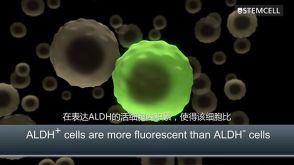

 沪公网安备31010102008431号