Ichikawa S et al. (MAY 2011)
Journal of immunology (Baltimore,Md. : 1950) 186 10 5549--55
Hepatic stellate cells function as regulatory bystanders.
Regulatory T cells (Tregs) contribute significantly to the tolerogenic nature of the liver. The mechanisms,however,underlying liver-associated Treg induction are still elusive. We recently identified the vitamin A metabolite,retinoic acid (RA),as a key controller that promotes TGF-β-dependent Foxp3(+) Treg induction but inhibits TGF-β-driven Th17 differentiation. To investigate whether the RA producing hepatic stellate cells (HSC) are part of the liver tolerance mechanism,we investigated the ability of HSC to function as regulatory APC. Different from previous reports,we found that highly purified HSC did not express costimulatory molecules and only upregulated MHC class II after in vitro culture in the presence of exogenous IFN-γ. Consistent with an insufficient APC function,HSC failed to stimulate naive OT-II TCR transgenic CD4(+) T cells and only moderately stimulated α-galactosylceramide-primed invariant NKT cells. In contrast,HSC functioned as regulatory bystanders and promoted enhanced Foxp3 induction by OT-II TCR transgenic T cells primed by spleen dendritic cells,whereas they greatly inhibited the Th17 differentiation. Furthermore,the regulatory bystander capacity of the HSC was completely dependent on their ability to produce RA. Our data thus suggest that HSC can function as regulatory bystanders,and therefore,by promoting Tregs and suppressing Th17 differentiation,they might represent key players in the mechanism that drives liver-induced tolerance.
View Publication
产品号#:
01700
01705
01701
01702
19755
产品名:
ALDEFLUOR™ 试剂盒
ALDEFLUOR™ DEAB试剂, 1.5 mM, 1 mL
ALDEFLUOR™检测缓冲液
Antunes I et al. (DEC 2010)
Journal of virology 84 24 12564--75
Suppression of innate immune pathology by regulatory T cells during Influenza A virus infection of immunodeficient mice.
The viral infection of higher vertebrates elicits potent innate and adaptive host immunity. However,an excessive or inappropriate immune response also may lead to host pathology that often is more severe than the direct effects of viral replication. Therefore,several mechanisms exist that regulate the magnitude and class of the immune response. Here,we have examined the potential involvement of regulatory T (Treg) cells in limiting pathology induced by influenza A virus (IAV) infection. Using lymphocyte-deficient mice as hosts,we showed that Treg cell reconstitution resulted in a significant delay in weight loss and prolonged survival following infection. The adoptively transferred Treg cells did not affect the high rate of IAV replication in the lungs of lymphocyte-deficient hosts,and therefore their disease-ameliorating effect was mediated through the suppression of innate immune pathology. Mechanistically,Treg cells reduced the accumulation and altered the distribution of monocytes/macrophages in the lungs of IAV-infected hosts. This reduction in lung monocytosis was associated with a specific delay in monocyte chemotactic protein-2 (MCP-2) induction in the infected lungs. Nevertheless,Treg cells failed to prevent the eventual development of severe disease in lymphocyte-deficient hosts,which likely was caused by the ongoing IAV replication. Indeed,using T-cell-deficient mice,which mounted a T-cell-independent B cell response to IAV,we further showed that the combination of virus-neutralizing antibodies and transferred Treg cells led to the complete prevention of clinical disease following IAV infection. Taken together,these results suggested that innate immune pathology and virus-induced pathology are the two main contributors to pathogenesis during IAV infection.
View Publication
产品号#:
19782
19792
产品名:
Feng T et al. (NOV 2010)
Journal of immunology (Baltimore,Md. : 1950) 185 10 5915--25
Generation of mucosal dendritic cells from bone marrow reveals a critical role of retinoic acid.
It is unknown how dendritic cells (DCs) become specialized as mucosal DCs and maintain intestinal homeostasis. We report that a subset of bone marrow cells freshly isolated from C57BL/6 mice express the retinoic acid (RA)-synthesizing enzyme aldehyde dehydrogenase family 1,subfamily A2 (ALDH1a2) and are capable of providing RA to DC precursors in the bone marrow microenvironment. RA induced bone marrow-derived DCs to express CCR9 and ALDH1a2 and conferred upon them mucosal DC functions,including induction of Foxp3(+) regulatory T cells,IgA-secreting B cells,and gut-homing molecules. This response of DCs to RA was dependent on a narrow time window and stringent dose effect. RA promoted bone marrow-derived DC production of bioactive TGF-β by inhibiting suppressor of cytokine signaling 3 expression and thereby enhancing STAT3 activation. These RA effects were evident in vivo,in that mucosal DCs from vitamin A-deficient mice had reduced mucosal DC function,namely failure to induce Foxp3(+) regulatory T cells. Furthermore,MyD88 signaling enhanced RA-educated DC ALDH1a2 expression and was required for optimal TGF-β production. These data indicate that RA plays a critical role in the generation of mucosal DCs from bone marrow and in their functional activity.
View Publication
C. Imbratta et al. (apr 2019)
Scientific reports 9 1 6135
Maf deficiency in T cells dysregulates Treg - TH17 balance leading to spontaneous colitis.
The maintenance of homeostasis in the gut is a major challenge for the immune system. Here we demonstrate that the transcription factor MAF plays a central role in T cells for the prevention of gastro-intestinal inflammation. Conditional knock out mice lacking Maf in all T cells developed spontaneous late-onset colitis,correlating with a decrease of FOXP3+RORgammat+ T cells proportion,dampened IL-10 production in the colon and an increase of inflammatory TH17 cells. Strikingly,FOXP3+ specific conditional knock out mice for MAF did not develop colitis and demonstrated normal levels of IL-10 in their colon,despite the incapacity of regulatory T cells lacking MAF to suppress colon inflammation in Rag1-/- mice transferred with na{\{i}}ve CD4+ T cells. We showed that one of the cellular sources of IL-10 in the colon of these mice are TH17 cells. Thus MAF is critically involved in the maintenance of the gut homeostasis by regulating the balance between Treg and TH17 cells either at the level of their differentiation or through the modulation of their functions."
View Publication
产品号#:
19765
19765RF
19852
19852RF
产品名:
EasySep™小鼠Naïve CD4+ T细胞分选试剂盒
RoboSep™ 小鼠Naïve CD4+ T细胞分选试剂盒
EasySep™小鼠CD4+ T细胞分选试剂盒
RoboSep™ 小鼠CD4+ T细胞分选试剂盒
Pospori C et al. (JUN 2011)
Blood 117 25 6813--24
Specificity for the tumor-associated self-antigen WT1 drives the development of fully functional memory T cells in the absence of vaccination.
Recently,vaccines against the Wilms Tumor antigen 1 (WT1) have been tested in cancer patients. However,it is currently not known whether physiologic levels of WT1 expression in stem and progenitor cells of normal tissue result in the deletion or tolerance induction of WT1-specific T cells. Here,we used an human leukocyte antigen-transgenic murine model to study the fate of human leukocyte antigen class-I restricted,WT1-specific T cells in the thymus and in the periphery. Thymocytes expressing a WT1-specific T-cell receptor derived from high avidity human CD8 T cells were positively selected into the single-positive CD8 population. In the periphery,T cells specific for the WT1 antigen differentiated into CD44-high memory phenotype cells,whereas T cells specific for a non-self-viral antigen retained a CD44(low) naive phenotype. Only the WT1-specific T cells,but not the virus-specific T cells,displayed rapid antigen-specific effector function without prior vaccination. Despite long-term persistence of WT1-specific memory T cells,the animals did not develop autoimmunity,and the function of hematopoietic stem and progenitor cells was unimpaired. This is the first demonstration that specificity for a tumor-associated self-antigen may drive differentiation of functionally competent memory T cells.
View Publication
Staphylococcus aureus-derived factors induce IL-10, IFN-γ and IL-17A-expressing FOXP3(+)CD161(+) T-helper cells in a partly monocyte-dependent manner.
Staphylococcus aureus (S. aureus) is a human pathogen as well as a frequent colonizer of skin and mucosa. This bacterium potently activates conventional T-cells through superantigens and it is suggested to induce T-cell cytokine-production as well as to promote a regulatory phenotype in T-cells in order to avoid clearance. This study aimed to investigate how S. aureus impacts the production of regulatory and pro-inflammatory cytokines and the expression of CD161 and HELIOS by peripheral CD4(+)FOXP3(+) T-cells. Stimulation of PBMC with S. aureus 161:2-cell free supernatant (CFS) induced expression of IL-10,IFN-γ and IL-17A in FOXP3(+) cells. Further,CD161 and HELIOS separated the FOXP3(+) cells into four distinct populations regarding cytokine-expression. Monocyte-depletion decreased S. aureus 161:2-induced activation of FOXP3(+) cells while pre-stimulation of purified monocytes with S. aureus 161:2-CFS and subsequent co-culture with autologous monocyte-depleted PBMC was sufficient to mediate activation of FOXP3(+) cells. Together,these data show that S. aureus potently induces FOXP3(+) cells and promotes a diverse phenotype with expression of regulatory and pro-inflammatory cytokines connected to increased CD161-expression. This could indicate potent regulation or a contribution of FOXP3(+) cells to inflammation and repression of immune-suppression upon encounter with S. aureus.
View Publication


 EasySep™小鼠TIL(CD45)正选试剂盒





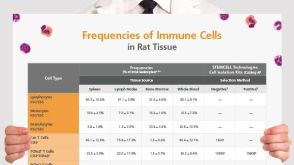 挂图Frequencies of Immune Cells in Rat Tissue Lists the estimated frequencies of more than 15 immune cell types in Sprague Dawley rats
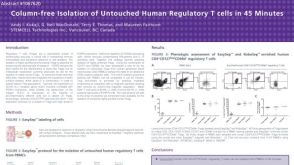 科学海报Immunomagnetic Cell Isolation of Untouched Human Regulatory T Cells

 沪公网安备31010102008431号