Abadier M et al. (DEC 2017)
Cell reports 21 13 3885--3899
Effector and Regulatory T Cells Roll at High Shear Stress by Inducible Tether and Sling Formation.
The adaptive immune response involves T cell differentiation and migration to sites of inflammation. T cell trafficking is initiated by rolling on inflamed endothelium. Tethers and slings,discovered in neutrophils,facilitate cell rolling at high shear stress. Here,we demonstrate that the ability to form tethers and slings during rolling is highly inducible in T helper 1 (Th1),Th17,and regulatory T (Treg) cells but less in Th2 cells. In vivo,endogenous Treg cells rolled stably in cremaster venules at physiological shear stress. Quantitative dynamic footprinting nanoscopy of Th1,Th17,and Treg cells uncovered the formation of multiple tethers per cell. Human Th1 cells also showed tethers and slings. RNA sequencing (RNA-seq) revealed the induction of cell migration and cytoskeletal genes in sling-forming cells. We conclude that differentiated CD4 T cells stabilize rolling by inducible tether and sling formation. These phenotypic changes approximate the adhesion phenotype of neutrophils and support CD4 T cell access to sites of inflammation.
View Publication
产品号#:
19762
19762RF
产品名:
EasySep™小鼠中性粒细胞富集试剂盒
RoboSep™ 小鼠中性粒细胞富集试剂盒含滤芯吸头
Lebson L et al. (DEC 2010)
Journal of immunology (Baltimore,Md. : 1950) 185 12 7161--4
Cutting edge: The transcription factor Kruppel-like factor 4 regulates the differentiation of Th17 cells independently of RORγt.
Th17 cells play a significant role in inflammatory and autoimmune responses. Although a number of molecular pathways that contribute to the lineage differentiation of T cells have been discovered,the mechanisms by which lineage commitment occurs are not fully understood. Transcription factors play a key role in driving T cells toward specific lineages. We have identified a role for the transcription factor Kruppel-like factor (KLF) 4 in the development of IL-17-producing CD4(+) T cells. KLF4 was required for the production of IL-17,and further,chromatin immunoprecipitation analysis demonstrated binding of KLF4 to the IL-17 promoter,indicating a direct effect on the regulation of IL-17. Further,KLF4-deficient T cells upregulated expression of retinoic acid-related orphan receptor γt similar to wild-type during the polarization process toward Th17,suggesting that these two transcription factors are regulated independently.
View Publication
产品号#:
19752
19752RF
产品名:
Katzman SD et al. (OCT 2010)
Proceedings of the National Academy of Sciences of the United States of America 107 42 18085--90
Duration of antigen receptor signaling determines T-cell tolerance or activation.
The early events that determine the decision between lymphocyte tolerance and activation are not well-understood. Using a model of systemic self-antigen recognition by CD4(+) T cells,we show,using single-cell biochemical analyses,that tolerance is characterized by transient signaling events downstream of T-cell receptor engagement in the mammalian target of rapamycin (mTOR) and NF-κB pathways. Parallel studies done by live cell imaging show that the key difference between tolerance and activation is the duration of the T cell-antigen presenting cell (APC) interaction,as revealed by stable T-cell immobilization on antigen encounter. Brief T cell-APC interactions result in tolerance,and prolonged interactions are associated with activation and the development of effector cells. These studies show that the duration of T cell-APC interactions and magnitude of associated TCR-mediated signaling are key determinants of lymphocyte tolerance vs. activation.
View Publication
产品号#:
19752
19752RF
产品名:
Pekalski ML et al. (AUG 2017)
JCI insight 2 16
Neonatal and adult recent thymic emigrants produce IL-8 and express complement receptors CR1 and CR2.
The maintenance of peripheral naive T lymphocytes in humans is dependent on their homeostatic division,not continuing emigration from the thymus,which undergoes involution with age. However,postthymic maintenance of naive T cells is still poorly understood. Previously we reported that recent thymic emigrants (RTEs) are contained in CD31+CD25- naive T cells as defined by their levels of signal joint T cell receptor rearrangement excision circles (sjTRECs). Here,by differential gene expression analysis followed by protein expression and functional studies,we define that the naive T cells having divided the least since thymic emigration express complement receptors (CR1 and CR2) known to bind complement C3b- and C3d-decorated microbial products and,following activation,produce IL-8 (CXCL8),a major chemoattractant for neutrophils in bacterial defense. We also observed an IL-8-producing memory T cell subpopulation coexpressing CR1 and CR2 and with a gene expression signature resembling that of RTEs. The functions of CR1 and CR2 on T cells remain to be determined,but we note that CR2 is the receptor for Epstein-Barr virus,which is a cause of T cell lymphomas and a candidate environmental factor in autoimmune disease.
View Publication


 EasySep™小鼠TIL(CD45)正选试剂盒




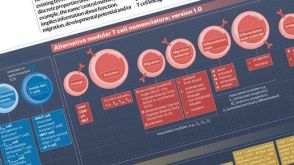 挂图T Cell Nomenclature: From Subsets to Modules A modular framework for classifying T cells by lineage, function, migration, differentiation, and antigen context.
 实验方案Optimizing Delivery Efficiency with Fluorescent Dextran Using the CellPore™ Transfection System


 沪公网安备31010102008431号