Kieback E et al. (MAY 2016)
Immunity 44 5 1114--26
Thymus-Derived Regulatory T Cells Are Positively Selected on Natural Self-Antigen through Cognate Interactions of High Functional Avidity.
Regulatory T (Treg) cells expressing Foxp3 transcripton factor are essential for immune homeostasis. They arise in the thymus as a separate lineage from conventional CD4(+)Foxp3(-) T (Tconv) cells. Here,we show that the thymic development of Treg cells depends on the expression of their endogenous cognate self-antigen. The formation of these cells was impaired in mice lacking this self-antigen,while Tconv cell development was not negatively affected. Thymus-derived Treg cells were selected by self-antigens in a specific manner,while autoreactive Tconv cells were produced through degenerate recognition of distinct antigens. These distinct modes of development were associated with the expression of T cell receptor of higher functional avidity for self-antigen by Treg cells than Tconv cells,a difference subsequently essential for the control of autoimmunity. Our study documents how self-antigens define the repertoire of thymus-derived Treg cells to subsequently endow this cell type with the capacity to undermine autoimmune attack.
View Publication
产品号#:
18782
18782RF
19852
19852RF
产品名:
EasySep™小鼠CD25调节性T细胞正选试剂盒
RoboSep™ 小鼠CD25调节性T细胞正选试剂盒
EasySep™小鼠CD4+ T细胞分选试剂盒
RoboSep™ 小鼠CD4+ T细胞分选试剂盒
Chen X et al. (DEC 2016)
Nature methods 13 12 1013--1020
ATAC-see reveals the accessible genome by transposase-mediated imaging and sequencing.
Spatial organization of the genome plays a central role in gene expression,DNA replication,and repair. But current epigenomic approaches largely map DNA regulatory elements outside of the native context of the nucleus. Here we report assay of transposase-accessible chromatin with visualization (ATAC-see),a transposase-mediated imaging technology that employs direct imaging of the accessible genome in situ,cell sorting,and deep sequencing to reveal the identity of the imaged elements. ATAC-see revealed the cell-type-specific spatial organization of the accessible genome and the coordinated process of neutrophil chromatin extrusion,termed NETosis. Integration of ATAC-see with flow cytometry enables automated quantitation and prospective cell isolation as a function of chromatin accessibility,and it reveals a cell-cycle dependence of chromatin accessibility that is especially dynamic in G1 phase. The integration of imaging and epigenomics provides a general and scalable approach for deciphering the spatiotemporal architecture of gene control.
View Publication
Roybal KT et al. (SEP 2016)
Cell 167 2 419--432.e16
Engineering T Cells with Customized Therapeutic Response Programs Using Synthetic Notch Receptors
Redirecting T cells to attack cancer using engineered chimeric receptors provides powerful new therapeutic capabilities. However,the effectiveness of therapeutic T cells is constrained by the endogenous T cell response: certain facets of natural response programs can be toxic,whereas other responses,such as the ability to overcome tumor immunosuppression,are absent. Thus,the efficacy and safety of therapeutic cells could be improved if we could custom sculpt immune cell responses. Synthetic Notch (synNotch) receptors induce transcriptional activation in response to recognition of user-specified antigens. We show that synNotch receptors can be used to sculpt custom response programs in primary T cells: they can drive a la carte cytokine secretion profiles,biased T cell differentiation,and local delivery of non-native therapeutic payloads,such as antibodies,in response to antigen. SynNotch T cells can thus be used as a general platform to recognize and remodel local microenvironments associated with diverse diseases.
View Publication
Albert BJ et al. (AUG 2017)
Scientific reports 7 1 7456
Combinations of isoform-targeted histone deacetylase inhibitors and bryostatin analogues display remarkable potency to activate latent HIV without global T-cell activation.
Current antiretroviral therapy (ART) for HIV/AIDS slows disease progression by reducing viral loads and increasing CD4 counts. Yet ART is not curative due to the persistence of CD4+ T-cell proviral reservoirs that chronically resupply active virus. Elimination of these reservoirs through the administration of synergistic combinations of latency reversing agents (LRAs),such as histone deacetylase (HDAC) inhibitors and protein kinase C (PKC) modulators,provides a promising strategy to reduce if not eradicate the viral reservoir. Here,we demonstrate that largazole and its analogues are isoform-targeted histone deacetylase inhibitors and potent LRAs. Significantly,these isoform-targeted HDAC inhibitors synergize with PKC modulators,namely bryostatin-1 analogues (bryologs). Implementation of this unprecedented LRA combination induces HIV-1 reactivation to unparalleled levels and avoids global T-cell activation within resting CD4+ T-cells.
View Publication
产品号#:
19052
19052RF
17861
产品名:
EasySep™人CD4+ T细胞富集试剂盒
RoboSep™ 人CD4+ T细胞富集试剂盒含滤芯吸头
EasySep™人Pan-CD25正选和去除试剂盒
Takeuchi H et al. (NOV 2010)
Journal of immunology (Baltimore,Md. : 1950) 185 9 5289--99
Efficient induction of CCR9 on T cells requires coactivation of retinoic acid receptors and retinoid X receptors (RXRs): exaggerated T Cell homing to the intestine by RXR activation with organotins.
The active vitamin A metabolite retinoic acid (RA) imprints gut-homing specificity on lymphocytes upon activation by inducing the expression of α4β7 integrin and CCR9. RA receptor (RAR) activation is essential for their expression,whereas retinoid X receptor (RXR) activation is not essential for α4β7 expression. However,it remains unclear whether RXR activation affects the RA-dependent CCR9 expression on T cells and their gut homing. The major physiological RA,all-trans-RA,binds to RAR but not to RXR at physiological concentrations. Cell-surface CCR9 expression was often induced on a limited population of murine naive CD4(+) T cells by all-trans-RA or the RAR agonist Am80 alone upon CD3/CD28-mediated activation in vitro,but it was markedly enhanced by adding the RXR agonist PA024 or the RXR-binding environmental chemicals tributyltin and triphenyltin. Accordingly,CD4(+) T cells treated with the combination of all-trans-RA and tributyltin migrated into the small intestine upon adoptive transfer much more efficiently than did those treated with all-trans-RA alone. Furthermore,naive TCR transgenic CD4(+) T cells transferred into wild-type recipients migrated into the small intestinal lamina propria following i.p. injection of Ag,and the migration was enhanced by i.p. injection of PA024. We also show that PA024 markedly enhanced the all-trans-RA-induced CCR9 expression on naturally occurring naive-like regulatory T cells upon activation,resulting in the expression of high levels of α4β7,CCR9,and Foxp3. These results suggest that RXR activation enhances the RAR-dependent expression of CCR9 on T cells and their homing capacity to the small intestine.
View Publication
产品号#:
19752
19752RF
产品名:
Balkow S et al. (SEP 2010)
Blood 116 11 1885--94
LFA-1 activity state on dendritic cells regulates contact duration with T cells and promotes T-cell priming.
A key event in the successful induction of adaptive immune responses is the antigen-specific activation of T cells by dendritic cells (DCs). Although LFA-1 (lymphocyte function-associated antigen 1) on T cells is considered to be important for antigen-specific T-cell activation,the role for LFA-1 on DCs remains elusive. Using 2 different approaches to activate LFA-1 on DCs,either by deletion of the αL-integrin cytoplasmic GFFKR sequence or by silencing cytohesin-1-interacting protein,we now provide evidence that DCs are able to make use of active LFA-1 and can thereby control the contact duration with naive T cells. Enhanced duration of DC/T-cell interaction correlates inversely with antigen-specific T-cell proliferation,generation of T-helper 1 cells,and immune responses leading to delayed-type hypersensitivity. We could revert normal interaction time and T-cell proliferation to wild-type levels by inhibition of active LFA-1 on DCs. Our data further suggest that cytohesin-1-interacting protein might be responsible for controlling LFA-1 deactivation on mature DCs. In summary,our findings indicate that LFA-1 on DCs needs to be in an inactive state to ensure optimal T-cell activation and suggest that regulation of LFA-1 activity allows DCs to actively control antigen-driven T-cell proliferation and effective immune responses.
View Publication
产品号#:
21000
20119
20155
19752
19752RF
19753
19753RF
产品名:
RoboSep™- S
RoboSep™ 吸头组件抛光剂
RoboSep™分选管套装(9个塑料管)
Donnarumma T et al. (NOV 2016)
Cell reports 17 6 1571--1583
Opposing Development of Cytotoxic and Follicular Helper CD4 T Cells Controlled by the TCF-1-Bcl6 Nexus.
CD4(+) T cells develop distinct and often contrasting helper,regulatory,or cytotoxic activities. Typically a property of CD8(+) T cells,granzyme-mediated cytotoxic T cell (CTL) potential is also exerted by CD4(+) T cells. However,the conditions that induce CD4(+) CTLs are not entirely understood. Using single-cell transcriptional profiling,we uncover a unique signature of Granzyme B (GzmB)(+) CD4(+) CTLs,which distinguishes them from other CD4(+) T helper (Th) cells,including Th1 cells,and strongly contrasts with the follicular helper T (Tfh) cell signature. The balance between CD4(+) CTL and Tfh differentiation heavily depends on the class of infecting virus and is jointly regulated by the Tfh-related transcription factors Bcl6 and Tcf7 (encoding TCF-1) and by the expression of the inhibitory receptors PD-1 and LAG3. This unique profile of CD4(+) CTLs offers targets for their study,and its antagonism by the Tfh program separates CD4(+) T cells with either helper or killer functions.
View Publication
产品号#:
18952
18952RF
产品名:
EasySep™小鼠CD4正选试剂盒II
RoboSep™ 小鼠CD4正选试剂盒II
Pekalski ML et al. (AUG 2017)
JCI insight 2 16
Neonatal and adult recent thymic emigrants produce IL-8 and express complement receptors CR1 and CR2.
The maintenance of peripheral naive T lymphocytes in humans is dependent on their homeostatic division,not continuing emigration from the thymus,which undergoes involution with age. However,postthymic maintenance of naive T cells is still poorly understood. Previously we reported that recent thymic emigrants (RTEs) are contained in CD31+CD25- naive T cells as defined by their levels of signal joint T cell receptor rearrangement excision circles (sjTRECs). Here,by differential gene expression analysis followed by protein expression and functional studies,we define that the naive T cells having divided the least since thymic emigration express complement receptors (CR1 and CR2) known to bind complement C3b- and C3d-decorated microbial products and,following activation,produce IL-8 (CXCL8),a major chemoattractant for neutrophils in bacterial defense. We also observed an IL-8-producing memory T cell subpopulation coexpressing CR1 and CR2 and with a gene expression signature resembling that of RTEs. The functions of CR1 and CR2 on T cells remain to be determined,but we note that CR2 is the receptor for Epstein-Barr virus,which is a cause of T cell lymphomas and a candidate environmental factor in autoimmune disease.
View Publication


 EasySep™小鼠TIL(CD45)正选试剂盒




 实验方案Optimizing Delivery Efficiency with Fluorescent Dextran Using the CellPore™ Transfection System
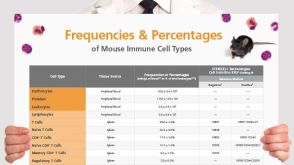 挂图Frequencies and Percentages of Mouse Immune Cell Types List of the frequencies of over 25 immune cell types in C57BL/6 mice
 沪公网安备31010102008431号