E. Giuliani et al. (mar 2019)
Scientific reports 9 1 4373
Hexamethylene bisacetamide impairs NK cell-mediated clearance of acute T lymphoblastic leukemia cells and HIV-1-infected T cells that exit viral latency.
The hexamethylene bisacetamide (HMBA) anticancer drug was dismissed due to limited efficacy in leukemic patients but it may re-enter into the clinics in HIV-1 eradication strategies because of its recently disclosed capacity to reactivate latent virus. Here,we investigated the impact of HMBA on the cytotoxicity of natural killer (NK) cells against acute T lymphoblastic leukemia (T-ALL) cells or HIV-1-infected T cells that exit from latency. We show that in T-ALL cells HMBA upmodulated MICB and ULBP2 ligands for the NKG2D activating receptor. In a primary CD4+ T cell-based latency model,HMBA did not reactivate HIV-1,yet enhanced ULBP2 expression on cells harboring virus reactivated by prostratin (PRO). However,HMBA reduced the expression of NKG2D and its DAP10 adaptor in NK cells,hence impairing NKG2D-mediated cytotoxicity and DAP10-dependent response to IL-15 stimulation. Alongside,HMBA dampened killing of T-ALL targets by IL-15-activated NK cells and impaired NK cell-mediated clearance of PRO-reactivated HIV-1+ cells. Overall,our results demonstrate a dominant detrimental effect of HMBA on the NKG2D pathway that crucially controls NK cell-mediated killing of tumors and virus-infected cells,providing one possible explanation for poor clinical outcome in HMBA-treated cancer patients and raising concerns for future therapeutic application of this drug.
View Publication
产品号#:
19052
19052RF
产品名:
EasySep™人CD4+ T细胞富集试剂盒
RoboSep™ 人CD4+ T细胞富集试剂盒含滤芯吸头
D. M. Previte et al. (apr 2019)
Cell reports 27 1 129--141.e4
Lymphocyte Activation Gene-3 Maintains Mitochondrial and Metabolic Quiescence in Naive CD4+ T Cells.
Lymphocyte activation gene-3 (LAG-3) is an inhibitory receptor expressed by CD4+ T cells and tempers their homeostatic expansion. Because CD4+ T cell proliferation is tightly coupled to bioenergetics,we investigate the role of LAG-3 in modulating naive CD4+ T cell metabolism. LAG-3 deficiency enhances the metabolic profile of naive CD4+ T cells by elevating levels of mitochondrial biogenesis. In vivo,LAG-3 blockade partially restores expansion and the metabolic phenotype of wild-type CD4+ T cells to levels of Lag3-/- CD4+ T cells,solidifying that LAG-3 controls these processes. Lag3-/- CD4+ T cells also demonstrate greater signal transducer and activator of transcription 5 (STAT5) activation,enabling resistance to interleukin-7 (IL-7) deprivation. These results implicate this pathway as a target of LAG-3-mediated inhibition. Additionally,enhancement of STAT5 activation,as a result of LAG-3 deficiency,contributes to greater activation potential in these cells. These results identify an additional mode of regulation elicited by LAG-3 in controlling CD4+ T cell responses.
View Publication
Huang S-H et al. (JAN 2018)
The Journal of clinical investigation
Latent HIV reservoirs exhibit inherent resistance to elimination by CD8+ T cells.
The presence of persistent,latent HIV reservoirs in CD4+ T cells obstructs current efforts to cure infection. The so-called kick-and-kill paradigm proposes to purge these reservoirs by combining latency-reversing agents with immune effectors such as cytotoxic T lymphocytes. Support for this approach is largely based on success in latency models,which do not fully reflect the makeup of latent reservoirs in individuals on long-term antiretroviral therapy (ART). Recent studies have shown that CD8+ T cells have the potential to recognize defective proviruses,which comprise the vast majority of all infected cells,and that the proviral landscape can be shaped over time due to in vivo clonal expansion of infected CD4+ T cells. Here,we have shown that treating CD4+ T cells from ART-treated individuals with combinations of potent latency-reversing agents and autologous CD8+ T cells consistently reduced cell-associated HIV DNA,but failed to deplete replication-competent virus. These CD8+ T cells recognized and potently eliminated CD4+ T cells that were newly infected with autologous reservoir virus,ruling out a role for both immune escape and CD8+ T cell dysfunction. Thus,our results suggest that cells harboring replication-competent HIV possess an inherent resistance to CD8+ T cells that may need to be addressed to cure infection.
View Publication
产品号#:
19052
19052RF
产品名:
EasySep™人CD4+ T细胞富集试剂盒
RoboSep™ 人CD4+ T细胞富集试剂盒含滤芯吸头
Prodeus A et al. (SEP 2017)
JCI insight 2 18
VISTA.COMP - an engineered checkpoint receptor agonist that potently suppresses T cell-mediated immune responses.
V-domain immunoglobulin suppressor of T cell activation (VISTA) is a recently discovered immune checkpoint ligand that functions to suppress T cell activity. The therapeutic potential of activating this immune checkpoint pathway to reduce inflammatory responses remains untapped,largely due to the inability to derive agonists targeting its unknown receptor. A dimeric construct of the IgV domain of VISTA (VISTA-Fc) was shown to suppress the activation of T cells in vitro. However,this effect required its immobilization on a solid surface,suggesting that VISTA-Fc may display limited efficacy as a VISTA-receptor agonist in vivo. Herein,we have designed a stable pentameric VISTA construct (VISTA.COMP) by genetically fusing its IgV domain to the pentamerization domain from the cartilage oligomeric matrix protein (COMP). In contrast to VISTA-Fc,VISTA.COMP does not require immobilization to inhibit the proliferation of CD4+ T cells undergoing polyclonal activation. Furthermore,we show that VISTA.COMP,but not VISTA-Fc,functions as an immunosuppressive agonist in vivo capable of prolonging the survival of skin allografts in a mouse transplant model as well as rescuing mice from acute concanavalin-A-induced hepatitis. Collectively,we believe our data demonstrate that VISTA.COMP is a checkpoint receptor agonist and the first agent to our knowledge targeting the putative VISTA-receptor to suppress T cell-mediated immune responses.
View Publication
产品号#:
19852
19852RF
产品名:
EasySep™小鼠CD4+ T细胞分选试剂盒
RoboSep™ 小鼠CD4+ T细胞分选试剂盒
Weiss L et al. (NOV 2004)
Blood 104 10 3249--56
Human immunodeficiency virus-driven expansion of CD4+CD25+ regulatory T cells, which suppress HIV-specific CD4 T-cell responses in HIV-infected patients.
The present study demonstrates that CD4(+)CD25(+) T cells,expanded in peripheral blood of HIV-infected patients receiving highly active antiretroviral therapy (HAART),exhibit phenotypic,molecular,and functional characteristics of regulatory T cells. The majority of peripheral CD4(+)CD25(+) T cells from HIV-infected patients expressed a memory phenotype. They were found to constitutively express transcription factor forkhead box P3 (Foxp3) messengers. CD4(+)CD25(+) T cells weakly proliferated to immobilized anti-CD3 monoclonal antibody (mAb) and addition of soluble anti-CD28 mAb significantly increased proliferation. In contrast to CD4(+)CD25(-) T cells,CD4(+)CD25(+) T cells from HIV-infected patients did not proliferate in response to recall antigens and to p24 protein. The proliferative capacity of CD4 T cells to tuberculin,cytomegalovirus (CMV),and p24 significantly increased following depletion of CD4(+)CD25(+) T cells. Furthermore,addition of increasing numbers of CD4(+)CD25(+) T cells resulted in a dose-dependent inhibition of CD4(+)CD25(-) T-cell proliferation to tuberculin and p24. CD4(+)CD25(+) T cells responded specifically to p24 antigen stimulation by expressing transforming growth factor beta (TGF-beta) and interleukin 10 (IL-10),thus indicating the presence of p24-specific CD4(+) T cells among the CD4(+)CD25(+) T-cell subset. Suppressive activity was not dependent on the secretion of TGF-beta or IL-10. Taken together,our results suggest that persistence of HIV antigens might trigger the expansion of CD4(+)CD25(+) regulatory T cells,which might induce a tolerance to HIV in vivo.
View Publication


 EasySep™小鼠TIL(CD45)正选试剂盒





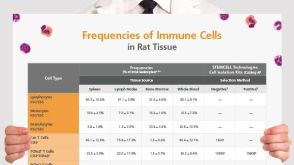 挂图Frequencies of Immune Cells in Rat Tissue Lists the estimated frequencies of more than 15 immune cell types in Sprague Dawley rats



 沪公网安备31010102008431号