A Cas9 Ribonucleoprotein Platform for Functional Genetic Studies of HIV-Host Interactions in Primary Human T Cells.
New genetic tools are needed to understand the functional interactions between HIV and human host factors in primary cells. We recently developed a method to edit the genome of primary CD4(+) T cells by electroporation of CRISPR/Cas9 ribonucleoproteins (RNPs). Here,we adapted this methodology to a high-throughput platform for the efficient,arrayed editing of candidate host factors. CXCR4 or CCR5 knockout cells generated with this method are resistant to HIV infection in a tropism-dependent manner,whereas knockout of LEDGF or TNPO3 results in a tropism-independent reduction in infection. CRISPR/Cas9 RNPs can furthermore edit multiple genes simultaneously,enabling studies of interactions among multiple host and viral factors. Finally,in an arrayed screen of 45 genes associated with HIV integrase,we identified several candidate dependency/restriction factors,demonstrating the power of this approach as a discovery platform. This technology should accelerate target validation for pharmaceutical and cell-based therapies to cure HIV infection.
View Publication
产品号#:
19052
19052RF
产品名:
EasySep™人CD4+ T细胞富集试剂盒
RoboSep™ 人CD4+ T细胞富集试剂盒含滤芯吸头
C. J. Chung et al. ( 2016)
PloS one 11 10 e0165450
Recognition of Highly Diverse Type-1 and -2 Porcine Reproductive and Respiratory Syndrome Viruses (PRRSVs) by T-Lymphocytes Induced in Pigs after Experimental Infection with a Type-2 PRRSV Strain.
BACKGROUND/AIM Live attenuated vaccines confer partial protection in pigs before the appearance of neutralizing antibodies,suggesting the contribution of cell-mediated immunity (CMI). However,PRRSV-specific T-lymphocyte responses and protective mechanisms need to be further defined. To this end,the hypothesis was tested that PRRSV-specific T-lymphocytes induced by exposure to type-2 PRRSV can recognize diverse isolates. METHODS An IFN-gamma ELISpot assay was used to enumerate PRRSV-specific T-lymphocytes from PRRSVSD23983-infected gilts and piglets born after in utero infection against 12 serologically and genetically distinct type-1 and -2 PRRSV isolates. The IFN-gamma ELISpot assay using synthetic peptides spanning all open reading frames of PRRSVSD23983 was utilized to localize epitopes recognized by T-lymphocytes. Virus neutralization tests were carried out using the challenge strain (type-2 PRRSVSD23983) and another strain (type-2 PRRSVVR2332) with high genetic similarity to evaluate cross-reactivity of neutralizing antibodies in gilts after PRRSVSD23983 infection. RESULTS At 72 days post infection,T-lymphocytes from one of three PRRSVSD23983-infected gilts recognized all 12 diverse PRRSV isolates,while T-lymphocytes from the other two gilts recognized all but one isolate. Furthermore,five of nine 14-day-old piglets infected in utero with PRRSVSD23983 had broadly reactive T-lymphocytes,including one piglet that recognized all 12 isolates. Overlapping peptides encompassing all open reading frames of PRRSVSD23983 were used to identify ≥28 peptides with T-lymphocyte epitopes from 10 viral proteins. This included one peptide from the M protein that was recognized by T-lymphocytes from all three gilts representing two completely mismatched MHC haplotypes. In contrast to the broadly reactive T-lymphocytes,neutralizing antibody responses were specific to the infecting PRRSVSD23983 isolate. CONCLUSION These results demonstrated that T-lymphocytes recognizing antigenically and genetically diverse isolates were induced by infection with a type 2 PRRSV strain (SD23983). If these reponses have cytotoxic or other protective functions,they may help overcome the suboptimal heterologous protection conferred by conventional vaccines.
View Publication
产品号#:
85450
85460
86450
86460
18060
18061
07861
07811
85415
85420
86415
86420
产品名:
SepMate™-50 (IVD)
SepMate™-50 (IVD)
SepMate™-50 (RUO)
SepMate™-50 (RUO)
Lymphoprep™
Lymphoprep™
Lymphoprep™
Lymphoprep™
SepMate™-15 (IVD)
SepMate™-15 (IVD)
SepMate™-15 (RUO)
SepMate™-15 (RUO)
Papait A et al. (NOV 2016)
Journal of tissue engineering and regenerative medicine
Allogeneic platelet-rich plasma affects monocyte differentiation to dendritic cells causing an anti-inflammatory microenvironment putatively fostering the wound healing.
Autologous platelet rich plasma (PRP) is clinically used to induce repair of different tissues through the release of bioactive molecules. In some patients,the production of an efficient autologous PRP is unfeasible due to their compromised health. We developed an allogeneic PRP mismatched for AB0 and Rh antigens. To broadcast its clinical applications avoiding side effects the outcome of allogeneic PRP on immune response should be defined. Thus,we investigated whether PRP affected the differentiation of peripheral blood monocytes to dendritic cells upon stimulation with granulocyte monocyte colony stimulating factor and interleukin-4. Indeed,these cells are the main players of immune response and tissue repair. PRP inhibited the differentiation of monocytes to CD1a(+) dendritic cells and favored the expansion of phagocytic CD163(+) CD206(+) fibrocyte-like cells. These cells produced inteleukin-10 and prostaglandin-E2,but not interferon-γ,upon stimulation with lipopolysaccharides. Moreover,they promoted the expansion of regulatory CD4(+) CD25(+) FoxP3(+) T cells upon allostimulation or antigen specific priming. Finally,the conditioned medium harvested from monocytes differentiated with PRP triggered a strong chemotactic effect on mesenchymal cells in both scratch and transwell migration assays. These results strongly suggest that allogeneic PRP can foster the differentiation of monocytes to a regulatory anti-inflammatory population possibly favoring wound healing.
View Publication
产品号#:
15022
15062
19155
19155RF
15028
15068
产品名:
RosetteSep™人CD4+ T细胞富集抗体混合物
RosetteSep™人CD4+ T细胞富集抗体混合物
RosetteSep™人单核细胞富集抗体混合物
RosetteSep™人单核细胞富集抗体混合物
Loo CP et al. (NOV 2016)
Journal of immunology (Baltimore,Md. : 1950)
Blocking Virus Replication during Acute Murine Cytomegalovirus Infection Paradoxically Prolongs Antigen Presentation and Increases the CD8+ T Cell Response by Preventing Type I IFN-Dependent Depletion of Dendritic Cells.
Increasing amounts of pathogen replication usually lead to a proportionate increase in size and effector differentiation of the CD8(+) T cell response,which is attributed to increased Ag and inflammation. Using a murine CMV that is highly sensitive to the antiviral drug famciclovir to modulate virus replication,we found that increased virus replication drove increased effector CD8(+) T cell differentiation,as expected. Paradoxically,however,increased virus replication dramatically decreased the size of the CD8(+) T cell response to two immunodominant epitopes. The decreased response was due to type I IFN-dependent depletion of conventional dendritic cells and could be reproduced by specific depletion of dendritic cells from day 2 postinfection or by sterile induction of type I IFN. Increased virus replication and type I IFN specifically inhibited the response to two immunodominant epitopes that are known to be dependent on Ag cross-presented by DCs,but they did not inhibit the response to inflationary" epitopes whose responses can be sustained by infected nonhematopoietic cells. Our results show that type I IFN can suppress CD8(+) T cell responses to cross-presented Ag by depleting cross-presenting conventional dendritic cells."
View Publication
产品号#:
19853
19853RF
产品名:
EasySep™小鼠CD8+ T细胞分选试剂盒
RoboSep™ 小鼠CD8+ T细胞分选试剂盒
Douaisi M et al. (FEB 2017)
Journal of immunology (Baltimore,Md. : 1950)
CD31, a Valuable Marker to Identify Early and Late Stages of T Cell Differentiation in the Human Thymus.
Although CD31 expression on human thymocytes has been reported,a detailed analysis of CD31 expression at various stages of T cell development in the human thymus is missing. In this study,we provide a global picture of the evolution of CD31 expression from the CD34(+) hematopoietic precursor to the CD45RA(+) mature CD4(+) and CD8(+) single-positive (SP) T cells. Using nine-color flow cytometry,we show that CD31 is highly expressed on CD34(+) progenitors and stays high until the early double-positive stage (CD3(-)CD4(+)CD8α(+)β(-)). After β-selection,CD31 expression levels become low to undetectable. CD31 expression then increases and peaks on CD3(high)CD4(+)CD8(+) double-positive thymocytes. However,following positive selection,CD31 expression differs dramatically between CD4(+) and CD8(+) lineages: homogeneously high on CD8 SP but lower or negative on CD4 SP cells,including a subset of CD45RA(+)CD31(-) mature CD4(+) thymocytes. CD31 expression on TCRγδ thymocytes is very similar to that of CD4 SP cells. Remarkably,there is a substantial subset of semimature (CD45RA(-)) CD4 SP thymocytes that lack CD31 expression. Moreover,FOXP3(+) and ICOS(+) cells are overrepresented in this CD31(-) subpopulation. Despite this CD31(-)CD45RA(-) subpopulation,most egress-capable mature CD45RA(+) CD4 SP thymocytes express CD31. The variations in CD31 expression appear to coincide with three major selection processes occurring during thymopoiesis: β-selection,positive selection,and negative selection. Considering the ability of CD31 to modulate the TCR's activation threshold via the recruitment of tyrosine phosphatases,our results suggest a significant role for CD31 during T cell development.
View Publication
产品号#:
21000
20119
20155
18098
18098RF
产品名:
RoboSep™- S
RoboSep™ 吸头组件抛光剂
RoboSep™分选管套装(9个塑料管)
Ayuso T et al. ( 2017)
PloS one 12 3 e0174726
Vitamin D receptor gene is epigenetically altered and transcriptionally up-regulated in multiple sclerosis.
OBJECTIVE Vitamin D deficiency has been linked to increased risk of multiple sclerosis (MS) and poor outcome. However,the specific role that vitamin D plays in MS still remains unknown. In order to identify potential mechanisms underlying vitamin D effects in MS,we profiled epigenetic changes in vitamin D receptor (VDR) gene to identify genomic regulatory elements relevant to MS pathogenesis. METHODS Human T cells derived from whole blood by negative selection were isolated in a set of 23 relapsing-remitting MS (RRMS) patients and 12 controls matched by age and gender. DNA methylation levels were assessed by bisulfite cloning sequencing in two regulatory elements of VDR. mRNA levels were measured by RT-qPCR to assess changes in VDR expression between patients and controls. RESULTS An alternative VDR promoter placed at exon 1c showed increased DNA methylation levels in RRMS patients (median 30.08%,interquartile range 19.2%) compared to controls (18.75%,9.5%),p-valuetextless0.05. Moreover,a 6.5-fold increase in VDR mRNA levels was found in RRMS patients compared to controls (p-valuetextless0.001). CONCLUSIONS An alternative promoter of the VDR gene shows altered DNA methylation levels in patients with multiple sclerosis,and it is associated with VDR mRNA upregulation. This locus may represent a candidate regulatory element in the genome relevant to MS pathogenesis.
View Publication
产品号#:
15021
15061
产品名:
RosetteSep™人T细胞富集抗体混合物
RosetteSep™人T细胞富集抗体混合物
Nakano T et al. (AUG 1994)
Science (New York,N.Y.) 265 5175 1098--101
Generation of lymphohematopoietic cells from embryonic stem cells in culture.
An efficient system was developed that induced the differentiation of embryonic stem (ES) cells into blood cells of erythroid,myeloid,and B cell lineages by coculture with the stromal cell line OP9. This cell line does not express functional macrophage colony-stimulating factor (M-CSF). The presence of M-CSF had inhibitory effects on the differentiation of ES cells to blood cells other than macrophages. Embryoid body formation or addition of exogenous growth factors was not required,and differentiation was highly reproducible even after the selection of ES cells with the antibiotic G418. Combined with the ability to genetically manipulate ES cells,this system will facilitate the study of molecular mechanisms involved in development and differentiation of hematopoietic cells.
View Publication
产品号#:
06902
06952
00321
00322
00323
00324
00325
产品名:
Smith GH (JAN 1996)
Breast cancer research and treatment 39 1 21--31
Experimental mammary epithelial morphogenesis in an in vivo model: evidence for distinct cellular progenitors of the ductal and lobular phenotype.
An in vivo transplantation system has been used to evaluate the developmental capacities of specific mouse mammary epithelial cell populations. Specifically,mouse mammary epithelial cells with distinctly limited developmental potentials have been identified using this procedure. Two distinct epithelial cell progenitors have been identified by experiments designed to determine whether basal lobular and ductal phenotypes could develop independently under conditions imposed by a limiting dilution. The prediction that these separate epithelial progenitors must exist was based upon the results from transplantation experiments carried out in epithelium-divested mammary fat pads of syngeneic mice with mammary epithelium from two different transgenic mouse models. The results presented here demonstrate the following points: 1) lobular,i.e. secretory,progenitor cells are present as distinct entities among the mammary epithelial cells found in immature virgin female mice; 2) similarly,ductal epithelial progenitors are present within the same population; 3) lobular progenitors are present in greater numbers,although both cell populations are extremely small; 4) as expected,some inocula produce outgrowths with simultaneous development of both lobular and ductal phenotypes--it is not known whether this indicates cooperative interaction between the two epithelial progenitors or signals the presence of a third progenitor type capable of producing both ductular and lobular committed daughters; 5) these findings have important consequences in the design of experiments aimed at testing the effects of known and putative mammary oncogenes and tumor suppressor genes,using techniques which include cellular transformation in vitro followed by in vivo cultivation and evaluation.
View Publication
J. H. Choi et al. ( 2019)
Science (New York,N.Y.) 364 6440
LMBR1L regulates lymphopoiesis through Wnt/beta-catenin signaling.
Precise control of Wnt signaling is necessary for immune system development. In this study,we detected severely impaired development of all lymphoid lineages in mice,resulting from an N-ethyl-N-nitrosourea-induced mutation in the limb region 1-like gene (Lmbr1l),which encodes a membrane-spanning protein with no previously described function in immunity. The interaction of LMBR1L with glycoprotein 78 (GP78) and ubiquitin-associated domain-containing protein 2 (UBAC2) attenuated Wnt signaling in lymphocytes by preventing the maturation of FZD6 and LRP6 through ubiquitination within the endoplasmic reticulum and by stabilizing destruction complex" proteins. LMBR1L-deficient T cells exhibited hallmarks of Wnt/beta-catenin activation and underwent apoptotic cell death in response to proliferative stimuli. LMBR1L has an essential function during lymphopoiesis and lymphoid activation acting as a negative regulator of the Wnt/beta-catenin pathway."
View Publication


 EasySep™小鼠TIL(CD45)正选试剂盒





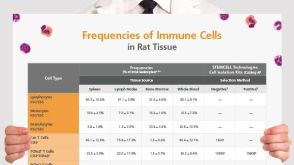 挂图Frequencies of Immune Cells in Rat Tissue Lists the estimated frequencies of more than 15 immune cell types in Sprague Dawley rats
 科学海报Rapid, Automated Lymphocyte Isolation Directly from Whole Blood with EasySep™ Direct
 沪公网安备31010102008431号