Lehnertz B et al. (MAY 2010)
The Journal of experimental medicine 207 5 915--22
Activating and inhibitory functions for the histone lysine methyltransferase G9a in T helper cell differentiation and function.
Accumulating evidence suggests that the regulation of gene expression by histone lysine methylation is crucial for several biological processes. The histone lysine methyltransferase G9a is responsible for the majority of dimethylation of histone H3 at lysine 9 (H3K9me2) and is required for the efficient repression of developmentally regulated genes during embryonic stem cell differentiation. However,whether G9a plays a similar role in adult cells is still unclear. We identify a critical role for G9a in CD4(+) T helper (Th) cell differentiation and function. G9a-deficient Th cells are specifically impaired in their induction of Th2 lineage-specific cytokines IL-4,IL-5,and IL-13 and fail to protect against infection with the intestinal helminth Trichuris muris. Furthermore,G9a-deficient Th cells are characterised by the increased expression of IL-17A,which is associated with a loss of H3K9me2 at the Il17a locus. Collectively,our results establish unpredicted and complex roles for G9a in regulating gene expression during lineage commitment in adult CD4(+) T cells.
View Publication
产品号#:
21000
20119
20155
19752
19752RF
产品名:
RoboSep™- S
RoboSep™ 吸头组件抛光剂
RoboSep™分选管套装(9个塑料管)
Hale JS et al. (JUN 2010)
Journal of immunology (Baltimore,Md. : 1950) 184 11 5964--8
Cutting Edge: Rag deletion in peripheral T cells blocks TCR revision.
Mature CD4(+)Vbeta5(+) T cells that recognize a peripherally expressed endogenous superantigen are tolerized either by deletion or TCR revision. In Vbeta5 transgenic mice,this latter tolerance pathway results in the appearance of CD4(+)Vbeta5(-)TCRbeta(+) T cells,coinciding with Rag1,Rag2,and TdT expression and the accumulation of V(beta)-DJ(beta) recombination intermediates in peripheral CD4(+) T cells. Because postthymic RAG-dependent TCR rearrangement has remained controversial,we sought to definitively determine whether TCR revision is an extrathymic process that occurs in mature peripheral T cells. We show in this study that Rag deletion in post-positive selection T cells in Vbeta5 transgenic mice blocks TCR revision in vivo and that mature peripheral T cells sorted to remove cells bearing endogenous TCRbeta-chains can express newly generated TCRbeta molecules in adoptive hosts. These findings unambiguously demonstrate postthymic,RAG-dependent TCR rearrangement and define TCR revision as a tolerance pathway that targets mature peripheral CD4(+) T cells.
View Publication
产品号#:
19751
19751RF
产品名:
Weiss L et al. (JUN 2010)
Proceedings of the National Academy of Sciences of the United States of America 107 23 10632--7
In vivo expansion of naive and activated CD4+CD25+FOXP3+ regulatory T cell populations in interleukin-2-treated HIV patients.
HIV-1 infection is characterized by a progressive decline in CD4(+) T cells leading to a state of profound immunodeficiency. IL-2 therapy has been shown to improve CD4(+) counts beyond that observed with antiretroviral therapy. Recent phase III trials revealed that despite a sustained increase in CD4(+) counts,IL-2-treated patients did not experience a better clinical outcome [Abrams D,et al. (2009) N Engl J Med 361(16):1548-1559]. To explain these disappointing results,we have studied phenotypic,functional,and molecular characteristics of CD4(+) T cell populations in IL-2-treated patients. We found that the principal effect of long-term IL-2 therapy was the expansion of two distinct CD4(+)CD25(+) T cell populations (CD4(+)CD25(lo)CD127(lo)FOXP3(+) and CD4(+)CD25(hi)CD127(lo)FOXP3(hi)) that shared phenotypic markers of Treg but could be distinguished by the levels of CD25 and FOXP3 expression. IL-2-expanded CD4(+)CD25(+) T cells suppressed proliferation of effector cells in vitro and had gene expression profiles similar to those of natural regulatory CD4(+)CD25(hi)FOXP3(+) T cells (Treg) from healthy donors,an immunosuppressive T cell subset critically important for the maintenance of self-tolerance. We propose that the sustained increase of the peripheral Treg pool in IL-2-treated HIV patients may account for the unexpected clinical observation that patients with the greatest expansion of CD4(+) T cells had a higher relative risk of clinical progression to AIDS.
View Publication
产品号#:
15022
15062
产品名:
RosetteSep™人CD4+ T细胞富集抗体混合物
RosetteSep™人CD4+ T细胞富集抗体混合物
Dorosko SM and Connor RI (OCT 2010)
Journal of virology 84 20 10533--42
Primary human mammary epithelial cells endocytose HIV-1 and facilitate viral infection of CD4+ T lymphocytes.
The contribution of mammary epithelial cells (MEC) to human immunodeficiency virus type 1 (HIV-1) in breast milk remains largely unknown. While breast milk contains CD4(+) cells throughout the breast-feeding period,it is not known whether MEC directly support HIV-1 infection or facilitate infection of CD4(+) cells in the breast compartment. This study evaluated primary human MEC for direct infection with HIV-1 and for indirect transfer of infection to CD4(+) target cells. Primary human MEC were isolated and assessed for expression of HIV-1 receptors. MEC were exposed to CCR5-,CXCR4- and dual-tropic strains of HIV-1 and evaluated for viral reverse transcription and integration and productive viral infection. MEC were also tested for the ability to transfer HIV to CD4(+) target cells and to activate resting CD4(+) T cells. Our results demonstrate that MEC express HIV-1 receptor proteins CD4,CCR5,CXCR4,and galactosyl ceramide (GalCer). While no evidence for direct infection of MEC was found,HIV-1 virions were observed in MEC endosomal compartments. Coculture of HIV-exposed MEC resulted in productive infection of activated CD4(+) T cells. In addition,MEC secretions increased HIV-1 replication and proliferation of infected target cells. Overall,our results indicate that MEC are capable of endosomal uptake of HIV-1 and can facilitate virus infection and replication in CD4(+) target cells. These findings suggest that MEC may serve as a viral reservoir for HIV-1 and may enhance infection of CD4(+) T lymphocytes in vivo.
View Publication
产品号#:
19052
19052RF
产品名:
EasySep™人CD4+ T细胞富集试剂盒
RoboSep™ 人CD4+ T细胞富集试剂盒含滤芯吸头
Antunes I et al. (DEC 2010)
Journal of virology 84 24 12564--75
Suppression of innate immune pathology by regulatory T cells during Influenza A virus infection of immunodeficient mice.
The viral infection of higher vertebrates elicits potent innate and adaptive host immunity. However,an excessive or inappropriate immune response also may lead to host pathology that often is more severe than the direct effects of viral replication. Therefore,several mechanisms exist that regulate the magnitude and class of the immune response. Here,we have examined the potential involvement of regulatory T (Treg) cells in limiting pathology induced by influenza A virus (IAV) infection. Using lymphocyte-deficient mice as hosts,we showed that Treg cell reconstitution resulted in a significant delay in weight loss and prolonged survival following infection. The adoptively transferred Treg cells did not affect the high rate of IAV replication in the lungs of lymphocyte-deficient hosts,and therefore their disease-ameliorating effect was mediated through the suppression of innate immune pathology. Mechanistically,Treg cells reduced the accumulation and altered the distribution of monocytes/macrophages in the lungs of IAV-infected hosts. This reduction in lung monocytosis was associated with a specific delay in monocyte chemotactic protein-2 (MCP-2) induction in the infected lungs. Nevertheless,Treg cells failed to prevent the eventual development of severe disease in lymphocyte-deficient hosts,which likely was caused by the ongoing IAV replication. Indeed,using T-cell-deficient mice,which mounted a T-cell-independent B cell response to IAV,we further showed that the combination of virus-neutralizing antibodies and transferred Treg cells led to the complete prevention of clinical disease following IAV infection. Taken together,these results suggested that innate immune pathology and virus-induced pathology are the two main contributors to pathogenesis during IAV infection.
View Publication
BiHC, a T-Cell-Engaging Bispecific Recombinant Antibody, Has Potent Cytotoxic Activity Against Her2 Tumor Cells.
Among different cancer immunotherapy approaches,bispecific antibodies (BsAbs) are of great interest due to their ability to recruit immune cells to kill tumor cells directly. Various BsAbs against Her2 tumor cells have been proposed with potent cytotoxic activities. However,most of these formats require extensive processing to obtain heterodimeric bispecific antibodies. In this study,we describe a bispecific antibody,BiHC (bispecific Her2-CD3 antibody),constructed with a single-domain anti-Her2 and a single-chain Fv (variable fragment) of anti-CD3 in an IgG-like format. In contrast to most IgG-like BsAbs,the two arms in BiHC have different molecular weights,making it easier to separate hetero- or homodimers. BiHC can be expressed in Escherichia coli and purified via Protein A affinity chromatography. The purified BiHC can recruit T cells and induce specific cytotoxicity of Her2-expressing tumor cells in vitro. The BiHC can also efficiently inhibit the tumor growth in vivo. Thus,BiHC is a promising candidate for the treatment of Her2-positive cancers.
View Publication


 EasySep™小鼠TIL(CD45)正选试剂盒





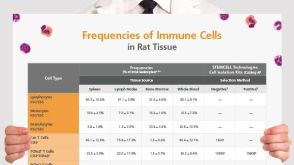 挂图Frequencies of Immune Cells in Rat Tissue Lists the estimated frequencies of more than 15 immune cell types in Sprague Dawley rats
 科学海报Rapid, Automated Lymphocyte Isolation Directly from Whole Blood with EasySep™ Direct


 沪公网安备31010102008431号