Ayasoufi K et al. (APR 2016)
Journal of Immunology 196 7 3180--90
CD4 T Cell Help via B Cells Is Required for Lymphopenia-Induced CD8 T Cell Proliferation.
Ab-mediated lymphoablation is commonly used in solid organ and hematopoietic cell transplantation. However,these strategies fail to control pathogenic memory T cells efficiently and to improve long-term transplant outcomes significantly. Understanding the mechanisms of T cell reconstitution is critical for enhancing the efficacy of Ab-mediated depletion in sensitized recipients. Using a murine analog of anti-thymocyte globulin (mATG) in a mouse model of cardiac transplantation,we previously showed that peritransplant lymphocyte depletion induces rapid memory T cell proliferation and only modestly prolongs allograft survival. We now report that T cell repertoire following depletion is dominated by memory CD4 T cells. Additional depletion of these residual CD4 T cells severely impairs the recovery of memory CD8 T cells after mATG treatment. The CD4 T cell help during CD8 T cell recovery depends on the presence of B cells expressing CD40 and intact CD40/CD154 interactions. The requirement for CD4 T cell help is not limited to the use of mATG in heart allograft recipients,and it is observed in nontransplanted mice and after CD8 T cell depletion with mAb instead of mATG. Most importantly,limiting helper signals increases the efficacy of mATG in controlling memory T cell expansion and significantly extends heart allograft survival in sensitized recipients. Our findings uncover the novel role for helper memory CD4 T cells during homeostatic CD8 T cell proliferation and open new avenues for optimizing lymphoablative therapies in allosensitized patients.
View Publication
产品号#:
19851
19851RF
产品名:
EasySep™小鼠T细胞分选试剂盒
RoboSep™ 小鼠T细胞分选试剂盒
Pu Y et al. (APR 2016)
Science Translational Medicine 8 333 333ra47
Androgen receptor antagonists compromise T cell response against prostate cancer leading to early tumor relapse.
Surgical and medical androgen deprivation therapy (ADT) is a cornerstone for prostate cancer treatment,but relapse usually occurs. We herein show that orchiectomy synergizes with immunotherapy,whereas the more widely used treatment of medical ADT involving androgen receptor (AR) antagonists suppresses immunotherapy. Furthermore,we observed that the use of medical ADT could unexpectedly impair the adaptive immune responses through interference with initial T cell priming rather than in the reactivation or expansion phases. Mechanistically,we have revealed that inadvertent immunosuppression might be potentially mediated by a receptor shared with γ-aminobutyric acid. Our data demonstrate that the timing and dosing of antiandrogens are critical to maximizing the antitumor effects of combination therapy. This study highlights an underappreciated mechanism of AR antagonist-mediated immunosuppression and provides a new strategy to enhance immune response and prevent the relapse of advanced prostate cancer.
View Publication
产品号#:
19853
19853RF
产品名:
EasySep™小鼠CD8+ T细胞分选试剂盒
RoboSep™ 小鼠CD8+ T细胞分选试剂盒
Apps R et al. (MAY 2016)
Cell Host & Microbe 19 5 686--95
HIV-1 Vpu Mediates HLA-C Downregulation.
Many pathogens evade cytotoxic T lymphocytes (CTLs) by downregulating HLA molecules on infected cells,but the loss of HLA can trigger NK cell-mediated lysis. HIV-1 is thought to subvert CTLs while preserving NK cell inhibition by Nef-mediated downregulation of HLA-A and -B but not HLA-C molecules. We find that HLA-C is downregulated by most primary HIV-1 clones,including transmitted founder viruses,in contrast to the laboratory-adapted NL4-3 virus. HLA-C reduction is mediated by viral Vpu and reduces the ability of HLA-C restricted CTLs to suppress viral replication in CD4+ cells in vitro. HLA-A/B are unaffected by Vpu,and primary HIV-1 clones vary in their ability to downregulate HLA-C,possibly in response to whether CTLs or NK cells dominate immune pressure through HLA-C. HIV-2 also suppresses HLA-C expression through distinct mechanisms,underscoring the immune pressure HLA-C exerts on HIV. This viral immune evasion casts new light on the roles of CTLs and NK cells in immune responses against HIV.
View Publication
产品号#:
17952
17952RF
100-0696
产品名:
EasySep™人CD4+ T细胞分选试剂盒
RoboSep™ 人CD4+ T细胞分选试剂盒
EasySep™人CD4+ T细胞分离试剂盒
Jung Y et al. (SEP 2016)
Proceedings of the National Academy of Sciences of the United States of America
Three-dimensional localization of T-cell receptors in relation to microvilli using a combination of superresolution microscopies.
Leukocyte microvilli are flexible projections enriched with adhesion molecules. The role of these cellular projections in the ability of T cells to probe antigen-presenting cells has been elusive. In this study,we probe the spatial relation of microvilli and T-cell receptors (TCRs),the major molecules responsible for antigen recognition on the T-cell membrane. To this end,an effective and robust methodology for mapping membrane protein distribution in relation to the 3D surface structure of cells is introduced,based on two complementary superresolution microscopies. Strikingly,TCRs are found to be highly localized on microvilli,in both peripheral blood human T cells and differentiated effector T cells,and are barely found on the cell body. This is a decisive demonstration that different types of T cells universally localize their TCRs to microvilli,immediately pointing to these surface projections as effective sensors for antigenic moieties. This finding also suggests how previously reported membrane clusters might form,with microvilli serving as anchors for specific T-cell surface molecules.
View Publication
产品号#:
15022
15062
产品名:
RosetteSep™人CD4+ T细胞富集抗体混合物
RosetteSep™人CD4+ T细胞富集抗体混合物
Lund PJ et al. (SEP 2016)
Journal of immunology (Baltimore,Md. : 1950)
Global Analysis of O-GlcNAc Glycoproteins in Activated Human T Cells.
T cell activation in response to Ag is largely regulated by protein posttranslational modifications. Although phosphorylation has been extensively characterized in T cells,much less is known about the glycosylation of serine/threonine residues by O-linked N-acetylglucosamine (O-GlcNAc). Given that O-GlcNAc appears to regulate cell signaling pathways and protein activity similarly to phosphorylation,we performed a comprehensive analysis of O-GlcNAc during T cell activation to address the functional importance of this modification and to identify the modified proteins. Activation of T cells through the TCR resulted in a global elevation of O-GlcNAc levels and in the absence of O-GlcNAc,IL-2 production and proliferation were compromised. T cell activation also led to changes in the relative expression of O-GlcNAc transferase (OGT) isoforms and accumulation of OGT at the immunological synapse of murine T cells. Using a glycoproteomics approach,we identified textgreater200 O-GlcNAc proteins in human T cells. Many of the identified proteins had a functional relationship to RNA metabolism,and consistent with a connection between O-GlcNAc and RNA,inhibition of OGT impaired nascent RNA synthesis upon T cell activation. Overall,our studies provide a global analysis of O-GlcNAc dynamics during T cell activation and the first characterization,to our knowledge,of the O-GlcNAc glycoproteome in human T cells.
View Publication
产品号#:
15021
15061
产品名:
RosetteSep™人T细胞富集抗体混合物
RosetteSep™人T细胞富集抗体混合物
Liu D et al. (NOV 2016)
Scientific reports 6 36002
IL-25 attenuates rheumatoid arthritis through suppression of Th17 immune responses in an IL-13-dependent manner.
IL-25,a new member of the IL-17 cytokine family,is involved in type 2 immunity initiation and has been associated with the pathogenesis of rheumatoid arthritis (RA). However,its exact role remains unclear. Here,we aimed to analyse IL-25 expression in the serum and synovial fluid of RA patients and evaluated the correlations between serum IL-25 levels,clinical and laboratory values and inflammation cytokines. Additionally,we investigated whether IL-25 can suppress Th1/Th17 responses involved in RA pathogenesis. We further determined whether IL-25 can alleviate collagen-induced arthritis (CIA) development in mice and the underlying mechanisms using in vitro and in vivo experiments. Our results showed that IL-25 was upregulated in the serum and synovial fluid of RA patients. Increased serum IL-25 levels were associated with disease severity and inflammatory response in RA patients. Furthermore,IL-25 inhibited CD4(+) T-cell activation and differentiation into Th17 cells,without affecting Th1 cells in human RA and CIA models. Administration of IL-25 could attenuate CIA development by Th17 suppression in an IL-13-dependent manner. Our findings indicate that IL-25 plays a potent immunosuppressive role in the pathogenesis of RA and CIA by downregulating Th17 cell response,and thus,may be a potential therapeutic agent for RA.
View Publication
产品号#:
17952
17952RF
19852
19852RF
100-0696
产品名:
EasySep™人CD4+ T细胞分选试剂盒
RoboSep™ 人CD4+ T细胞分选试剂盒
EasySep™小鼠CD4+ T细胞分选试剂盒
RoboSep™ 小鼠CD4+ T细胞分选试剂盒
EasySep™人CD4+ T细胞分离试剂盒
Siedlik JA et al. (MAR 2017)
Journal of immunological methods
T cell activation and proliferation following acute exercise in human subjects is altered by storage conditions and mitogen selection.
Recent work investigating exercise induced changes in immunocompetence suggests that some of the ambiguity in the literature is resultant from different cell isolation protocols and mitogen selection. To understand this effect,we compared post-exercise measures of T cell activation and proliferation using two different stimulation methods (costimulation through CD28 or stimulation with phytohaemagglutinin [PHA]). Further,we investigated whether exercise induced changes are maintained when T cell isolation from whole blood is delayed overnight in either a room temperature or chilled (4°C) environment. As expected,an increased proliferation response was observed post-exercise in T cells isolated from whole blood of previously trained individuals immediately after blood collection. Also,cells stimulated with PHA after resting overnight in whole blood were not adversely impacted by the storage conditions. In contrast,allowing cells to rest overnight in whole blood prior to stimulation through CD28,lessened the proliferation observed by cells following exercise rendering both the room temperature and chilled samples closer to the results seen in the control condition. Changes in early markers of activation (CD25),followed a similar pattern,with activation in PHA stimulated cells remaining fairly robust after overnight storage; whereas cell activation following stimulation through CD3+CD28 was disproportionately decreased by the influence of overnight storage. These findings indicate that decisions regarding cell stimulation methods need to be paired with the timeline for T cell isolation from whole blood. These considerations will be especially important for field based studies of immunocompetence where there is a delay in getting whole blood samples to a lab for processing as well as clinical applications where a failure to isolate T cells in a timely manner may result in loss of the response of interest.
View Publication


 EasySep™小鼠TIL(CD45)正选试剂盒






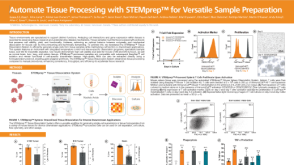 科学海报Automate Tissue Processing with STEMprep™ for Versatile Sample Preparation
 沪公网安备31010102008431号