Allan LL et al. (MAY 2011)
Journal of immunology (Baltimore,Md. : 1950) 186 9 5261--72
CD1d and CD1c expression in human B cells is regulated by activation and retinoic acid receptor signaling.
B cell activation and Ab production in response to protein Ags requires presentation of peptides for recruitment of T cell help. We and others have recently demonstrated that B cells can also acquire innate help by presenting lipid Ags via CD1d to NKT cells. Given the newfound contribution of NKT cells to humoral immunity,we sought to identify the pathways that regulate CD1 molecule expression in human B cells. We show that ex vivo,activated and memory B cells expressed lower levels of CD1d compared with resting,naive,and marginal zone-like B cells. In vitro,CD1d was downregulated by all forms of B cell activation,leaving a narrow temporal window in which B cells could activate NKT cells. CD1c expression and function also decreased following activation by CD40L alone,whereas activation via the BCR significantly upregulated CD1c,particularly on marginal zone-like B cells. We found that the CD40L-induced downregulation of CD1d and CD1c correlated with diminished expression of retinoic acid receptor α (RARα) response genes,an effect that was reversed by RARα agonists. However,BCR-induced upregulation of CD1c was independent of the RAR pathway. Our findings that both CD1d and CD1c are upregulated by RARα signaling in human B cells is distinct from effects reported in dendritic cells,in which CD1c is inversely downregulated. One functional consequence of CD1d upregulation by retinoic acid was NKT cell cytotoxicity toward B cells. These results are central to our understanding of how CD1-restricted T cells may control humoral immunity.
View Publication
产品号#:
01700
01705
18054
18054RF
01702
产品名:
ALDEFLUOR™ 试剂盒
ALDEFLUOR™ DEAB试剂, 1.5 mM, 1 mL
ALDEFLUOR™检测缓冲液
G. B. Cross et al. ( 2019)
PloS one 14 5 e0216616
Impact of selective immune-cell depletion on growth of Mycobacterium tuberculosis (Mtb) in a whole-blood bactericidal activity (WBA) assay.
We investigated the contribution of host immune cells to bacterial killing in a whole-blood bactericidal activity (WBA) assay,an ex vivo model used to test efficacy of drugs against mycobacterium tuberculosis (Mtb). We performed WBA assays with immuno-magnetic depletion of specific cell types,in the presence or absence of rifampicin. Innate immune cells decreased Mtb growth in absence of drug,but appeared to diminish the cidal activity of rifampicin,possibly attributable to intracellular bacterial sequestration. Adaptive immune cells had no effect with or without drug. The WBA assay may have potential for testing adjunctive host-directed therapies acting on phagocytic cells.
View Publication
Decitabine enhances Fc engineered anti-CD33 mAb mediated natural killer antibody dependent cellular cytotoxicity against AML blasts.
Acute myeloid leukemia (AML) is the most common type of acute leukemia affecting older individuals at a median age of 67 years. Resistance to intensive induction chemotherapy is the major cause of death in elderly AML; hence novel treatment strategies are warranted. CD33-directed antibody-drug conjugates (Gemtuzumab ozogamicin) have been shown to improve overall survival,validating CD33 as a target for antibody-based therapy of AML. Here we report the in vitro efficacy of BI 836858,a fully human,Fc-engineered,anti-CD33 antibody using AML cell lines and primary AML blasts as targets. BI 836858-opsonized AML cells significantly induced both autologous and allogeneic natural killer (NK)-cell degranulation and NK cell-mediated antibody-dependent cellular cytotoxicity (ADCC). In vitro treatment of AML blasts with decitabine (DAC) or 5-azacytidine,two hypomethylating agents that show efficacy in older patients,did not compromise BI 836858-induced NK cell-mediated ADCC. Evaluation of BI 836858-mediated ADCC in serial marrow AML aspirates in patients who received a ten-day course of DAC (pre-DAC,days 4,11 and 28 post-DAC) revealed significantly higher ADCC in samples at day 28 post-DAC when compared to pre-DAC treatment. Analysis of ligands (L) to activating receptors (NKG2D showed significantly increased NKG2DL expression in day 28 post-DAC samples compared to pre-DAC samples; when NKG2DL receptor was blocked using antibodies,BI 836858-mediated ADCC was significantly decreased,suggesting that DAC enhances AML blast susceptibility to BI 836858 by upregulating NKG2DL. These data provide a rationale for combination therapy of Fc-engineered antibodies such as BI 836858 with azanucleosides in elderly patients with AML.
View Publication
产品号#:
15025
15065
产品名:
RosetteSep™人NK细胞富集抗体混合物
RosetteSep™人NK细胞富集抗体混合物
Zhao L et al. (SEP 2014)
Stem Cell Research 13 2 342--354
Heterelogous expression of mutated HLA-G decreases immunogenicity of human embryonic stem cells and their epidermal derivatives.
Human embryonic stem cells (hESCs) are capable of extensive self-renewal and expansion and can differentiate into any somatic tissue,making them useful for regenerative medicine applications. Allogeneic transplantation of hESC-derived tissues from results in immunological rejection absent adjunctive immunosuppression. The goal of our study was to generate a universal pluripotent stem cell source by nucleofecting a mutated human leukocyte antigen G (mHLA-G) gene into hESCs using the PiggyBac transposon. We successfully generated stable mHLA-G(EF1$\$)-hESC lines using chEF1$\$ system that stably expressed mHLA-G protein during prolonged undifferentiated proliferation andin differentiated embryoid bodies as well as teratomas. Morphology,karyotype,and telomerase activity of mHLA-G expressing hESC were normal. Immunofluorescence staining and flow cytometry analysis revealed persistent expression of pluripotent markers,OCT-3/4 and SSEA-4,in undifferentiated mHLA-G(EF1$\$)-hESC. Nucleofected hESC formed teratomas and when directed to differentiate into epidermal precursors,expressed high levels of mHLA-G and keratinocyte markers K14 and CD29. Natural killer cell cytotoxicity assays demonstrated a significant decrease in lysis of mHLA-G(EF1a)-hESC targets relative to control cells. Similar results were obtained with mHLA-G(EF1$\$)-hESC-derived epidermal progenitors (hEEP). One way mixed T lymphocyte reactions unveiled that mHLA-G(EF1a)-hESC and -hEEP restrained the proliferative activity of mixed T lymphocytes. We conclude that heterologous expression of mHLA-G decreases immunogenicity of hESCs and their epidermal differentiated derivatives.
View Publication


 EasySep™小鼠TIL(CD45)正选试剂盒




 技术公告Achieve Scalable, High-Quality Nucleic Acid Extractions with the EasySep™ Total Nucleic Acid Extraction Kit
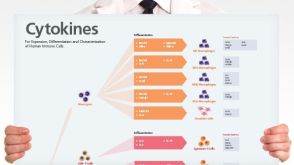 挂图Human Immune Cytokines Infographic of key cytokines for expansion, differentiation and characterization of major immune cell types

 沪公网安备31010102008431号