Norman JM et al. (OCT 2011)
Nature immunology 12 10 975--83
The antiviral factor APOBEC3G enhances the recognition of HIV-infected primary T cells by natural killer cells.
APOBEC3G (A3G) is an intrinsic antiviral factor that inhibits the replication of human immunodeficiency virus (HIV) by deaminating cytidine residues to uridine. This causes guanosine-to-adenosine hypermutation in the opposite strand and results in inactivation of the virus. HIV counteracts A3G through the activity of viral infectivity factor (Vif),which promotes degradation of A3G. We report that viral protein R (Vpr),which interacts with a uracil glycosylase,also counteracted A3G by diminishing the incorporation of uridine. However,this process resulted in activation of the DNA-damage–response pathway and the expression of natural killer (NK) cell–activating ligands. Our results show that pathogen-induced deamination of cytidine and the DNA-damage response to virus-mediated repair of the incorporation of uridine enhance the recognition of HIV-infected cells by NK cells.
View Publication
Costantini C et al. (OCT 2010)
International immunology 22 10 827--38
Neutrophil activation and survival are modulated by interaction with NK cells.
It is increasingly evident that neutrophils are able to cross-talk with other leukocytes to shape ongoing inflammatory and immune responses. In this study,we analyzed whether human NK cells may influence the survival and activation of neutrophils under co-culture conditions. We report that NK cells exposed to either IL-15 or IL-18 alone strongly protect the survival of neutrophils via the release of IFNγ and granulocyte macrophage colony-stimulating factor (GM-CSF) plus IFNγ,respectively,and cause a slight up-regulation of neutrophil CD64 and CD11b expression. In comparison,NK cells exposed to both IL-15 and IL-18 show a lesser ability to increase the survival of neutrophils but can more potently up-regulate CD64 and CD11b expression,as well as induce the de novo surface expression of CD69,in neutrophils. Analysis of the events occurring in neutrophil/NK co-cultures exposed to IL-15 plus IL-18 revealed that (i) neutrophil survival is positively affected by NK-derived GM-CSF but negatively influenced by a CD18-dependent neutrophil/NK contact,(ii) NK-derived IFNγ is almost entirely responsible for the induction of CD64,(iii) both soluble factors (primarily GM-CSF) and direct cell-cell contact up-regulate CD11b and CD69 and (iv) NK-derived GM-CSF induces the expression of biologically active heparin-binding EGF-like growth factor (HB-EGF) in neutrophils. Finally,we demonstrate that NK cells can also express HB-EGF when stimulated with either IL-2 or IL-15,yet independently of endogenous GM-CSF. Altogether,our results define a novel interaction within the innate immune system whereby NK cells,by directly modulating neutrophil functions,might contribute to the pathogenesis of inflammatory diseases.
View Publication
产品号#:
19257
19257RF
19055
19055RF
产品名:
EasySep™人NK细胞富集试剂盒
RoboSep™ 人NK细胞富集试剂盒含滤芯吸头
Magri G et al. (JAN 2011)
Blood 117 3 848--56
NKp46 and DNAM-1 NK-cell receptors drive the response to human cytomegalovirus-infected myeloid dendritic cells overcoming viral immune evasion strategies.
Information on natural killer (NK)-cell receptor-ligand interactions involved in the response to human cytomegalovirus (HCMV) is limited and essentially based on the study of infected fibroblasts. Experimental conditions were set up to characterize the NK response to HCMV-infected myeloid dendritic cells (DCs). Monocyte-derived DCs (moDCs) infected by the TB40/E HCMV strain down-regulated the expression of human leukocyte antigen class I molecules and specifically activated autologous NK-cell populations. NKG2D ligands appeared virtually undetectable in infected moDCs,reflecting the efficiency of immune evasion mechanisms,and explained the lack of antagonistic effects of NKG2D-specific monoclonal antibody. By contrast,DNAM-1 and DNAM-1 ligands (DNAM-1L)-specific monoclonal antibodies inhibited the NK response at 48 hours after infection,although the impact of HCMV-dependent down-regulation of DNAM-1L in infected moDCs was perceived at later stages. moDCs constitutively expressed ligands for NKp46 and NKp30 natural cytotoxicity receptors,which were partially reduced on HCMV infection; yet,only NKp46 appeared involved in the NK response. In contrast to previous reports in fibroblasts,human leukocyte antigen-E expression was not preserved in HCMV-infected moDCs,which triggered CD94/NKG2A(+) NK-cell activation. The results provide an insight on key receptor-ligand interactions involved in the NK-cell response against HCMV-infected moDCs,stressing the importance of the dynamics of viral immune evasion mechanisms.
View Publication
产品号#:
19055
19055RF
产品名:
EasySep™人NK细胞富集试剂盒
RoboSep™ 人NK细胞富集试剂盒含滤芯吸头
Fiedler K et al. (JAN 2011)
Blood 117 4 1329--39
Neutrophil development and function critically depend on Bruton tyrosine kinase in a mouse model of X-linked agammaglobulinemia.
Bruton tyrosine kinase (Btk) is essential for B cell development and function and also appears to be important for myeloid cells. The bone marrow of Btk-deficient mice shows enhanced granulopoiesis compared with that of wild-type mice. In purified granulocyte-monocyte-progenitors (GMP) from Btk-deficient mice,the development of granulocytes is favored at the expense of monocytes. However,Btk-deficient neutrophils are impaired in maturation and function. Using bone marrow chimeras,we show that this defect is cell-intrinsic to neutrophils. In GMP and neutrophils,Btk plays a role in GM-CSF- and Toll-like receptor-induced differentiation. Molecular analyses revealed that expression of the lineage-determining transcription factors C/EBPα,C/EBPβ,and PU.1,depends on Btk. In addition,expression of several granule proteins,including myeloperoxidase,neutrophilic granule protein,gelatinase and neutrophil elastase,is Btk-dependent. In the Arthus reaction,an acute inflammatory response,neutrophil migration into tissues,edema formation,and hemorrhage are significantly reduced in Btk-deficient animals. Together,our findings implicate Btk as an important regulator of neutrophilic granulocyte maturation and function in vivo.
View Publication
产品号#:
03231
产品名:
MethoCult™ M3231
Kaplan IM et al. (MAR 2011)
Journal of immunology (Baltimore,Md. : 1950) 186 5 2826--34
Deletion of tristetraprolin caused spontaneous reactive granulopoiesis by a non-cell-autonomous mechanism without disturbing long-term hematopoietic stem cell quiescence.
Tristetraprolin (TTP,Zfp36,Nup475,Tis11) dramatically reduces the stability of target mRNAs by binding to AU-rich elements in their 3' untranslated regions. Through this mechanism,TTP functions as a rheostatic,temporal regulator of gene expression. TTP knockout (KO) mice exhibit completely penetrant granulocytic hyperplasia. We have shown that the hematopoietic stem-progenitor cell compartment in TTP KO mice is also altered. Although no change was detected in long-term hematopoietic stem cell (HSC) frequency or function,as assayed by immunophenotypic markers or limiting dilution transplants,we observed increases in the frequencies and numbers of short-term HSCs,multipotent progenitors,and granulocyte-monocyte progenitors. This pattern is consistent with reactive granulopoiesis�
View Publication
产品号#:
03434
03444
产品名:
MethoCult™ GF M3434
MethoCult™ GF M3434
Garg TK et al. (SEP 2012)
Haematologica 97 9 1348--56
Highly activated and expanded natural killer cells for multiple myeloma immunotherapy.
BACKGROUND Patients with gene expression profiling-defined high-risk myeloma in relapse have poor outcomes with current therapies. We tested whether natural killer cells expanded by co-culture with K562 cells transfected with 41BBL and membrane-bound interleukin-15 could kill myeloma cells with a high-risk gene expression profile in vitro and in a unique model which recapitulates human myeloma. DESIGN AND METHODS OPM2 and high-risk primary myeloma tumors were grown in human fetal bone implanted into non-obese diabetic severe combined immunodeficiency mice with a deficient interleukin-2 receptor gamma chain. These mice are devoid of endogenous natural killer and T-cell activity and were used to determine whether adoptively transferred expanded natural killer cells could inhibit myeloma growth and myeloma-associated bone destruction. RESULTS Natural killer cells from healthy donors and myeloma patients expanded a median of 804- and 351-fold,respectively,without significant T-cell expansion. Expanded natural killer cells killed both allogeneic and autologous primary myeloma cells avidly via a perforin-mediated mechanism in which the activating receptor NKG2D,natural cytotoxicity receptors,and DNAX-accessory molecule-1 played a central role. Adoptive transfer of expanded natural killer cells inhibited the growth of established OPM2 and high-risk primary myeloma tumors grown in the murine model. The transferred,expanded natural killer cells proliferated in vivo in an interleukin-2 dose-dependent fashion,persisted up to 4 weeks,were readily detectable in the human bone,inhibited myeloma growth and protected bone from myeloma-induced osteolysis. CONCLUSIONS These studies provide the rationale for testing expanded natural killer cells in humans.
View Publication


 EasySep™小鼠TIL(CD45)正选试剂盒




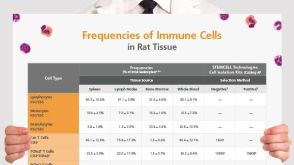 挂图Frequencies of Immune Cells in Rat Tissue Lists the estimated frequencies of more than 15 immune cell types in Sprague Dawley rats


 沪公网安备31010102008431号