Xue D et al. (NOV 2016)
Journal of immunology (Baltimore,Md. : 1950)
Semaphorin 4C Protects against Allergic Inflammation: Requirement of Regulatory CD138+ Plasma Cells.
The regulatory properties of B cells have been studied in autoimmune diseases; however,their role in allergic diseases is poorly understood. We demonstrate that Semaphorin 4C (Sema4C),an axonal guidance molecule,plays a crucial role in B cell regulatory function. Mice deficient in Sema4C exhibited increased airway inflammation after allergen exposure,with massive eosinophilic lung infiltrates and increased Th2 cytokines. This phenotype was reproduced by mixed bone marrow chimeric mice with Sema4C deficient only in B cells,indicating that B lymphocytes were the key cells affected by the absence of Sema4C expression in allergic inflammation. We determined that Sema4C-deficient CD19(+)CD138(+) cells exhibited decreased IL-10 and increased IL-4 expression in vivo and in vitro. Adoptive transfer of Sema4c(-/-) CD19(+)CD138(+) cells induced marked pulmonary inflammation,eosinophilia,and increased bronchoalveolar lavage fluid IL-4 and IL-5,whereas adoptive transfer of wild-type CD19(+)CD138(+)IL-10(+) cells dramatically decreased allergic airway inflammation in wild-type and Sema4c(-/-) mice. This study identifies a novel pathway by which Th2-mediated immune responses are regulated. It highlights the importance of plasma cells as regulatory cells in allergic inflammation and suggests that CD138(+) B cells contribute to cytokine balance and are important for maintenance of immune homeostasis in allergic airways disease. Furthermore,we demonstrate that Sema4C is critical for optimal regulatory cytokine production in CD138(+) B cells.
View Publication
产品号#:
19854
19854RF
产品名:
EasySep™小鼠B细胞分选试剂盒
RoboSep™ 小鼠B细胞分选试剂盒
Ols ML et al. (OCT 2016)
Immunity
Dendritic Cells Regulate Extrafollicular Autoreactive B Cells via T Cells Expressing Fas and Fas Ligand.
The extrafollicular (EF) plasmablast response to self-antigens that contain Toll-like receptor (TLR) ligands is prominent in murine lupus models and some bacterial infections,but the inhibitors and activators involved have not been fully delineated. Here,we used two conventional dendritic cell (cDC) depletion systems to investigate the role of cDCs on a classical TLR-dependent autoreactive EF response elicited in rheumatoid-factor B cells by DNA-containing immune complexes. Contrary to our hypothesis,cDC depletion amplified rather than dampened the EF response in Fas-intact but not Fas-deficient mice. Further,we demonstrated that cDC-dependent regulation requires Fas and Fas ligand (FasL) expression by T cells,but not Fas expression by B cells. Thus,cDCs activate FasL-expressing T cells that regulate Fas-expressing extrafollicular helper T (Tefh) cells. These studies reveal a regulatory role for cDCs in B cell plasmablast responses and provide a mechanistic explanation for the excess autoantibody production observed in Fas deficiency.
View Publication
产品号#:
19754
19754RF
产品名:
Dumont N et al. (APR 2009)
Immunology 126 4 588--95
Increased secretion of hyperimmune antibodies following lipopolysaccharide stimulation of CD40-activated human B cells in vitro.
Human B cells can be cultured ex vivo for a few weeks,following stimulation of the CD40 cell surface molecule in the presence of recombinant cytokines such as interleukin-4 (IL-4). However,attempts to produce polyclonal antigen-specific human antibodies by in vitro culture of human B cells obtained from immunized donors have not been successful. It has been shown in mice that lipopolysaccharide (LPS) is a potent mitogen for B cells and plays an important role in the generation of antigen-specific antibody responses. Although it has long been believed that LPS has no direct effect on human B cells,recent data indicating that IL-4-activated human B cells are induced to express Toll-like receptor-4,the main LPS receptor,prompted us to study the effects of LPS on the proliferation and antibody secretion of human B cells. Our results showed that LPS caused a reduction in the expansion of CD40-activated human B cells,accompanied by an increase in antigen-specific antibody secretion. This result suggested that some,but not all,B cells were able to differentiate into antibody-secreting cells in response to LPS. This increased differentiation could be explained by the observation that LPS-stimulated human B cells were induced to secrete higher amounts of IL-6,a pleiotropic cytokine well-known for its B-cell differentiation activity. In vivo,the effect of LPS on cytokine secretion by B cells may not only enhance B-cell differentiation but also help to sustain a local ongoing immune response to invading Gram-negative bacteria,until all pathogens have been cleared from the organism.
View Publication
产品号#:
14054
18357
18357RF
产品名:
Walter JE et al. (JUL 2010)
The Journal of experimental medicine 207 7 1541--54
Expansion of immunoglobulin-secreting cells and defects in B cell tolerance in Rag-dependent immunodeficiency.
The contribution of B cells to the pathology of Omenn syndrome and leaky severe combined immunodeficiency (SCID) has not been previously investigated. We have studied a mut/mut mouse model of leaky SCID with a homozygous Rag1 S723C mutation that impairs,but does not abrogate,V(D)J recombination activity. In spite of a severe block at the pro-B cell stage and profound B cell lymphopenia,significant serum levels of immunoglobulin (Ig) G,IgM,IgA,and IgE and a high proportion of Ig-secreting cells were detected in mut/mut mice. Antibody responses to trinitrophenyl (TNP)-Ficoll and production of high-affinity antibodies to TNP-keyhole limpet hemocyanin were severely impaired,even after adoptive transfer of wild-type CD4(+) T cells. Mut/mut mice produced high amounts of low-affinity self-reactive antibodies and showed significant lymphocytic infiltrates in peripheral tissues. Autoantibody production was associated with impaired receptor editing and increased serum B cell-activating factor (BAFF) concentrations. Autoantibodies and elevated BAFF levels were also identified in patients with Omenn syndrome and leaky SCID as a result of hypomorphic RAG mutations. These data indicate that the stochastic generation of an autoreactive B cell repertoire,which is associated with defects in central and peripheral checkpoints of B cell tolerance,is an important,previously unrecognized,aspect of immunodeficiencies associated with hypomorphic RAG mutations.
View Publication
产品号#:
19754
19754RF
产品名:
Fathallah I et al. (DEC 2010)
Journal of immunology (Baltimore,Md. : 1950) 185 11 6439--47
EBV latent membrane protein 1 is a negative regulator of TLR9.
EBV infects most of the human population and is associated with a number of human diseases including cancers. Moreover,evasion of the immune system and chronic infection is an essential step for EBV-associated diseases. In this paper,we show that EBV can alter the regulation and expression of TLRs,the key effector molecules of the innate immune response. EBV infection of human primary B cells resulted in the inhibition of TLR9 functionality. Stimulation of TLR9 on primary B cells led to the production of IL-6,TNF-α,and IgG,which was inhibited in cells infected with EBV. The virus exerts its inhibitory function by decreasing TLR9 mRNA and protein levels. This event was observed at early time points after EBV infection of primary cells,as well as in an immortalized lymphoblastoid cell line. We determined that the EBV oncoprotein latent membrane protein 1 (LMP1) is a strong inhibitor of TLR9 transcription. Overexpression of LMP1 in B cells reduced TLR9 promoter activity,mRNA,and protein levels. LMP1 mutants altered in activating the NF-κB pathway prevented TLR9 promoter deregulation. Blocking the NF-κB pathway recovered TLR9 promoter activity. Mutating the NF-κB cis element on the TLR9 promoter restored luciferase transcription in the presence of LMP1. Finally,deletion of the LMP1 gene in the EBV genome abolished the ability of the virus to induce TLR9 downregulation. Our study describes a mechanism used by EBV to suppress the host immune response by deregulating the TLR9 transcript through LMP1-mediated NF-κB activation.
View Publication
Montecino-Rodriguez E et al. (JAN 2001)
Nature immunology 2 1 83--8
Bipotential B-macrophage progenitors are present in adult bone marrow.
According to the current model of adult hematopoiesis,differentiation of pluripotential hematopoietic stem cells into common myeloid- and lymphoid-committed progenitors establishes an early separation between the myeloid and lymphoid lineages. This report describes a rare and previously unidentified CD45R-CD19+ B cell progenitor population in postnatal bone marrow that can also generate macrophages. In addition to the definition of this B-lineage intermediate,the data indicate that a developmental relationship between the B and macrophage lineages is retained during postnatal hematopoiesis.
View Publication


 EasySep™小鼠TIL(CD45)正选试剂盒




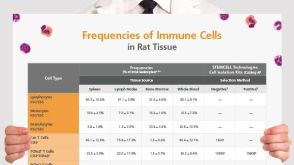 挂图Frequencies of Immune Cells in Rat Tissue Lists the estimated frequencies of more than 15 immune cell types in Sprague Dawley rats





 沪公网安备31010102008431号