ETV6-RUNX1 promotes survival of early B lineage progenitor cells via a dysregulated erythropoietin receptor.
ETV6-RUNX1 gene fusion is usually an early,prenatal event in childhood acute lymphoblastic leukemia (ALL). Transformation results in the generation of a persistent (> 14 years) preleukemic clone,which postnatally converts to ALL after the acquisition of necessary secondary genetic alterations. Many cancer cells show some expression of the erythropoietin receptor (EPOR) gene,although the functionality" of any EPOR complexes and their relevant signaling pathways in nonerythroid cells has not been validated. EPOR mRNA is selectively and ectopically expressed in ETV6-RUNX1(+) ALL but the presence of a functional EPOR on the cell surface and its role in leukemogenesis driven by ETV6-RUNX1 remains to be identified. Here we show that ETV6-RUNX1 directly binds the EPOR promoter and that expression of ETV6-RUNX1 alone in normal pre-B cells is sufficient to activate EPOR transcription. We further reveal that murine and human ETV6-RUNX1(+) cells expressing EPOR mRNA have EPO ligand binding activity that correlates with an increased cell survival through activation of the JAK2-STAT5 pathway and up-regulation of antiapoptotic BCL-XL. These data support the contention that ETV6-RUNX1 directly activates ectopic expression of a functional EPOR and provides cell survival signals that may contribute critically to persistence of covert premalignant clones in children.
View Publication
产品号#:
70007
70007.1
70007.2
产品名:
冻存的人脐带血单核细胞
冻存的人脐带血单核细胞
冻存的人脐带血单核细胞
Zeng J et al. (MAY 2012)
The Journal of Immunology 188 9 4297--4304
Enhancing Immunostimulatory Function of Human Embryonic Stem Cell-Derived Dendritic Cells by CD1d Overexpression
Human embryonic stem cell-derived dendritic cells (hESC-DCs) may potentially provide a platform to generate off-the-shelf" therapeutic cancer vaccines. To apply hESC-DCs for cancer immunotherapy in a semiallogeneic setting�
View Publication
产品号#:
05850
05857
05870
05875
09600
09650
70024
70024.1
85850
85857
85870
85875
70025
70025.1
70025.2
70025.3
70047
70047.1
70047.2
70048
70048.1
70048.2
产品名:
StemSpan™ SFEM
StemSpan™ SFEM
冻存的人外周血Pan T细胞
冻存的人外周血Pan T细胞
mTeSR™1
mTeSR™1
冻存的人外周血单个核细胞
冻存的人外周血单个核细胞
冻存的人外周血单个核细胞
冻存的人外周血单个核细胞
Nettenstrom L et al. (JAN 2013)
Journal of immunological methods 387 2-Jan 81--8
An optimized multi-parameter flow cytometry protocol for human T regulatory cell analysis on fresh and viably frozen cells, correlation with epigenetic analysis, and comparison of cord and adult blood.
Multi-parameter flow cytometry analysis of T regulatory (Treg) cells is a widely used approach in basic and translational research studies. This approach has been complicated by a lack of specific markers for Treg cells and lack of uniformity in the quantification of Treg cells. Given the central role of Treg cells in the inception and perpetuation of diverse immune responses as well as its target as a therapeutic,it is imperative to have established methodologies for Treg cell analysis that are robust and usable for studies with multiple subjects as well as multicenter studies. In this study,we describe an optimized multi-parameter flow cytometry protocol for the quantification of human Treg cells from freshly obtained and viably frozen samples and correlations with epigenetic Treg cell analysis (TSDR demethylation). We apply these two methodologies to characterize Treg cell differences between cord blood and adult peripheral blood. In summary,the optimized protocol appears to be robust for Treg cell quantification from freshly isolated or viably frozen cells and the multi-parameter flow cytometry findings are strongly positively correlated with TSDR demethylation thus providing several options for the characterization of Treg cell frequency and function in large translational or clinical studies.
View Publication
Callahan KP et al. (OCT 2014)
Leukemia 28 10 1960--8
Flavaglines target primitive leukemia cells and enhance anti-leukemia drug activity.
Identification of agents that target human leukemia stem cells is an important consideration for the development of new therapies. The present study demonstrates that rocaglamide and silvestrol,closely related natural products from the flavagline class of compounds,are able to preferentially kill functionally defined leukemia stem cells,while sparing normal stem and progenitor cells. In addition to efficacy as single agents,flavaglines sensitize leukemia cells to several anticancer compounds,including front-line chemotherapeutic drugs used to treat leukemia patients. Mechanistic studies indicate that flavaglines strongly inhibit protein synthesis,leading to the reduction of short-lived antiapoptotic proteins. Notably though,treatment with flavaglines,alone or in combination with other drugs,yields a much stronger cytotoxic activity toward leukemia cells than the translational inhibitor temsirolimus. These results indicate that the underlying cell death mechanism of flavaglines is more complex than simply inhibiting general protein translation. Global gene expression profiling and cell biological assays identified Myc inhibition and the disruption of mitochondrial integrity to be features of flavaglines,which we propose contribute to their efficacy in targeting leukemia cells. Taken together,these findings indicate that rocaglamide and silvestrol are distinct from clinically available translational inhibitors and represent promising candidates for the treatment of leukemia.
View Publication
产品号#:
07930
07931
07940
07955
07956
07959
07954
100-1061
07952
产品名:
CryoStor® CS10
CryoStor® CS10
CryoStor® CS10
CryoStor® CS10
CryoStor® CS10
CryoStor® CS10
CryoStor® CS10
Kofanova OA et al. (JUN 2014)
Biopreservation and biobanking 12 3 206--16
Viable mononuclear cell stability study for implementation in a proficiency testing program: impact of shipment conditions.
The impact of shipping temperatures and preservation media used during transport of either peripheral blood mononuclear cells (PBMCs) or Jurkat cells was assessed,in view of implementing of a proficiency testing scheme on mononuclear cell viability. Samples were analyzed before and after shipment at different temperatures (ambient temperature,dry ice,and liquid nitrogen) and in different preservation media (serum with cryoprotectant,commercial cryopreservation solution,and room temperature transport medium). Sample quality was assessed by viability assays (Trypan Blue dye exclusion,flow cytometry,Cell Analysis System cell counting (CASY)),and by ELISpot functional assay. The liquid nitrogen storage and shipment were found to be the most stable conditions to preserve cell viability and functionality. However,we show that alternative high quality shipment conditions for viable cells are dry ice shipment and commercial cryopreservation solution. These were also cost-efficient shipment conditions,satisfying the requirements of a proficiency testing scheme for viable mononuclear cells. Room temperature transport medium dramatically and adversely affected the integrity of mononuclear cells.
View Publication
产品号#:
07930
07931
07940
07955
07956
07959
07954
100-1061
07952
产品名:
CryoStor® CS10
CryoStor® CS10
CryoStor® CS10
CryoStor® CS10
CryoStor® CS10
CryoStor® CS10
CryoStor® CS10
Hamot G et al. (JUN 2015)
Biopreservation and biobanking 13 3 152--63
Method validation for automated isolation of viable peripheral blood mononuclear cells.
BACKGROUND This article is part of a series of publications providing formal method validation for biospecimen processing in the context of accreditation in laboratories and biobanks. We report the optimization and validation for fitness-for-purpose of automated and manual protocols for isolating peripheral blood mononuclear cells (PBMCs) from whole blood,and compare the two methods. METHODS The manual method was optimized for whole blood centrifugation speed,gradient type (Ficoll,Leucosep,CPT),and freezing method (Mr Frosty,Controlled Rate Freezing). Various parameters of the automated protocol using a CPT gradient on a Tecan liquid handler were optimized. Optimal protocols were validated in parallel for reproducibility and robustness. Optimization and validation were assessed in terms of cell yield,viability,recovery,white blood cell (WBC) subpopulation distribution,gene expression,and lymphoblastoid cell line (LCL) transformation. RESULTS An initial centrifugation of whole blood at 2000 g was considered optimal for further processing,allowing isolation of plasma and PBMCs from a single sample. The three gradients gave similar outcomes in terms of cell yield,viability,and WBC subpopulation distribution. Ficoll showed some advantages and was selected for further evaluations. Optimization of the automated protocol script using a CPT gradient gave 61% cell recovery. No significant differences in quality,quantity,and WBC subpopulation distribution were seen between the two freezing methods,and Mr. Frosty was selected. The manual and automated protocols were reproducible in terms of quantity,recovery,viability,WBC subpopulation distribution,gene expression,and LCL transformation. Most (75%-100%) of the 13 robustness parameters were accepted for both methods with an 8 h pre-centrifugation delay versus 38%-85% after 24 h. Differences identified between the automated and manual methods were not considered consequential. CONCLUSIONS We validated the first fully automated method for isolating viable PBMCs,including RNA analysis and generation of LCLs. We recommend processing within 8 h of blood collection.
View Publication


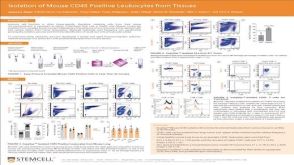
 EasySep™小鼠TIL(CD45)正选试剂盒






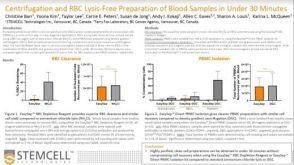 科学海报Centrifugation and RBC Lysis-Free Preparation of Blood Samples in Under 30 Minutes


 沪公网安备31010102008431号