Pereira LE et al. (MAY 2007)
Journal of virology 81 9 4445--56
Simian immunodeficiency virus (SIV) infection influences the level and function of regulatory T cells in SIV-infected rhesus macaques but not SIV-infected sooty mangabeys.
Differences in clinical outcome of simian immunodeficiency virus (SIV) infection in disease-resistant African sooty mangabeys (SM) and disease-susceptible Asian rhesus macaques (RM) prompted us to examine the role of regulatory T cells (Tregs) in these two animal models. Results from a cross-sectional study revealed maintenance of the frequency and absolute number of peripheral Tregs in chronically SIV-infected SM while a significant loss occurred in chronically SIV-infected RM compared to uninfected animals. A longitudinal study of experimentally SIV-infected animals revealed a transient increase in the frequency of Tregs from baseline values following acute infection in RM,but no change in the frequency of Tregs occurred in SM during this period. Further examination revealed a strong correlation between plasma viral load (VL) and the level of Tregs in SIV-infected RM but not SM. A correlation was also noted in SIV-infected RM that control VL spontaneously or in response to antiretroviral chemotherapy. In addition,immunofluorescent cell count assays showed that while Treg-depleted peripheral blood mononuclear cells from RM led to a significant enhancement of CD4+ and CD8+ T-cell responses to select pools of SIV peptides,there was no detectable T-cell response to the same pool of SIV peptides in Treg-depleted cells from SIV-infected SM. Our data collectively suggest that while Tregs do appear to play a role in the control of viremia and the magnitude of the SIV-specific immune response in RM,their role in disease resistance in SM remains unclear.
View Publication
产品号#:
18557
18557RF
15809
产品名:
Fahey AJ et al. (JUN 2007)
Journal of leukocyte biology 81 6 1562--7
Reciprocal effects of IFN-beta and IL-12 on STAT4 activation and cytokine induction in T cells.
IL-12 is an immunoregulatory cytokine,which promotes Th1 cell differentiation and is a major inducer of IFN-gamma. IFN-beta,a Type I IFN used in the treatment of multiple sclerosis,has been shown to significantly increase the expression of the anti-inflammatory cytokine IL-10,a major suppressor of Th1 cytokines. The beneficial immunomodulatory effects of IFN-beta may in part be a result of its ability to suppress IL-12. However,IL-12 and IFN-beta signal via the STAT4 pathway. Our aim was to investigate the relationship between IL-12 and IFN-beta by observing the effect of prior exposure to IL-12 or IFN-beta on the ability of T cells to subsequently respond to the other cytokine. We report that IFN-beta increases IL-12-induced STAT4 phosphorylation and up-regulates IL-12 receptor beta1 and beta2 expression. However,despite this up-regulation,IFN-beta suppressed IL-12-induced IFN-gamma expression. Our results suggest that this may be a result of the parallel induction of IL-10 by IFN-beta.
View Publication
产品号#:
19053
19053RF
19052
19052RF
产品名:
EasySep™人CD8+ T细胞富集试剂盒
RoboSep™ 人CD8+ T细胞富集试剂盒含滤芯吸头
EasySep™人CD4+ T细胞富集试剂盒
RoboSep™ 人CD4+ T细胞富集试剂盒含滤芯吸头
Yonkers NL et al. (APR 2007)
Journal of immunology (Baltimore,Md. : 1950) 178 7 4436--44
TLR ligand-dependent activation of naive CD4 T cells by plasmacytoid dendritic cells is impaired in hepatitis C virus infection.
Chronic hepatitis C virus (HCV) infection is characterized by diminished numbers and function of HCV-reactive T cells and impaired responses to immunization. Because host response to viral infection likely involves TLR signaling,we examined whether chronic HCV infection impairs APC response to TLR ligand and contributes to the origin of dysfunctional T cells. Freshly purified myeloid dendritic cells (MDC) and plasmacytoid DC (PDC) obtained from subjects with chronic HCV infection and healthy controls were exposed to TLR ligands (poly(I:C),R-848,or CpG),in the presence or absence of cytokine (TNF-alpha or IL-3),and examined for indices of maturation and for their ability to activate allogeneic naive CD4 T cells to proliferate and secrete IFN-gamma. TLR ligand was observed to enhance both MDC and PDC activation of naive CD4 T cells. Although there was increased CD83 and CD86 expression on MDC from HCV-infected persons,the ability of MDC to activate naive CD4 T cells in the presence or absence of poly(I:C) or TNF-alpha did not differ between HCV-infected and healthy control subjects. In contrast,PDC from HCV-infected persons had reduced activation marker (HLA-DR) and cytokine (IFN-alpha) expression upon R-848 stimulation,and these were associated with impaired activation of naive CD4 T cells. These data indicate that an impaired PDC responsiveness to TLR ligation may play an important role in the fundamental and unexplained failure to induce new T cell responses to HCV Ags and to other new Ags as a consequence of HCV infection.
View Publication
BiHC, a T-Cell-Engaging Bispecific Recombinant Antibody, Has Potent Cytotoxic Activity Against Her2 Tumor Cells.
Among different cancer immunotherapy approaches,bispecific antibodies (BsAbs) are of great interest due to their ability to recruit immune cells to kill tumor cells directly. Various BsAbs against Her2 tumor cells have been proposed with potent cytotoxic activities. However,most of these formats require extensive processing to obtain heterodimeric bispecific antibodies. In this study,we describe a bispecific antibody,BiHC (bispecific Her2-CD3 antibody),constructed with a single-domain anti-Her2 and a single-chain Fv (variable fragment) of anti-CD3 in an IgG-like format. In contrast to most IgG-like BsAbs,the two arms in BiHC have different molecular weights,making it easier to separate hetero- or homodimers. BiHC can be expressed in Escherichia coli and purified via Protein A affinity chromatography. The purified BiHC can recruit T cells and induce specific cytotoxicity of Her2-expressing tumor cells in vitro. The BiHC can also efficiently inhibit the tumor growth in vivo. Thus,BiHC is a promising candidate for the treatment of Her2-positive cancers.
View Publication
Direct interaction of whole-inactivated influenza A and pneumococcal vaccines enhances influenza-specific immunity.
The upper respiratory tract is continuously exposed to a vast array of potentially pathogenic viruses and bacteria. Influenza A virus (IAV) has particular synergism with the commensal bacterium Streptococcus pneumoniae in this niche,and co-infection exacerbates pathogenicity and causes significant mortality. However,it is not known whether this synergism is associated with a direct interaction between the two pathogens. We have previously reported that co-administration of a whole-inactivated IAV vaccine (gamma-Flu) with a whole-inactivated pneumococcal vaccine (gamma-PN) enhances pneumococcal-specific responses. In this study,we show that mucosal co-administration of gamma-Flu and gamma-PN similarly augments IAV-specific immunity,particularly tissue-resident memory cell responses in the lung. In addition,our in vitro analysis revealed that S. pneumoniae directly interacts with both gamma-Flu and with live IAV,facilitating increased uptake by macrophages as well as increased infection of epithelial cells by IAV. These observations provide an additional explanation for the synergistic pathogenicity of IAV and S. pneumoniae,as well as heralding the prospect of exploiting the phenomenon to develop better vaccine strategies for both pathogens.
View Publication
产品号#:
19858
19858RF
产品名:
EasySep™小鼠Naïve CD8+ T细胞分选试剂盒
RoboSep™ 小鼠Naïve CD8+ T细胞分选试剂盒
A. Lopresti et al. (jun 2019)
JCI insight 5
Sensitive and easy screening for circulating tumor cells by flow cytometry.
Circulating Tumor Cells (CTCs) represent an easy,repeatable and representative access to information regarding solid tumors. However,their detection remains difficult because of their paucity,their short half-life,and the lack of reliable surface biomarkers. Flow cytometry (FC) is a fast,sensitive and affordable technique,ideal for rare cells detection. Adapted to CTCs detection (i.e. extremely rare cells),most FC-based techniques require a time-consuming pre-enrichment step,followed by a 2-hours staining procedure,impeding on the efficiency of CTCs detection. We overcame these caveats and reduced the procedure to less than one hour,with minimal manipulation. First,cells were simultaneously fixed,permeabilized,then stained. Second,using low-speed FC acquisition conditions and two discriminators (cell size and pan-cytokeratin expression),we suppressed the pre-enrichment step. Applied to blood from donors with or without known malignant diseases,this protocol ensures a high recovery of the cells of interest independently of their epithelial-mesenchymal plasticity and can predict which samples are derived from cancer donors. This proof-of-concept study lays the bases of a sensitive tool to detect CTCs from a small amount of blood upstream of in-depth analyses.
View Publication
产品号#:
15122
15162
产品名:
RosetteSep™人CD45去除抗体混合物
RosetteSep™人CD45去除抗体混合物
D. Park et al. (may 2019)
Scientific reports 9 1 7094
Differences in the molecular signatures of mucosal-associated invariant T cells and conventional T cells.
Mucosal-associated invariant T (MAIT) cells exhibit different characteristics from those of TCRalpha7.2- conventional T cells. They play important roles in various inflammatory diseases,including rheumatoid arthritis and inflammatory bowel disease. MAIT cells express a single T cell receptor alpha chain,TCRalpha7.2 segment associated with Jalpha33 and CDR3 with fixed length,which recognizes bacteria-derived vitamin B metabolites. However,the characteristics of MAIT cells and TCRalpha7.2+ CD161- T cells have never been compared. Here,we performed RNA sequencing to compare the properties of MAIT cells,TCRalpha7.2- conventional T cells and TCRalpha7.2+ CD161- T cells. Genome-wide transcriptomes of MAIT cells,TCRalpha7.2- conventional T cells,and TCRalpha7.2+ CD161- T cells were compared and analyzed using causal network analysis. This is the first report comparing the transcriptomes of MAIT cells,TCRalpha7.2- conventional T cells and TCRalpha7.2+ CD161- T cells. We also identified the predominant signaling pathways of MAIT cells,which differed from those of TCRalpha7.2- conventional T cells and TCRalpha7.2+ CD161- T cells,through a gene set enrichment test and upstream regulator analysis and identified the genes responsible for the characteristic MAIT cell phenotypes. Our study advances the complete understanding of MAIT biology.
View Publication


 EasySep™小鼠TIL(CD45)正选试剂盒





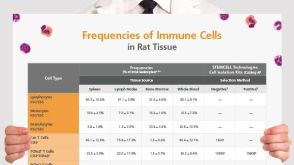 挂图Frequencies of Immune Cells in Rat Tissue Lists the estimated frequencies of more than 15 immune cell types in Sprague Dawley rats


 沪公网安备31010102008431号