Smith Sa et al. (MAR 2012)
Journal of Virology 86 5 2665--75
Persistence of circulating memory B cell clones with potential for Dengue virus disease enhancement for decades following infection
Symptomatic dengue virus infection ranges in disease severity from an influenza-like illness to life-threatening shock. One model of the mechanism underlying severe disease proposes that weakly neutralizing,dengue serotype cross-reactive antibodies induced during a primary infection facilitate virus entry into Fc receptor-bearing cells during a subsequent secondary infection,increasing viral replication and the release of cytokines and vasoactive mediators,culminating in shock. This process has been termed antibody-dependent enhancement of infection and has significantly hindered vaccine development. Much of our understanding of this process has come from studies using mouse monoclonal antibodies (MAbs); however,antibody responses in mice typically exhibit less complexity than those in humans. A better understanding of the humoral immune response to natural dengue virus infection in humans is sorely needed. Using a high-efficiency human hybridoma technology,we isolated 37 hybridomas secreting human MAbs to dengue viruses from 12 subjects years or even decades following primary or secondary infection. The majority of the human antibodies recovered were broadly cross-reactive,directed against either envelope or premembrane proteins,and capable of enhancement of infection in vitro; few exhibited serotype-specific binding or potent neutralizing activity. Memory B cells encoding enhancing antibodies predominated in the circulation,even two or more decades following infection. Mapping the epitopes and activity of naturally occurring dengue antibodies should prove valuable in determining whether the enhancing and neutralizing activity of antibodies can be separated. Such principles could be used in the rational design of vaccines that enhance the induction of neutralizing antibodies,while lowering the risk of dengue shock syndrome.
View Publication
产品号#:
03800
03801
03802
03803
03804
03805
03806
产品名:
ClonaCell™-HY杂交瘤试剂盒
ClonaCell™-HY培养基A
ClonaCell™-HY 培养基 B
ClonaCell™-HY 培养基 C
ClonaCell™-HY 培养基 D
ClonaCell™-HY 培养基 E
ClonaCell™-HY PEG
Bemark M et al. ( 2016)
Nature communications 7 12698
Limited clonal relatedness between gut IgA plasma cells and memory B cells after oral immunization.
Understanding how memory B cells are induced and relate to long-lived plasma cells is important for vaccine development. Immunity to oral vaccines has been considered short-lived because of a poor ability to develop IgA B-cell memory. Here we demonstrate that long-lived mucosal IgA memory is readily achieved by oral but not systemic immunization in mouse models with NP hapten conjugated with cholera toxin and transfer of B1-8(high)/GFP(+) NP-specific B cells. Unexpectedly,memory B cells are poorly related to long-lived plasma cells and less affinity-matured. They are α4β7-integrin(+)CD73(+)PD-L2(+)CD80(+) and at systemic sites mostly IgM(+),while 80% are IgA(+) in Peyer's patches. On reactivation,most memory B cells in Peyer's patches are GL7(-),but expand in germinal centres and acquire higher affinity and more mutations,demonstrating strong clonal selection. CCR9 expression is found only in Peyer's patches and appears critical for gut homing. Thus,gut mucosal memory possesses unique features not seen after systemic immunization.
View Publication
产品号#:
19854
19854RF
产品名:
EasySep™小鼠B细胞分选试剂盒
RoboSep™ 小鼠B细胞分选试剂盒
Tian M et al. (SEP 2016)
Cell 166 6 1471--1484.e18
Induction of HIV Neutralizing Antibody Lineages in Mice with Diverse Precursor Repertoires.
The design of immunogens that elicit broadly reactive neutralizing antibodies (bnAbs) has been a major obstacle to HIV-1 vaccine development. One approach to assess potential immunogens is to use mice expressing precursors of human bnAbs as vaccination models. The bnAbs of the VRC01-class derive from the IGHV1-2 immunoglobulin heavy chain and neutralize a wide spectrum of HIV-1 strains via targeting the CD4 binding site of the envelope glycoprotein gp120. We now describe a mouse vaccination model that allows a germline human IGHV1-2(∗)02 segment to undergo normal V(D)J recombination and,thereby,leads to the generation of peripheral B cells that express a highly diverse repertoire of VRC01-related receptors. When sequentially immunized with modified gp120 glycoproteins designed to engage VRC01 germline and intermediate antibodies,IGHV1-2(∗)02-rearranging mice,which also express a VRC01-antibody precursor light chain,can support the affinity maturation of VRC01 precursor antibodies into HIV-neutralizing antibody lineages.
View Publication
产品号#:
19844
19844RF
产品名:
EasySep™小鼠Pan-B细胞分选试剂盒
RoboSep™ 小鼠Pan-B细胞分选试剂盒
Le MX et al. (NOV 2016)
Scientific reports 6 37215
Kin17 facilitates multiple double-strand break repair pathways that govern B cell class switching.
Class switch recombination (CSR) in B cells requires the timely repair of DNA double-stranded breaks (DSBs) that result from lesions produced by activation-induced cytidine deaminase (AID). Through a genome-wide RNAi screen,we identified Kin17 as a gene potentially involved in the maintenance of CSR in murine B cells. In this study,we confirm a critical role for Kin17 in CSR independent of AID activity. Furthermore,we make evident that DSBs generated by AID or ionizing radiation require Kin17 for efficient repair and resolution. Our report shows that reduced Kin17 results in an elevated deletion frequency following AID mutational activity in the switch region. In addition,deficiency in Kin17 affects the functionality of multiple DSB repair pathways,namely homologous recombination,non-homologous end-joining,and alternative end-joining. This report demonstrates the importance of Kin17 as a critical factor that acts prior to the repair phase of DSB repair and is of bona fide importance for CSR.
View Publication
产品号#:
19854
19854RF
产品名:
EasySep™小鼠B细胞分选试剂盒
RoboSep™ 小鼠B细胞分选试剂盒
Li MMH et al. (NOV 2016)
The Journal of experimental medicine
Interferon regulatory factor 2 protects mice from lethal viral neuroinvasion.
The host responds to virus infection by activating type I interferon (IFN) signaling leading to expression of IFN-stimulated genes (ISGs). Dysregulation of the IFN response results in inflammatory diseases and chronic infections. In this study,we demonstrate that IFN regulatory factor 2 (IRF2),an ISG and a negative regulator of IFN signaling,influences alphavirus neuroinvasion and pathogenesis. A Sindbis virus strain that in wild-type (WT) mice only causes disease when injected into the brain leads to lethal encephalitis in Irf2(-/-) mice after peripheral inoculation. Irf2(-/-) mice fail to control virus replication and recruit immune infiltrates into the brain. Reduced B cells and virus-specific IgG are observed in the Irf2(-/-) mouse brains despite the presence of peripheral neutralizing antibodies,suggesting a defect in B cell trafficking to the central nervous system (CNS). B cell-deficient μMT mice are significantly more susceptible to viral infection,yet WT B cells and serum are unable to rescue the Irf2(-/-) mice. Collectively,our data demonstrate that proper localization of B cells and local production of antibodies in the CNS are required for protection. The work advances our understanding of host mechanisms that affect viral neuroinvasion and their contribution to immunity against CNS infections.
View Publication
Biologic and genetic characterization of the novel amyloidogenic lambda light chain-secreting human cell lines, ALMC-1 and ALMC-2.
Primary systemic amyloidosis (AL) is a rare monoclonal plasma cell (PC) disorder characterized by the deposition of misfolded immunoglobulin (Ig) light chains (LC) in vital organs throughout the body. To our knowledge,no cell lines have ever been established from AL patients. Here we describe the establishment of the ALMC-1 and ALMC-2 cell lines from an AL patient. Both cell lines exhibit a PC phenotype and display cytokine-dependent growth. Using a comprehensive genetic approach,we established the genetic relationship between the cell lines and the primary patient cells,and we were also able to identify new genetic changes accompanying tumor progression that may explain the natural history of this patient's disease. Importantly,we demonstrate that free lambda LC secreted by both cell lines contained a beta structure and formed amyloid fibrils. Despite absolute Ig LC variable gene sequence identity,the proteins show differences in amyloid formation kinetics that are abolished by the presence of Na(2)SO(4). The formation of amyloid fibrils from these naturally secreting human LC cell lines is unprecedented. Moreover,these cell lines will provide an invaluable tool to better understand AL,from the combined perspectives of amyloidogenic protein structure and amyloid formation,genetics,and cell biology.
View Publication
M. Epeldegui et al. (jun 2019)
Scientific reports 9 1 9371
Elevated numbers of PD-L1 expressing B cells are associated with the development of AIDS-NHL.
The risk for non-Hodgkin lymphoma (NHL) is markedly increased in persons living with human immunodeficiency virus (HIV) infection,and remains elevated in those on anti-retroviral therapy (cART). Both the loss of immunoregulation of Epstein-Barr virus (EBV) infected cells,as well as chronic B-cell activation,are believed to contribute to the genesis of AIDS-related NHL (AIDS-NHL). However,the mechanisms that lead to AIDS-NHL have not been completely defined. A subset of B cells that is characterized by the secretion of IL10,as well as the expression of the programmed cell death ligand-1 (PD-L1/CD274),was recently described. These PD-L1+ B cells can exert regulatory function,including the dampening of T-cell activation,by interacting with the program cell death protein (PD1) on target cells. The role of PD-L1+ B cells in the development of AIDS-NHL has not been explored. We assessed B cell PD-L1 expression on B cells preceding AIDS-NHL diagnosis in a nested case-control study of HIV+ subjects who went on to develop AIDS-NHL,as well as HIV+ subjects who did not,using multi-color flow cytometry. Archival frozen viable PBMC were obtained from the UCLA Multicenter AIDS Cohort Study (MACS). It was seen that the number of CD19+CD24++CD38++and CD19+PD-L1+cells was significantly elevated in cases 1-4 years prior to AIDS-NHL diagnosis,compared to controls,raising the possibility that these cells may play a role in the etiology of AIDS-NHL. Interestingly,most PD-L1+ expression on CD19+ cells was seen on CD19+CD24++CD38++ cells. In addition,we showed that HIV can directly induce PD-L1 expression on B cells through interaction of virion-associated CD40L with CD40 on B cells.
View Publication


 EasySep™小鼠TIL(CD45)正选试剂盒




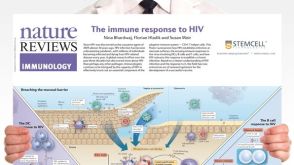 挂图The Immune Response to HIV Poster Summary of how HIV subverts the immune response to establish a chronic infection



 沪公网安备31010102008431号