若您需要咨询产品或有任何技术问题,请通过官方电话 400 885 9050 或邮箱 info.cn@stemcell.com 与我们联系。

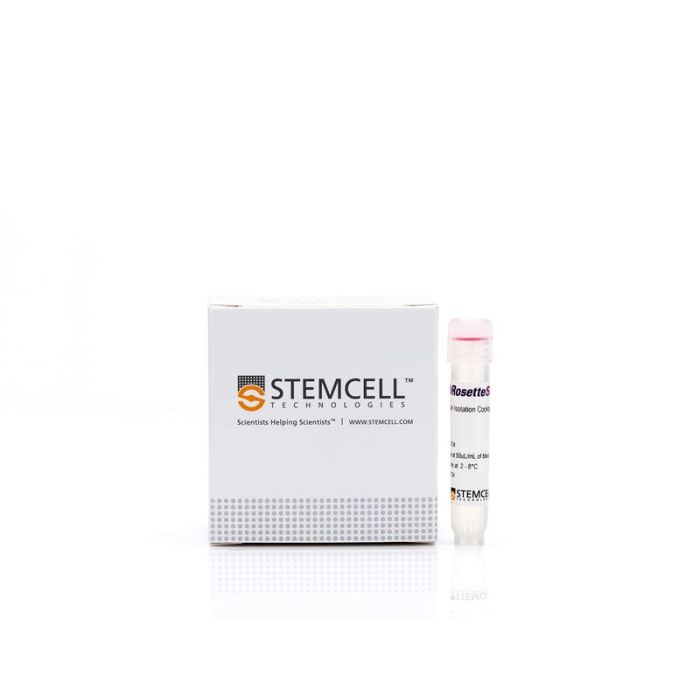
RosetteSep™人造血祖细胞富集抗体混合物

免疫密度负选试剂混合物
只有 %1
¥2,788.00

产品号 #(选择产品)

产品号 #15026_C

免疫密度负选试剂混合物

产品优势

  • 快捷、操作简单
  • 不需要特殊设备或额外培训
  • 获得的活细胞未被     标记
  • 可与SepMate™联合使用,实现一致的     高通量     样本处理

产品组分包括

  • RosetteSep™人造血祖细胞富集抗体混合物     (产品号#15026)
    • RosetteSep™人造血祖细胞富集抗体混合物     ,2mL
  • RosetteSep™人造血祖细胞富集抗体混合物     (产品号#15066)
    • RosetteSep™人造血祖细胞富集抗体混合物     ,5x2mL
New look, same high quality and support! You may notice that your instrument or reagent packaging looks slightly different from images displayed on the website, or from previous orders. We are updating our look but rest assured, the products themselves and how you should use them have not changed. Learn more
专为您的实验方案打造的产品
要查看实验方案所需的所有配套产品,请参阅《实验方案与技术文档》

总览

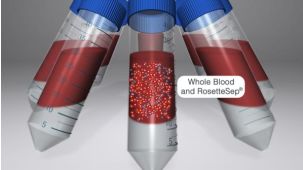
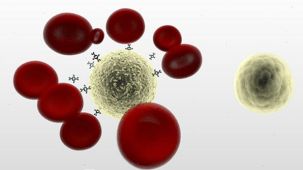
RosetteSep™人造血祖细胞富集抗体混合物通过负选从脐带血和全血分离造血祖细胞。四聚体抗体复合物可识别CD2 、CD3、CD14,、CD16,、CD19、CD24、CD56、CD61、CD66b以及红细胞(RBC)上的糖蛋白A,从而靶向去除非目的细胞。使用密度梯度离心液如Lymphoprep™(产品号 #18060)离心后,非目的细胞会与红细胞一起沉淀。纯化的祖细胞为血浆和密度梯度离心液的交界界面中高度富集的细胞。若使用大体积血液样本,我们推荐包含HetaSep™的RosetteSep™脐血祖细胞富集试剂盒(产品号#15276)。

分类
细胞分选试剂盒
 
细胞类型
造血干/祖细胞
 
种属

 
样本来源
脐带血、全血
 
分选方法
负选
 
应用
细胞分选
 
品牌
RosetteSep
 
研究领域
免疫,干细胞生物学
 

实验数据

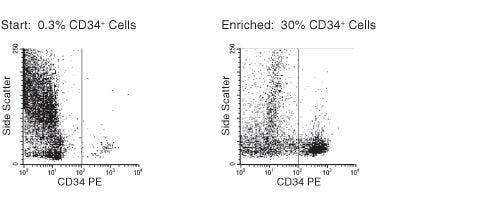
FACS Profile Results With RosetteSep™ Human Cord Blood Progenitor CellEnrichment Kit

Figure 1. FACS Profile Results With RosetteSep™ Human Cord Blood Progenitor Cell Enrichment Kit

Starting with fresh cord blood, the enrichment of CD34+ cells is typically 29 ± 9%.

产品说明书及文档

请在《产品说明书》中查找相关支持信息和使用说明,或浏览下方更多实验方案。

Document Type
Product Name
Catalog #
Lot #
Language
Catalog #
15066, 15026
Lot #
All
Language
English
Document Type
Safety Data Sheet
Catalog #
15066, 15026
Lot #
All
Language
English

应用领域

本产品专为以下研究领域设计,适用于工作流程中的高亮阶段。探索这些工作流程,了解更多我们为各研究领域提供的其他配套产品。

相关材料与文献

技术资料 (4)

常见问题 (9)

What is RosetteSep™?

RosetteSep™ is a rapid cell separation procedure for the isolation of purified cells directly from whole blood, without columns or magnets.

How does RosetteSep™ work?

The antibody cocktail crosslinks unwanted cells to red blood cells (RBCs), forming rosettes. The unwanted cells then pellet with the free RBCs when centrifuged over a density centrifugation medium (e.g. Ficoll-Paque™ PLUS, Lymphoprep™).

What factors affect cell recovery?

The temperature of the reagents can affect cell recovery. All reagents should be at room temperature (sample, density centrifugation medium, PBS, centrifuge) before performing the isolations. Layering can also affect recovery so be sure to carefully layer the sample to avoid mixing with the density centrifugation medium as much as possible. Be sure to collect the entire enriched culture without disturbing the RBC pellet. A small amount of density centrifugation medium can be collected without worry.

Which cell samples can RosetteSep™ be used with?

RosetteSep™ can be used with leukapheresis samples, bone marrow or buffy coat, as long as: the concentration of cells does not exceed 5 x 10⁷ per mL (can dilute if necessary); and there are at least 100 RBCs for every nucleated cell (RBCs can be added if necessary).

Can RosetteSep™ be used with previously frozen or cultured cells?

Yes. Cells should be re-suspended at 2 - 5 x 10⁷ cells / mL in PBS + 2% FBS. Fresh whole blood should be added at 250 µL per mL of sample, as a source of red cells.

Can RosetteSep™ be used to enrich progenitors from cord blood?

Yes. Sometimes cord blood contains immature nucleated red cells that have a lower density than mature RBCs. These immature red cells do not pellet over Ficoll™, which can lead to a higher RBC contamination than peripheral blood separations.

Does RosetteSep™ work with mouse cells?

No, but we have developed EasySep™, a magnetic-based cell isolation system which works with mouse and other non-human species.

Which anticoagulant should be used with RosetteSep™?

Peripheral blood should be collected in heparinized Vacutainers. Cord blood should be collected in ACD.

Should the anticoagulant be washed off before using RosetteSep™?

No, the antibody cocktail can be added directly to the sample.

文献 (11)

A noncoding regulatory variant in Cell Genomics 2024 Mar

Abstract

SummaryHispanic/Latino children have the highest risk of acute lymphoblastic leukemia (ALL) in the US compared to other racial/ethnic groups, yet the basis of this remains incompletely understood. Through genetic fine-mapping analyses, we identified a new independent childhood ALL risk signal near IKZF1 in self-reported Hispanic/Latino individuals, but not in non-Hispanic White individuals, with an effect size of ∼1.44 (95% confidence interval = 1.33–1.55) and a risk allele frequency of ∼18% in Hispanic/Latino populations and <0.5% in European populations. This risk allele was positively associated with Indigenous American ancestry, showed evidence of selection in human history, and was associated with reduced IKZF1 expression. We identified a putative causal variant in a downstream enhancer that is most active in pro-B cells and interacts with the IKZF1 promoter. This variant disrupts IKZF1 autoregulation at this enhancer and results in reduced enhancer activity in B cell progenitors. Our study reveals a genetic basis for the increased ALL risk in Hispanic/Latino children. Graphical abstract Highlights•IKZF1 variants contribute to the increased risk of ALL in Hispanic/Latino children•Risk allele is associated with Indigenous American ancestry and underwent selection•Risk variant impacts IKZF1 enhancer that is selectively active in B cell development•Risk allele reduces enhancer activity, chromatin accessibility, and IKZF1 expression Genetic fine-mapping across the IKZF1 gene revealed a variant associated with childhood ALL that contributes to the increased risk of this disease in Hispanic/Latino individuals. The ALL risk allele reduces enhancer activity and IKZF1 expression specifically in B cell progenitors, likely resulting in stalled B cell development and an increased risk of ALL.
Humanizing NOD/SCID/IL-2Rγnull (NSG) mice using busulfan and retro-orbital injection of umbilical cord blood-derived CD34(+) cells. Kang YK et al. Blood research 2016 MAR

Abstract

BACKGROUND Humanized mouse models are still under development, and various protocols exist to improve human cell engraftment and function. METHODS Fourteen NOD/SCID/IL-2Rγnull (NSG) mice (4‒5 wk old) were conditioned with busulfan and injected with human umbilical cord blood (hUCB)-derived CD34(+) hematopoietic stem cells (HSC) via retro-orbital sinuses. The bone marrow (BM), spleen, and peripheral blood (PB) were analyzed 8 and 12 weeks after HSC transplantation. RESULTS Most of the NSG mice tolerated the regimen well. The percentage of hCD45(+) and CD19(+) cells rose significantly in a time-dependent manner. The median percentage of hCD45(+)cells in the BM was 55.5&percnt; at week 8, and 67.2&percnt; at week 12. The median percentage of hCD45(+) cells in the spleen at weeks 8 and 12 was 42&percnt; and 51&percnt;, respectively. The median percentage of hCD19(+) cells in BM at weeks 8 and 12 was 21.5&percnt; and 39&percnt;, respectively (P=0.04). Similarly, the median percentage of hCD19(+) cells in the spleen at weeks 8 and 12 was 10&percnt; and 24&percnt;, respectively (P=0.04). The percentage of hCD19(+) B cells in PB was 23&percnt; at week 12. At week 8, hCD3(+) T cells were barely detectable, while hCD7(+) was detected in the BM and spleen. The percentage of hCD3(+) T cells was 2‒3&percnt; at week 12 in the BM, spleen, and PB of humanized NSG mice. CONCLUSION We adopted a simplified protocol for establishing humanized NSG mice. We observed a higher engraftment rate of human CD45(+) cells than earlier studies without any significant toxicity. And human CD45(+) cell engraftment at week 8 was comparable to that of week 12.
Cell-Extrinsic MHC Class I Molecule Engagement Augments Human NK Cell Education Programmed by Cell-Intrinsic MHC Class I. Boudreau JE et al. Immunity 2016 AUG

Abstract

The effector potential of NK cells is counterbalanced by their sensitivity to inhibition by self" MHC class I molecules in a process called "education." In humans�

更多信息

更多信息
物种 人类
样本来源 全血, 脐带血
Selection Method Negative
质量保证:

产品仅供研究使用,不用于针对人或动物的诊断或治疗。 欲获悉更多关于STEMCELL的质控信息,请访问 STEMCELL.CN/COMPLIANCE.
Copyright © 2025 by STEMCELL Technologies. All rights reserved.

在线联系