若您需要咨询产品或有任何技术问题,请通过官方电话 400 885 9050 或邮箱 info.cn@stemcell.com 与我们联系。

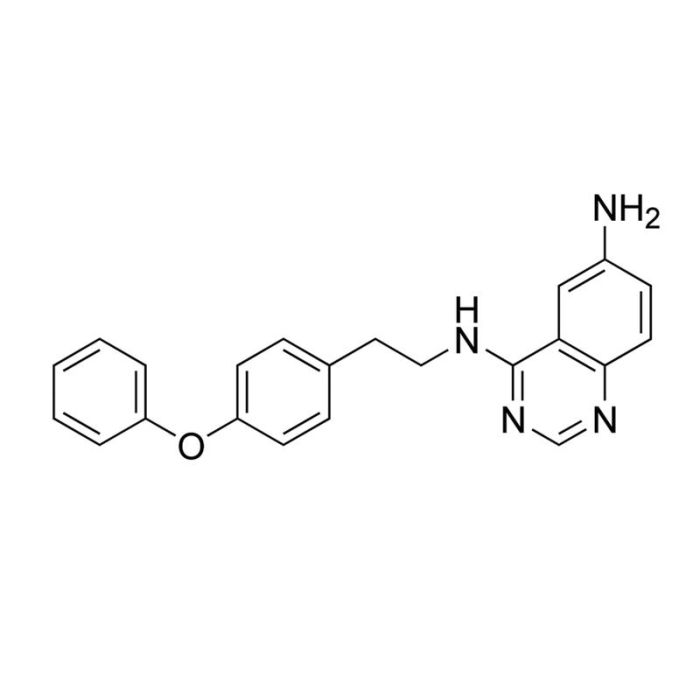
QNZ

NF-κB通路抑制剂;抑制NF-κB
只有 %1
¥510.00

产品号 #(选择产品)

产品号 #73352_C

NF-κB通路抑制剂;抑制NF-κB

总览

QNZ是一种喹唑啉衍生物,可抑制核因子NF-κB的活化(在人Jurkat T淋巴细胞中IC₅₀=11 nM)。NF-κB可增强促炎细胞因子的转录,而QNZ可抑制脂多糖(LPS)刺激的小鼠脾细胞中肿瘤坏死因子TNF-α的产生(IC₅₀=7 nM;Tobe等),以及CXCL1介导的成年大鼠神经元中促炎性钾电流的增加(Yang等)。在标准筛选中,它不会抑制激酶(Wu等)。

维持培养
·在使用YAC128培养基棘神经元培养物在谷氨酸毒性试验中,QNZ显示出神经保护作用(Wu等)。

疾病建模
·阻断由毒蕈碱受体激活引起的人SH-SY5Y神经母细胞瘤细胞中淀粉样蛋白前体的释放(Choi等)。

细胞类型
癌细胞及细胞系,神经元
 
种属
人,小鼠,非人灵长类,其他物种,大鼠
 
研究领域
癌症,疾病建模,神经科学
 
CAS 编号
545380-34-5
 
化学式
C₂₂H₂₀N₄O
 
纯度
≥98%
 
通路
NF-κB
 
靶点
NF-κB
 

产品说明书及文档

请在《产品说明书》中查找相关支持信息和使用说明,或浏览下方更多实验方案。

Document Type
Product Name
Catalog #
Lot #
Language
Product Name
QNZ
Catalog #
73352
Lot #
All
Language
English
Document Type
Safety Data Sheet
Product Name
QNZ
Catalog #
73352
Lot #
All
Language
English

应用领域

本产品专为以下研究领域设计,适用于工作流程中的高亮阶段。探索这些工作流程,了解更多我们为各研究领域提供的其他配套产品。

相关材料与文献

技术资料 (2)

文献 (4)

Discovery of quinazolines as a novel structural class of potent inhibitors of NF-kappa B activation. Tobe M et al. Bioorganic & medicinal chemistry 2003

Abstract

We disclose here a new structural class of low-molecular-weight inhibitors of NF-kappa B activation that were designed and synthesized by starting from quinazoline derivative 6a. Structure-activity relationship (SAR) studies based on 6a elucidated the structural requirements essential for the inhibitory activity toward NF-kappa B transcriptional activation,and led to the identification of the 6-amino-4-phenethylaminoquinazoline skeleton as the basic framework. In this series of compounds,11q,containing the 4-phenoxyphenethyl moiety at the C(4)-position,showed strong inhibitory effects on both NF-kappa B transcriptional activation and TNF-alpha production. Furthermore,11q exhibited an anti-inflammatory effect on carrageenin-induced paw edema in rats.
Nuclear factor-kappaB activated by capacitative Ca2+ entry enhances muscarinic receptor-mediated soluble amyloid precursor protein (sAPPalpha) release in SH-SY5Y cells. Choi S et al. The Journal of biological chemistry 2006

Abstract

G(q/11) protein-coupled muscarinic receptors are known to regulate the release of soluble amyloid precursor protein (sAPPalpha) produced by alpha-secretase processing; however,their signaling mechanisms remain to be elucidated. It has been reported that a muscarinic agonist activates nuclear factor (NF)-kappaB,a transcription factor that has been shown to play an important role in the Alzheimer disease brain,and that NF-kappaB activation is regulated by intracellular Ca2+ level. In the present study,we investigated whether NF-kappaB activation plays a role in muscarinic receptor-mediated sAPPalpha release enhancement and contributes to a changed capacitative Ca2+ entry (CCE),which was suggested to be involved in the muscarinic receptor-mediated stimulation of sAPPalpha release. Muscarinic receptor-mediated NF-kappaB activation was confirmed by observing the translocation of the active subunit (p65) of NF-kappaB to the nucleus by the muscarinic agonist,oxotremorine M (oxoM),in SH-SY5Y neuroblastoma cells expressing muscarinic receptors that are predominantly of the M3 subtype. NF-kappaB activation and sAPPalpha release enhancement induced by oxoM were inhibited by NF-kappaB inhibitors,such as an NF-kappaB peptide inhibitor (SN50),an IkappaB alpha kinase inhibitor (BAY11-7085),a proteasome inhibitor (MG132),the inhibitor of proteasome activity and IkappaB phosphorylation,pyrrolidine dithiocarbamate,the novel NF-kappaB activation inhibitor (6-amino-4-(4-phenoxyphenylethylamino) quinazoline),and by an intracellular Ca2+ chelator (TMB-8). Furthermore,both oxoM-induced NF-kappaB activation and sAPPalpha release were antagonized by CCE inhibitors (gadolinium or SKF96365) but not by voltage-gated Ca2+-channel blockers. On the other hand,treatment of cells with NF-kappaB inhibitors (SN50,BAY11-7085,MG132,or pyrrolidine dithiocarbamate) did not inhibit muscarinic receptor-mediated CCE. These findings provide evidence for the involvement of NF-kappaB regulated by CCE in muscarinic receptor-mediated sAPPalpha release enhancement.
NF-kappaB mediated enhancement of potassium currents by the chemokine CXCL1/growth related oncogene in small diameter rat sensory neurons. Yang R-H et al. Molecular pain 2009 JAN

Abstract

BACKGROUND: Inflammatory processes play important roles in both neuropathic and inflammatory pain states,but the effects of inflammation per se within the sensory ganglia are not well understood. The cytokine growth-related oncogene (GRO/KC; CXCL1) shows strong,rapid upregulation in dorsal root ganglion (DRG) in both nerve injury and inflammatory pain models. We examined the direct effects of GRO/KC on small diameter DRG neurons,which are predominantly nociceptive. Whole cell voltage clamp technique was used to measure voltage-activated potassium (K) currents in acutely cultured adult rat small diameter sensory neurons. Fluorescently labeled isolectin B4 (IB4) was used to classify cells as IB4-positive or IB4-negative. RESULTS: In IB4-negative neurons,voltage-activated K current densities of both transient and sustained components were increased after overnight incubation with GRO/KC (1.5 nM),without marked changes in voltage dependence or kinetics. The average values for the slow and fast decay time constants at 20 mV were unchanged by GRO/KC. The amplitude of the fast inactivating component increased significantly with no large shifts in the voltage dependence of inactivation. The increase in K currents was completely blocked by co-incubation with protein synthesis inhibitor cycloheximide (CHX) or NF-kappaB inhibitors pyrrolidine dithiocarbamate (PDTC) or quinazoline (6-Amino-4-(4-phenoxypheny lethylamino;QNZ). In contrast,the voltage-activated K current of IB4-positive neurons was unchanged by GRO/KC. GRO/KC incubation caused no significant changes in the expression level of eight selected voltage-gated K channel genes in quantitative PCR analysis. CONCLUSION: The results suggest that GRO/KC has important effects in inflammatory processes via its direct actions on sensory neurons,and that activation of NF-kappaB is involved in the GRO/KC-induced enhancement of K currents.

更多信息

更多信息
物种 人, 其它物种, 大鼠, 小鼠, 非人灵长类
Cas Number 545380-34-5
Chemical Formula C₂₂H₂₀N₄O
纯度 ≥ 98%
Target NF-κB
Pathway NF-κB
质量保证:

产品仅供研究使用,不用于针对人或动物的诊断或治疗。 欲获悉更多关于STEMCELL的质控信息,请访问 STEMCELL.CN/COMPLIANCE.
Copyright © 2026 by STEMCELL Technologies. All rights reserved.

在线联系