若您需要咨询产品或有任何技术问题,请通过官方电话 400 885 9050 或邮箱 info.cn@stemcell.com 与我们联系。

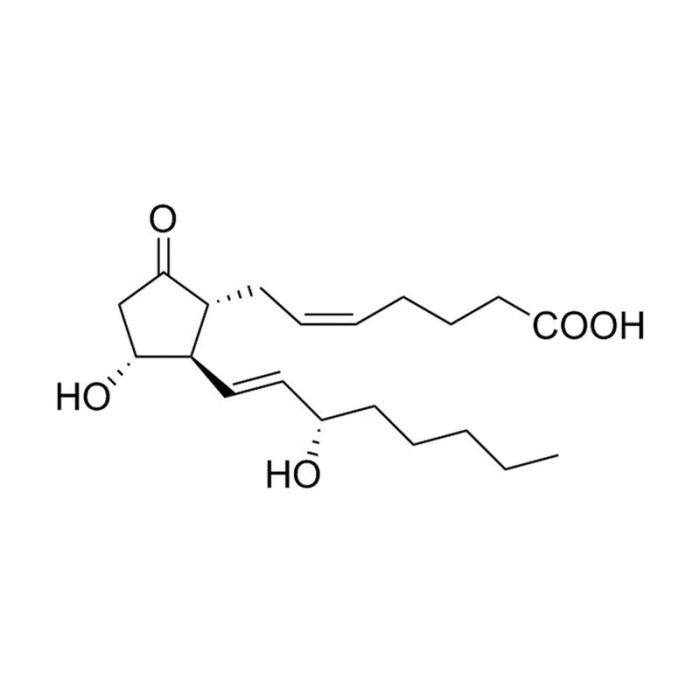
前列腺素E2(Prostaglandin E2)

前列腺素通路激活剂;激活前列腺素受体 EP1、EP2、EP3 和 EP4
只有 %1
¥912.00

产品号 #(选择产品)

产品号 #72192_C

前列腺素通路激活剂;激活前列腺素受体 EP1、EP2、EP3 和 EP4

总览

前列腺素E₂ (PGE₂) 是生物活性最高、研究最深入的前列腺素。它与EP1、EP2、EP3和EP4受体具有极高的亲和力(Ki分别为9.1、4.9、0.33和0.79 nM)。(Abramovitz et al., Bos et al.)

维持和自我更新
·是小鼠和斑马鱼造血干细胞 (HSC) 发育所必需的(North et al.)。
可能通过促进归巢、存活和/或自我更新来改善小鼠造血干细胞的植入(Hoggatt et al. 2009, Hoggatt et al. 2013, North et al.)。

分化
·促进小鼠、恒河猴和人胚胎干细胞向造血祖细胞分化(Gori et al., North et al., Woods et al.)。
·促进髓系来源的抑制细胞从造血祖细胞分化(Sinha et al.)。
·促进 Th17 细胞从 naïve T 细胞分化(Boniface et al.)。

别名
Dinoprostone;PGE2
 
细胞类型
造血干/祖细胞,髓系细胞,多能干细胞,T 细胞
 
种属
人,小鼠,非人灵长类,其他物种,大鼠
 
应用
分化,培养
 
研究领域
干细胞生物学
 
CAS 编号
363-24-6
 
化学式
C₂₀H₃₂O₅
 
分子量
352.5 g/mol
 
纯度
≥98%
 
通路
前列腺素衍生物
 
靶点
前列腺素受体
 

产品说明书及文档

请在《产品说明书》中查找相关支持信息和使用说明,或浏览下方更多实验方案。

Document Type
Product Name
Catalog #
Lot #
Language
Product Name
Prostaglandin E2
Catalog #
72194, 72192
Lot #
All
Language
English
Document Type
Safety Data Sheet
Product Name
Prostaglandin E2
Catalog #
72194, 72192
Lot #
All
Language
English

相关材料与文献

技术资料 (3)

文献 (10)

The utilization of recombinant prostanoid receptors to determine the affinities and selectivities of prostaglandins and related analogs. Abramovitz M et al. Biochimica et biophysica acta 2000 JAN

Abstract

Stable cell lines that individually express the eight known human prostanoid receptors (EP(1),EP(2),EP(3),EP(4),DP,FP,IP and TP) have been established using human embryonic kidney (HEK) 293(EBNA) cells. These recombinant cell lines have been employed in radioligand binding assays to determine the equilibrium inhibitor constants of known prostanoid receptor ligands at these eight receptors. This has allowed,for the first time,an assessment of the affinity and selectivity of several novel compounds at the individual human prostanoid receptors. This information should facilitate interpretation of pharmacological studies that employ these ligands as tools to study human tissues and cell lines and should,therefore,result in a greater understanding of prostanoid receptor biology.
Prostanoids and prostanoid receptors in signal transduction. Bos CL et al. The international journal of biochemistry & cell biology 2004 JUL

Abstract

Prostanoids are arachidonic acid metabolites and are generally accepted to play pivotal functions in amongst others inflammation,platelet aggregation,and vasoconstriction/relaxation. Inhibition of their production with,for instance,aspirin has been used for over a century to combat a large variety of pathophysiological processes,with great clinical success. Hence,the cellular changes induced by prostanoids have been subject to an intensive research effort and especially prostanoid-dependent signal transduction has been extensively studied. In this review,we discuss the impact of the five basic prostanoids,TxA(2),PGF(2alpha),PGE(2),PGI(2),and PGD(2),via their receptors on cellular physiology. These inflammatory lipids may stimulate serpentine plasma membrane-localized receptors,which in turn affect major signaling pathways,such as the MAP kinase pathway and the protein kinase A pathway,finally resulting in altered cellular physiology. In addition,prostanoids may activate the PPARgamma members of the steroid/thyroid family of nuclear hormone receptors,which act as transcription factors and may thus directly influence gene transcription. Finally,evidence exists that prostanoids act as second messengers downstream of mitogen receptor activation,mediating events,such as cytoskeletal changes,maybe via direct interaction with GTPase activating proteins. The final cellular reaction to prostaglandin stimulation will most likely depend on combined effects of the above-mentioned levels of interaction between prostaglandins and their cellular receptors.
Prostaglandin E2 promotes tumor progression by inducing myeloid-derived suppressor cells. Sinha P et al. Cancer research 2007 MAY

Abstract

A causative relationship between chronic inflammation and cancer has been postulated for many years,and clinical observations and laboratory experiments support the hypothesis that inflammation contributes to tumor onset and progression. However,the precise mechanisms underlying the relationship are not known. We recently reported that the proinflammatory cytokine,interleukin-1beta,induces the accumulation and retention of myeloid-derived suppressor cells (MDSC),which are commonly found in many patients and experimental animals with cancer and are potent suppressors of adaptive and innate immunity. This finding led us to hypothesize that inflammation leads to cancer through the induction of MDSC,which inhibit immunosurveillance and thereby allow the unchecked persistence and proliferation of premalignant and malignant cells. We now report that host MDSC have receptors for prostaglandin E2 (PGE2) and that E-prostanoid receptor agonists,including PGE2,induce the differentiation of Gr1(+)CD11b(+) MDSC from bone marrow stem cells,whereas receptor antagonists block differentiation. BALB/c EP2 knockout mice inoculated with the spontaneously metastatic BALB/c-derived 4T1 mammary carcinoma have delayed tumor growth and reduced numbers of MDSC relative to wild-type mice,suggesting that PGE2 partially mediates MDSC induction through the EP2 receptor. Treatment of 4T1-tumor-bearing wild-type mice with the cyclooxygenase 2 inhibitor,SC58236,delays primary tumor growth and reduces MDSC accumulation,further showing that PGE2 induces MDSC and providing a therapeutic approach for reducing this tumor-promoting cell population.

更多信息

更多信息
Molecular Weight 352.5 g/mol
物种 人, 其它物种, 大鼠, 小鼠, 非人灵长类
Alternative Names Dinoprostone, PGE2
Cas Number 363-24-6
Chemical Formula C₂₀H₃₂O₅
纯度 ≥ 98%
Target Prostaglandin Receptor
Pathway Prostanoid
质量保证:

产品仅供研究使用,不用于针对人或动物的诊断或治疗。
Copyright © 2026 by STEMCELL Technologies. All rights reserved.

在线联系