若您需要咨询产品或有任何技术问题,请通过官方电话 400 885 9050 或邮箱 info.cn@stemcell.com 与我们联系。

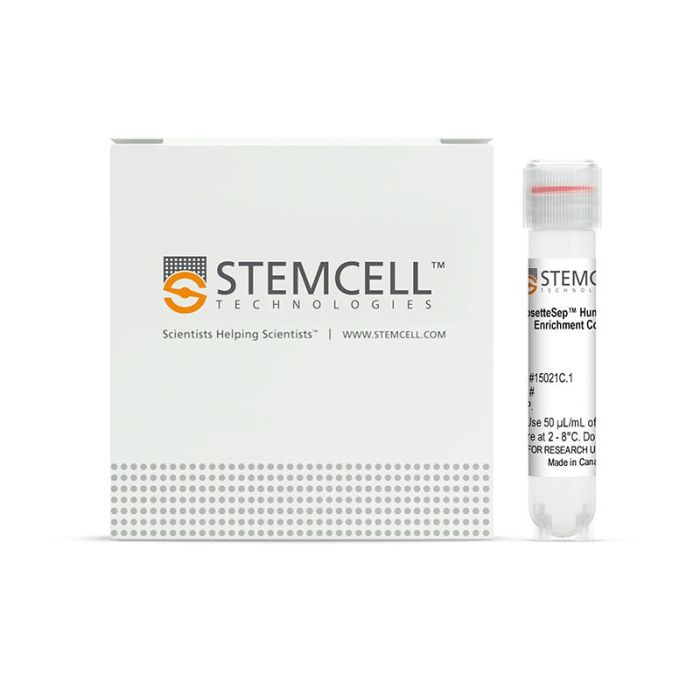
RosetteSep™人T细胞富集抗体混合物

免疫密度负选试剂混合物
只有 %1
¥2,310.00

产品号 #(选择产品)

产品号 #15021_C

通过免疫密度分离法分选未被标记的T细胞

产品优势

  • 快捷、操作简单     
  • 不需要特殊设备或额外培训
  • 分选得到的细胞不带标记
  • 可与SepMate™联合使用,实现一致的高通量样本处理

产品组分包括

  • RosetteSep™人KT细胞富集抗体混合物(产品号 #15021     )
    • RosetteSep™人T细胞富集抗体混合物,2mL
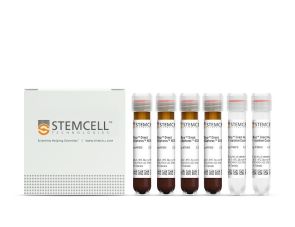
  • RosetteSep™人T细胞富集抗体混合物(产品号 #15025)
    • RosetteSep™人T细胞富集抗体混合物,5x2mL
专为您的实验方案打造的产品
要查看实验方案所需的所有配套产品,请参阅《实验方案与技术文档》

总览

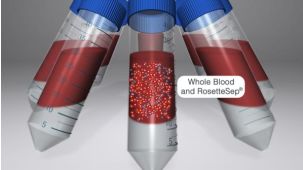
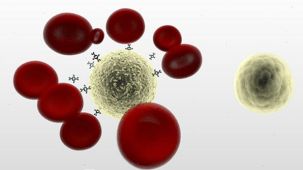
RosetteSep™人T细胞富集抗体混合物通过负选从全血分离T细胞。四聚体抗体复合物可识别非T细胞和红细胞(RBC)表面的糖蛋白A,从而靶向去除非目的细胞。使用     密度梯度离心液(如RosetteSep™ DM-L(产品号 #15705)或Lymphoprep™(产品号 #18060)离心后,非目的细胞会与红细胞一起沉淀。纯化的T细胞为血浆和密度梯度离心液的交界界面中高度富集的细胞。

分类
细胞分选试剂盒
 
细胞类型
T 细胞
 
种属

 
样本来源
白膜层、全血
 
分选方法
负选
 
应用
细胞分选
 
品牌
RosetteSep
 
研究领域
免疫
 

实验数据

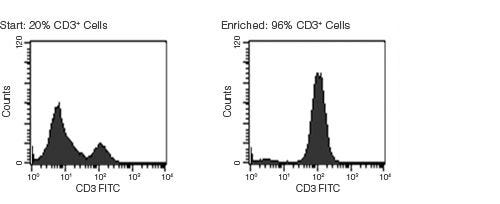
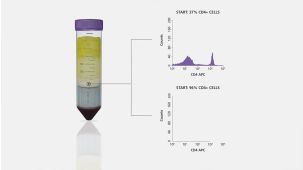
Typical RosetteSep™ HLA T Cell Enrichment Profile

Figure 1. Typical RosetteSep™ T Cell Enrichment Profile

Starting with fresh whole blood the CD3+ cell content of the enriched fraction typically ranges from 90% - 97%. Red blood cells were removed by lysis prior to flow cytometry.

产品说明书及文档

请在《产品说明书》中查找相关支持信息和使用说明,或浏览下方更多实验方案。

Document Type
Product Name
Catalog #
Lot #
Language
Document Type
产品说明书
Catalog #
15021
Lot #
All
Language
中文
Document Type
产品说明书
Catalog #
15061
Lot #
All
Language
中文
Catalog #
15021, 15061
Lot #
All
Language
English
Document Type
Safety Data Sheet
Catalog #
15021, 15061
Lot #
All
Language
English

应用领域

本产品专为以下研究领域设计,适用于工作流程中的高亮阶段。探索这些工作流程,了解更多我们为各研究领域提供的其他配套产品。

相关材料与文献

技术资料 (9)

常见问题 (9)

What is RosetteSep™?

RosetteSep™ is a rapid cell separation procedure for the isolation of purified cells directly from whole blood, without columns or magnets.

How does RosetteSep™ work?

The antibody cocktail crosslinks unwanted cells to red blood cells (RBCs), forming rosettes. The unwanted cells then pellet with the free RBCs when centrifuged over a density centrifugation medium (e.g. Ficoll-Paque™ PLUS, Lymphoprep™).

What factors affect cell recovery?

The temperature of the reagents can affect cell recovery. All reagents should be at room temperature (sample, density centrifugation medium, PBS, centrifuge) before performing the isolations. Layering can also affect recovery so be sure to carefully layer the sample to avoid mixing with the density centrifugation medium as much as possible. Be sure to collect the entire enriched culture without disturbing the RBC pellet. A small amount of density centrifugation medium can be collected without worry.

Which cell samples can RosetteSep™ be used with?

RosetteSep™ can be used with leukapheresis samples, bone marrow or buffy coat, as long as: the concentration of cells does not exceed 5 x 10⁷ per mL (can dilute if necessary); and there are at least 100 RBCs for every nucleated cell (RBCs can be added if necessary).

Can RosetteSep™ be used with previously frozen or cultured cells?

Yes. Cells should be re-suspended at 2 - 5 x 10⁷ cells / mL in PBS + 2% FBS. Fresh whole blood should be added at 250 µL per mL of sample, as a source of red cells.

Can RosetteSep™ be used to enrich progenitors from cord blood?

Yes. Sometimes cord blood contains immature nucleated red cells that have a lower density than mature RBCs. These immature red cells do not pellet over Ficoll™, which can lead to a higher RBC contamination than peripheral blood separations.

Does RosetteSep™ work with mouse cells?

No, but we have developed EasySep™, a magnetic-based cell isolation system which works with mouse and other non-human species.

Which anticoagulant should be used with RosetteSep™?

Peripheral blood should be collected in heparinized Vacutainers. Cord blood should be collected in ACD.

Should the anticoagulant be washed off before using RosetteSep™?

No, the antibody cocktail can be added directly to the sample.

文献 (61)

Toll-like receptor 2 ligands as adjuvants for human Th1 responses. Sieling PA et al. Journal of immunology (Baltimore,Md. : 1950) 2003 JAN

Abstract

Bacterial lipopeptides (bLPs) are increasingly used as adjuvants to activate cell-mediated immune responses to foreign Ags. To explore mechanisms whereby bLPs adjuvant T cell responses,we stimulated human PBMCs with bLPs. We found that bLPs stimulate T cells to proliferate and produce IFN-gamma in an accessory cell-dependent manner and in the absence of exogenous protein Ags. The ability of bLPs to stimulate T cell proliferation was Toll-like receptor 2 dependent and required IL-12,interaction with costimulatory molecules,and MHC proteins. Our data suggest that bLPs adjuvant adaptive Th1 responses by enhancing Ag presentation of endogenous peptides.
A novel fluorescent toxin to detect and investigate Kv1.3 channel up-regulation in chronically activated T lymphocytes. Beeton C et al. The Journal of biological chemistry 2003 MAR

Abstract

T lymphocytes with unusually high expression of the voltage-gated Kv1.3 channel (Kv1.3(high) cells) have been implicated in the pathogenesis of experimental autoimmune encephalomyelitis,an animal model for multiple sclerosis. We have developed a fluoresceinated analog of ShK (ShK-F6CA),the most potent known inhibitor of Kv1.3,for detection of Kv1.3(high) cells by flow cytometry. ShK-F6CA blocked Kv1.3 at picomolar concentrations with a Hill coefficient of 1 and exhibited textgreater80-fold specificity for Kv1.3 over Kv1.1 and other K(V) channels. In flow cytometry experiments,ShK-F6CA specifically stained Kv1.3-expressing cells with a detection limit of approximately 600 channels per cell. Rat and human T cells that had been repeatedly stimulated 7-10 times with antigen were readily distinguished on the basis of their high levels of Kv1.3 channels (textgreater600 channels/cell) and ShK-F6CA staining from resting T cells or cells that had undergone 1-3 rounds of activation. Functional Kv1.3 expression levels increased substantially in a myelin-specific rat T cell line following myelin antigen stimulation,peaking at 15-20 h and then declining to baseline over the next 7 days,in parallel with the acquisition and loss of encephalitogenicity. Both calcium- and protein kinase C-dependent pathways were required for the antigen-induced Kv1.3 up-regulation. ShK-F6CA might be useful for rapid and quantitative detection of Kv1.3(high) expressing cells in normal and diseased tissues,and to visualize the distribution of functional channels in intact cells.
Discrimination of polycythemias and thrombocytoses by novel, simple, accurate clonality assays and comparison with PRV-1 expression and BFU-E response to erythropoietin. Liu E et al. Blood 2003 APR

Abstract

Essential thrombocythemia (ET) and polycythemia vera (PV) are clonal myeloproliferative disorders that are often difficult to distinguish from other causes of elevated blood cell counts. Assays that could reliably detect clonal hematopoiesis would therefore be extremely valuable for diagnosis. We previously reported 3 X-chromosome transcription-based clonality assays (TCAs) involving the G6PD,IDS,and MPP1 genes,which together were informative in about 65% of female subjects. To increase our ability to detect clonality,we developed simple TCA for detecting the transcripts of 2 additional X-chromosome genes: Bruton tyrosine kinase (BTK) and 4-and-a-half LIM domain 1 (FHL1). The combination of TCA established the presence or absence of clonal hematopoiesis in about 90% of female subjects. We show that both genes are subject to X-chromosome inactivation and are polymorphic in all major US ethnic groups. The 5 TCAs were used to examine clonality in 46 female patients along with assays for erythropoietin-independent erythroid colonies (EECs) and granulocyte PRV-1 mRNA levels to discriminate polycythemias and thrombocytoses. Of these,all 19 patients with familial polycythemia or thrombocytosis had polyclonal hematopoiesis,whereas 22 of 26 patients with clinical evidence of myeloproliferative disorder and 1 patient with clinically obscure polycythemia were clonal. Interestingly,interferon alpha therapy in 2 patients with PV was associated with reversion of clonal to polyclonal hematopoiesis. EECs were observed in 14 of 14 patients with PV and 4 of 12 with ET,and increased granulocyte PRV-1 mRNA levels were found in 9 of 13 patients with PV and 2 of 12 with ET. Thus,these novel clonality assays are useful in the diagnosis and follow-up of polycythemic conditions and disorders with increased platelet levels.

更多信息

更多信息
物种
样本来源 全血, 白膜层
Selection Method Negative
质量保证:

产品仅供研究使用,不用于针对人或动物的诊断或治疗。 欲获悉更多关于STEMCELL的质控信息,请访问 STEMCELL.CN/COMPLIANCE.
Copyright © 2026 by STEMCELL Technologies. All rights reserved.

在线联系