New look, same high quality and support! You may notice that your instrument or reagent packaging looks slightly different from images displayed on the website, or from previous orders. We are updating our look but rest assured, the products themselves and how you should use them have not changed. Learn more
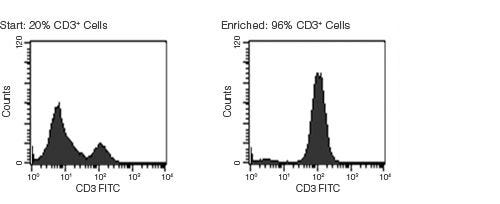
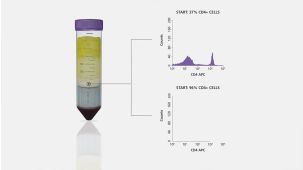
Figure 1. Typical RosetteSep™ T Cell Enrichment Profile
Starting with fresh whole blood the CD3+ cell content of the enriched fraction typically ranges from 90% - 97%. Red blood cells were removed by lysis prior to flow cytometry.
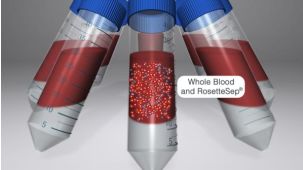
RosetteSep™ is a rapid cell separation procedure for the isolation of purified cells directly from whole blood, without columns or magnets.
How does RosetteSep™ work?
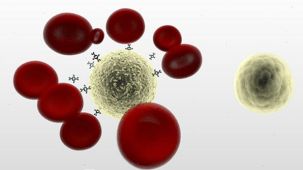
The antibody cocktail crosslinks unwanted cells to red blood cells (RBCs), forming rosettes. The unwanted cells then pellet with the free RBCs when centrifuged over a density centrifugation medium (e.g. Ficoll-Paque™ PLUS, Lymphoprep™).
What factors affect cell recovery?
The temperature of the reagents can affect cell recovery. All reagents should be at room temperature (sample, density centrifugation medium, PBS, centrifuge) before performing the isolations. Layering can also affect recovery so be sure to carefully layer the sample to avoid mixing with the density centrifugation medium as much as possible. Be sure to collect the entire enriched culture without disturbing the RBC pellet. A small amount of density centrifugation medium can be collected without worry.
Which cell samples can RosetteSep™ be used with?
RosetteSep™ can be used with leukapheresis samples, bone marrow or buffy coat, as long as: the concentration of cells does not exceed 5 x 10⁷ per mL (can dilute if necessary); and there are at least 100 RBCs for every nucleated cell (RBCs can be added if necessary).
Can RosetteSep™ be used with previously frozen or cultured cells?
Yes. Cells should be re-suspended at 2 - 5 x 10⁷ cells / mL in PBS + 2% FBS. Fresh whole blood should be added at 250 µL per mL of sample, as a source of red cells.
Can RosetteSep™ be used to enrich progenitors from cord blood?
Yes. Sometimes cord blood contains immature nucleated red cells that have a lower density than mature RBCs. These immature red cells do not pellet over Ficoll™, which can lead to a higher RBC contamination than peripheral blood separations.
Does RosetteSep™ work with mouse cells?
No, but we have developed EasySep™, a magnetic-based cell isolation system which works with mouse and other non-human species.
Which anticoagulant should be used with RosetteSep™?
Peripheral blood should be collected in heparinized Vacutainers. Cord blood should be collected in ACD.
Should the anticoagulant be washed off before using RosetteSep™?
No, the antibody cocktail can be added directly to the sample.
A deep single cell mass cytometry approach to capture canonical and noncanonical cell cycle states
M. Amouzgar et al.
Nature Communications 2025 Oct
Abstract
The cell cycle (CC) underpins diverse cell processes like cell differentiation, cell expansion, and tumorigenesis but current single-cell (sc) strategies study CC as: coarse phases, rely on transcriptomic signatures, use imaging modalities limited to adherent cells, or lack high-throughput multiplexing. To solve this, we develop an expanded, Mass Cytometry (MC) approach with 48 CC-related molecules that deeply phenotypes the diversity of scCC states. Using Cytometry by Time of Flight, we quantify scCC states across suspension and adherent cell lines, and stimulated primary human T cells. Our approach captures the diversity of scCC states, including atypical CC states beyond canonical definitions. Pharmacologically-induced CC arrest reveals that perturbations exacerbate noncanonical states and induce previously unobserved states. Notably, primary cells escaping CC inhibition demonstrated aberrant CC states compared to untreated cells. Our approach enables deeper phenotyping of CC biology that generalizes to diverse cell systems with simultaneous multiplexing and integration with MC platforms. Subject terms: Assay systems, Proteomics, Cell biology, Immunology, Systems biology
Retinol Binding Protein 4 reactivates latent HIV-1 by triggering canonical NF-κB, JAK/STAT5 and JNK signalling
C. Pastorio et al.
Signal Transduction and Targeted Therapy 2025 Oct
Abstract
Reactivation of the latent viral reservoirs is crucial for a cure of HIV/AIDS. However, current latency reversing agents are inefficient, and the endogenous factors that have the potential to reactivate HIV in vivo remain poorly understood. To identify natural activators of latent HIV-1, we screened a comprehensive peptide/protein library derived from human hemofiltrate, representing the entire blood peptidome, using J-Lat cell lines harboring transcriptionally silent HIV-1 GFP reporter viruses. Fractions potently reactivating HIV-1 from latency contained human Retinol Binding Protein 4 (RBP4), the carrier of retinol (Vitamin A). We found that retinol-bound holo-RBP4 but not retinol-free apo-RBP4 strongly reactivates HIV-1 in a variety of latently infected T cell lines. Functional analyses indicate that this reactivation involves activation of the canonical NF-κB pathway and is strengthened by JAK/STAT5 and JNK signalling but does not require retinoic acid production. High levels of RBP4 were detected in plasma from both healthy individuals and people living with HIV-1. Physiological concentrations of RBP4 induced significant viral reactivation in latently infected cells from individuals on long-term antiretroviral therapy with undetectable viral loads. As a potent natural HIV-1 latency-reversing agent, RBP4 offers a novel approach to activating the latent reservoirs and bringing us closer to a cure. Subject terms: Preclinical research, Infectious diseases
A hexamerization-enhanced, Fc-silenced agonistic CD27 antibody amplifies T-cell effector functions as single agent and in combination with PD-1 blockade
I. Altıntaş et al.
Scientific Reports 2025 Jul
Abstract
HexaBody-CD27 (GEN1053/BNT313) is an investigational novel agonistic CD27 antibody engineered to enhance T-cell costimulation and promote antitumor immunity. Through the introduction of a hexamerization-enhancing mutation in the IgG Fc domain, HexaBody-CD27 was designed to drive clustering and activation of CD27 via intermolecular Fc:Fc interactions between membrane-bound antibodies, independent of crosslinking by FcγR-bearing cells. HexaBody-CD27 carries an Fc-silencing mutation to prevent T-cell depletion through Fc-mediated effector functions. In vitro, HexaBody-CD27 induced CD27 receptor signaling independent of FcγR-mediated crosslinking in a reporter assay. It also enhanced T-cell proliferation, cytotoxic activity and proinflammatory cytokine secretion in primary human lymphocytes. In contrast to benchmark IgG1 CD27 antibodies, HexaBody-CD27 did not induce phagocytosis of T cells in vitro. HexaBody-CD27 promoted ex vivo tumor infiltrating lymphocyte (TIL) expansion in non-small cell lung cancer (NSCLC) specimens, in particular of CD8 + TILs. The combination of HexaBody-CD27 with an anti-PD-1 antibody enhanced T-cell proliferation, cytokine secretion, and cytotoxic activity in vitro compared to either compound alone. In conclusion, HexaBody-CD27 enhanced T-cell activation and effector functions in an FcγR-crosslinking-independent manner, without inducing T-cell depletion. The immune agonist activity of HexaBody-CD27 was potentiated in combination with PD-1 blockade.
Thank you for your interest in IntestiCult™ Organoid Growth Medium (Human). Please provide us with your contact information and your local representative will contact you with a customized quote. Where appropriate, they
can also assist you with a(n):
Estimated delivery time for your area
Product sample or exclusive offer
In-lab demonstration
By submitting this form, you are providing your consent to STEMCELL Technologies Canada Inc. and its subsidiaries and affiliates (“STEMCELL”) to collect and use your information, and send you newsletters and emails in accordance with our
privacy policy. Please contact us with any questions that you may have. You can unsubscribe or change your email preferences at any time.