若您需要咨询产品或有任何技术问题,请通过官方电话 400 885 9050 或邮箱 info.cn@stemcell.com 与我们联系。

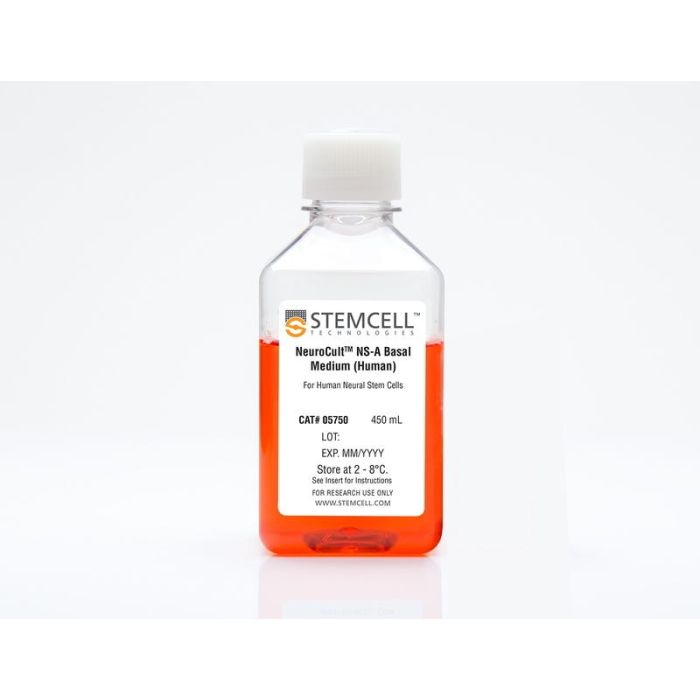
NeuroCult™ NS-A 基础培养基(人)

培养人神经干细胞和祖细胞的基础培养基
只有 %1
¥1,556.00

产品号 #(选择产品)

产品号 #05750_C

培养人神经干细胞和祖细胞的基础培养基

专为您的实验方案打造的产品
要查看实验方案所需的所有配套产品,请参阅《实验方案与技术文档》

总览

NeuroCult™NS-A基础培养基(人)是一种标准化的基础培养基,用于在神经球或贴壁单层培养系统中扩增人神经干细胞和脑肿瘤干细胞。本基础培养基是NeuroCult™NS-A扩增试剂盒(人;产品号 #05751)和NeuroCult™NS-A分化试剂盒(人;产品号 # 05752)得组成成分。

分类
基础培养基,专用培养基
 
细胞类型
脑肿瘤干细胞,神经干/祖细胞
 
种属

 
应用
细胞培养,克隆筛选,分化,扩增,功能学筛选,球状体培养
 
品牌
NeuroCult
 
研究领域
癌症,药物发现和毒理检测,神经科学,干细胞生物学
 
制剂类别
无血清
 

产品说明书及文档

请在《产品说明书》中查找相关支持信息和使用说明,或浏览下方更多实验方案。

Document Type
Product Name
Catalog #
Lot #
Language
Catalog #
05750
Lot #
All
Language
English

应用领域

本产品专为以下研究领域设计,适用于工作流程中的高亮阶段。探索这些工作流程,了解更多我们为各研究领域提供的其他配套产品。

相关材料与文献

技术资料 (9)

文献 (100)

Gamma-Secretase Represents a Therapeutic Target for the Treatment of Invasive Glioma Mediated by the p75 Neurotrophin Receptor Wang L et al. PLoS Biology 2008 NOV

Abstract

The multifunctional signaling protein p75 neurotrophin receptor (p75(NTR)) is a central regulator and major contributor to the highly invasive nature of malignant gliomas. Here,we show that neurotrophin-dependent regulated intramembrane proteolysis (RIP) of p75(NTR) is required for p75(NTR)-mediated glioma invasion,and identify a previously unnamed process for targeted glioma therapy. Expression of cleavage-resistant chimeras of p75(NTR) or treatment of animals bearing p75(NTR)-positive intracranial tumors with clinically applicable gamma-secretase inhibitors resulted in dramatically decreased glioma invasion and prolonged survival. Importantly,proteolytic processing of p75(NTR) was observed in p75(NTR)-positive patient tumor specimens and brain tumor initiating cells. This work highlights the importance of p75(NTR) as a therapeutic target,suggesting that gamma-secretase inhibitors may have direct clinical application for the treatment of malignant glioma.
Tumor heterogeneity is an active process maintained by a mutant EGFR-induced cytokine circuit in glioblastoma. Inda M-d-M et al. Genes & development 2010 AUG

Abstract

Human solid tumors frequently have pronounced heterogeneity of both neoplastic and normal cells on the histological,genetic,and gene expression levels. While current efforts are focused on understanding heterotypic interactions between tumor cells and surrounding normal cells,much less is known about the interactions between and among heterogeneous tumor cells within a neoplasm. In glioblastoma multiforme (GBM),epidermal growth factor receptor gene (EGFR) amplification and mutation (EGFRvIII/DeltaEGFR) are signature pathogenetic events that are invariably expressed in a heterogeneous manner. Strikingly,despite its greater biological activity than wild-type EGFR (wtEGFR),individual GBM tumors expressing both amplified receptors typically express wtEGFR in far greater abundance than the DeltaEGFR lesion. We hypothesized that the minor DeltaEGFR-expressing subpopulation enhances tumorigenicity of the entire tumor cell population,and thereby maintains heterogeneity of expression of the two receptor forms in different cells. Using mixtures of glioma cells as well as immortalized murine astrocytes,we demonstrate that a paracrine mechanism driven by DeltaEGFR is the primary means for recruiting wtEGFR-expressing cells into accelerated proliferation in vivo. We determined that human glioma tissues,glioma cell lines,glioma stem cells,and immortalized mouse Ink4a/Arf(-/-) astrocytes that express DeltaEGFR each also express IL-6 and/or leukemia inhibitory factor (LIF) cytokines. These cytokines activate gp130,which in turn activates wtEGFR in neighboring cells,leading to enhanced rates of tumor growth. Ablating IL-6,LIF,or gp130 uncouples this cellular cross-talk,and potently attenuates tumor growth enhancement. These findings support the view that a minor tumor cell population can potently drive accelerated growth of the entire tumor mass,and thereby actively maintain tumor cell heterogeneity within a tumor mass. Such interactions between genetically dissimilar cancer cells could provide novel points of therapeutic intervention.
Endothelial cells create a stem cell niche in glioblastoma by providing NOTCH ligands that nurture self-renewal of cancer stem-like cells. Zhu TS et al. Cancer research 2011 SEP

Abstract

One important function of endothelial cells in glioblastoma multiforme (GBM) is to create a niche that helps promote self-renewal of cancer stem-like cells (CSLC). However,the underlying molecular mechanism for this endothelial function is not known. Since activation of NOTCH signaling has been found to be required for propagation of GBM CSLCs,we hypothesized that the GBM endothelium may provide the source of NOTCH ligands. Here,we report a corroboration of this concept with a demonstration that NOTCH ligands are expressed in endothelial cells adjacent to NESTIN and NOTCH receptor-positive cancer cells in primary GBMs. Coculturing human brain microvascular endothelial cells (hBMEC) or NOTCH ligand with GBM neurospheres promoted GBM cell growth and increased CSLC self-renewal. Notably,RNAi-mediated knockdown of NOTCH ligands in hBMECs abrogated their ability to induce CSLC self-renewal and GBM tumor growth,both in vitro and in vivo. Thus,our findings establish that NOTCH activation in GBM CSLCs is driven by juxtacrine signaling between tumor cells and their surrounding endothelial cells in the tumor microenvironment,suggesting that targeting both CSLCs and their niche may provide a novel strategy to deplete CSLCs and improve GBM treatment.

更多信息

更多信息
物种
配方 无血清
法律声明:

Sold under license from StemCells California, Inc. US Patent Nos. 5,750,376; 5,851,832; 5,980,885; 5,968,829; 5,981,165; 6,071,889; 6,093,531; 6,103,530; 6,165,783; 6,238,922. 质量保证:

产品仅供研究使用,不用于针对人或动物的诊断或治疗。 欲获悉更多关于STEMCELL的质控信息,请访问 STEMCELL.CN/COMPLIANCE.
Copyright © 2026 by STEMCELL Technologies. All rights reserved.

在线联系