若您需要咨询产品或有任何技术问题,请通过官方电话 400 885 9050 或邮箱 info.cn@stemcell.com 与我们联系。

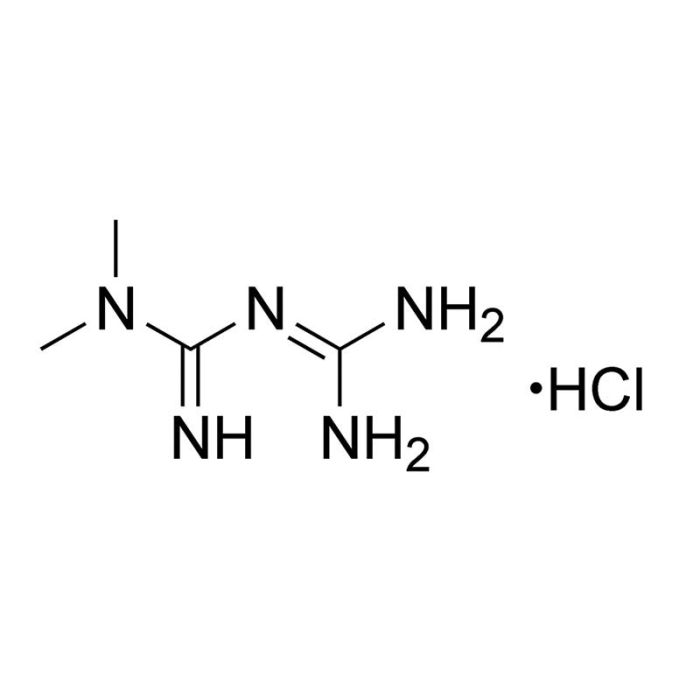
二甲双胍(Metformin)

AMPK 激活剂;线粒体呼吸链复合物 I 抑制剂
只有 %1
¥650.00

产品号 #(选择产品)

产品号 #73252_C

AMPK 激活剂;线粒体呼吸链复合物 I 抑制剂

总览

二甲双胍是AMP活化蛋白激酶(AMPK)通路的激活剂,也是线粒体呼吸链复合物1的抑制剂(Rena等人;Viollet等人)。它作为一种抗高血糖药,科降低血浆葡萄糖水平,改善胰岛素敏感性(Viollet等人)。本产品以分子盐酸盐的形式提供。

分化
·通过激活aPKC-CBP通路,在体外促进小鼠皮质前体和人前脑神经前体,以及在体内促进成年小鼠中枢神经系统的神经发生(Wang等人)。

代谢
·刺激骨骼肌的葡萄糖摄取并抑制肝脏的糖异生(Kim等人;Shaw等人)。
·改善肥胖(ob/ob)小鼠的脂肪肝疾病(非酒精性脂肪肝)(Lin 等)。
·抑制小鼠棕色脂肪细胞中脂肪细胞激素瘦素的分泌(Klein等人)。

癌症研究
·在多种癌细胞系和小鼠异种移植模型中抑制肿瘤细胞生长(Dowling等人;Zakikhani等人;Isakovic等人)。
·抑制与癌症干细胞生长相关的炎症反应(Hirsch等人)。

细胞类型
脂肪细胞,癌细胞及细胞系,肌源干/祖细胞,神经干/祖细胞
 
种属
人,小鼠,非人灵长类,其他物种,大鼠
 
应用
分化
 
研究领域
癌症,上皮细胞研究,免疫,代谢,神经科学
 
CAS 编号
1115-70-4
 
化学式
C₄H₁₁N₅ · HCl
 
纯度
≥98%
 
通路
AMPK,线粒体呼吸链复合体
 
靶点
AMPK
 

产品说明书及文档

请在《产品说明书》中查找相关支持信息和使用说明,或浏览下方更多实验方案。

Document Type
Product Name
Catalog #
Lot #
Language
Catalog #
73254, 73252
Lot #
For 73252 lot #1000004915 and higher | For 73254 lot #1000003239 and higher
Language
English
Document Type
Safety Data Sheet
Catalog #
73254, 73252
Lot #
All
Language
English

应用领域

本产品专为以下研究领域设计,适用于工作流程中的高亮阶段。探索这些工作流程,了解更多我们为各研究领域提供的其他配套产品。

相关材料与文献

技术资料 (3)

文献 (13)

Metformin reverses fatty liver disease in obese, leptin-deficient mice. Lin HZ et al. Nature medicine 2000

Abstract

There is no known treatment for fatty liver,a ubiquitous cause of chronic liver disease. However,because it is associated with hyperinsulinemia and insulin-resistance,insulin-sensitizing agents might be beneficial. To evaluate this possibility,insulin-resistant ob/ob mice with fatty livers were treated with metformin,an agent that improves hepatic insulin-resistance. Metformin improved fatty liver disease,reversing hepatomegaly,steatosis and aminotransferase abnormalities. The therapeutic mechanism likely involves inhibited hepatic expression of tumor necrosis factor (TNF) alpha and TNF-inducible factors that promote hepatic lipid accumulation and ATP depletion. These findings suggest a mechanism of action for metformin and identify novel therapeutic targets in insulin-resistant states.
Metformin inhibits leptin secretion via a mitogen-activated protein kinase signalling pathway in brown adipocytes. Klein J et al. The Journal of endocrinology 2004

Abstract

Metformin is an anti-diabetic drug with anorexigenic properties. The precise cellular mechanisms of its action are not entirely understood. Adipose tissue has recently been recognized as an important endocrine organ that is pivotal for the regulation of insulin resistance and energy homeostasis. Due to its thermogenic capacity brown adipose tissue contributes to the regulation of energy metabolism and is an attractive target tissue for pharmacological approaches to treating insulin resistance and obesity. Leptin is the prototypic adipocyte-derived hormone inducing a negative energy balance. We investigated effects of metformin on adipocyte metabolism,signalling,and leptin secretion in a brown adipocyte model. Metformin acutely stimulated p44/p42 mitogen-activated protein (MAP) kinase in a dose- (3.2-fold at 1 mmol/l,Ptextless 0.05) as well as time-dependent (3.8-fold at 5 min,Ptextless 0.05) manner. This stimulation was highly selective since phosphorylation of intermediates in the stress kinase,janus kinase (JAK)-signal transducer and activator of transcription (STAT),and phosphatidylinositol (PI) 3-kinase signalling pathways such as p38 MAP kinase,STAT3,and Akt was unaltered. Furthermore,chronic metformin treatment for 12 days dose-dependently inhibited leptin secretion by 35% and 75% at 500 mumol/l and 1 mmol/l metformin respectively (Ptextless 0.01). This reduction was not caused by alterations in adipocyte differentiation. Moreover,the impairment in leptin secretion by metformin was reversible within 48 h after removal of the drug. Pharmacological inhibition of p44/p42 MAP kinase prevented the metformin-induced negative effect on leptin secretion. Taken together,our data demonstrate direct acute effects of metformin on adipocyte signalling and endocrine function with robust inhibition of leptin secretion. They suggest a selective molecular mechanism that may contribute to the anorexigenic effect of this antidiabetic compound.
The kinase LKB1 mediates glucose homeostasis in liver and therapeutic effects of metformin. Shaw RJ et al. Science (New York,N.Y.) 2005 DEC

Abstract

The Peutz-Jegher syndrome tumor-suppressor gene encodes a protein-threonine kinase,LKB1,which phosphorylates and activates AMPK [adenosine monophosphate (AMP)-activated protein kinase]. The deletion of LKB1 in the liver of adult mice resulted in a nearly complete loss of AMPK activity. Loss of LKB1 function resulted in hyperglycemia with increased gluconeogenic and lipogenic gene expression. In LKB1-deficient livers,TORC2,a transcriptional coactivator of CREB (cAMP response element-binding protein),was dephosphorylated and entered the nucleus,driving the expression of peroxisome proliferator-activated receptor-gamma coactivator 1alpha (PGC-1alpha),which in turn drives gluconeogenesis. Adenoviral small hairpin RNA (shRNA) for TORC2 reduced PGC-1alpha expression and normalized blood glucose levels in mice with deleted liver LKB1,indicating that TORC2 is a critical target of LKB1/AMPK signals in the regulation of gluconeogenesis. Finally,we show that metformin,one of the most widely prescribed type 2 diabetes therapeutics,requires LKB1 in the liver to lower blood glucose levels.

更多信息

更多信息
物种 人, 其它物种, 大鼠, 小鼠, 非人灵长类
Cas Number 1115-70-4
Chemical Formula C₄H₁₁N₅ · HCl
纯度 ≥ 98%
Target AMPK
Pathway AMPK, Mitochondrial Respiratory Chain Complex
质量保证:

产品仅供研究使用,不用于针对人或动物的诊断或治疗。 欲获悉更多关于STEMCELL的质控信息,请访问 STEMCELL.CN/COMPLIANCE.
Copyright © 2026 by STEMCELL Technologies. All rights reserved.

在线联系