若您需要咨询产品或有任何技术问题,请通过官方电话 400 885 9050 或邮箱 info.cn@stemcell.com 与我们联系。

Fasudil

RHO/ROCK通路抑制剂;抑制ROCK2
只有 %1
¥1,276.00

产品号 #(选择产品)

产品号 #73662_C

RHO/ROCK通路抑制剂;抑制ROCK2

总览

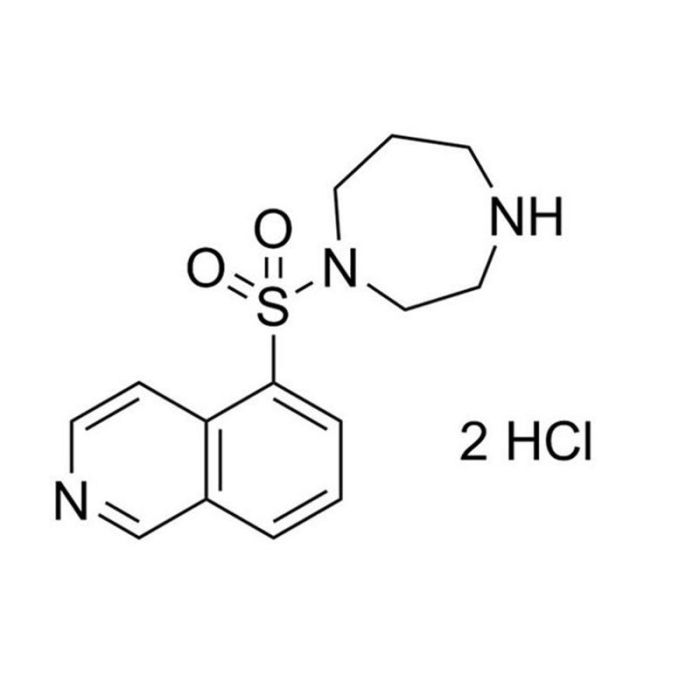
Fasudil(法舒地尔,又名HA-1077)是Rho相关卷曲螺旋蛋白激酶2(ROCK2;IC₅₀=1.9 µM)的强效抑制剂。此外,它还抑制蛋白激酶C相关激酶2(PRK2)、丝裂原活化和应激活化蛋白激酶(MSK1)以及丝裂原活化蛋白激酶活化的蛋白激酶1b(MAPKAP-K1b),其IC₅₀值分别为4µM、5µM和15µM(Davies et al.)。本产品以该分子的二盐酸盐形式供应。

分化
·抑制增殖和胶原蛋白的产生,同时也增加肝星状细胞的胶原酶活性(Fukushima et al.)。
·抑制内皮细胞在HUVEC中的迁移、活力和管形成(Yin et al.)。
·改善脂肪细胞分化,预防胰岛素抵抗糖尿病大鼠患糖尿病和肾病(Kikuchi et al.)。

疾病建模
·降低大鼠的肺动脉高压(Oka et al.)。
·增强脊髓创伤后的神经功能恢复(Hara et al.)。
·抑制小鼠碱烧伤后的角膜新生血管,促进角膜上皮缺损的愈合(Zeng et al.)。

细胞类型
脂肪细胞,内皮细胞,HUVEC细胞(人脐静脉内皮细胞),神经干/祖细胞
 
种属
人,小鼠,非人灵长类,其他物种,大鼠
 
应用
分化
 
研究领域
血管生成细胞研究,疾病建模
 
CAS 编号
203911-27-7
 
化学式
C₁₄H₁₇N₃O₂S · 2HCl
 
纯度
≥98%
 
通路
RHO/ROCK
 
靶点
ROCK2
 

产品说明书及文档

请在《产品说明书》中查找相关支持信息和使用说明,或浏览下方更多实验方案。

Document Type
Product Name
Catalog #
Lot #
Language
Catalog #
73662, 73664
Lot #
All
Language
English
Document Type
Safety Data Sheet
Catalog #
73662, 73664
Lot #
All
Language
English

相关材料与文献

文献 (7)

文献 (7)

Protein kinase inhibition by fasudil hydrochloride promotes neurological recovery after spinal cord injury in rats. Hara M et al. Journal of neurosurgery 2000 JUL

Abstract

OBJECT In Japan fasudil hydrochloride (HA1077),a protein kinase inhibitor,is widely administered to prevent vasospasm in patients after subarachnoid hemorrhage. The effects of fasudil on experimental spinal cord injury (SCI) were investigated and compared with those obtained using methylprednisolone. METHODS Spinal cord contusion was induced in rats by applying an aneurysm clip extradurally to the spinal cord at T-3 for 1 minute. After injury three groups of rats were treated with intravenously administered saline (control),intraperitoneally administered fasudil (10 mg/kg),or intravenously administered methylprednisolone (four 30 mg/kg injections). Neurological recovery was evaluated periodically over 1 month by using a modified combined behavioral scale and histopathological examination. Leukocyte infiltration near the injury site was evaluated by measuring myeloperoxidase (MPO) activity at 24 hours. Spinal cord blood flow was measured at intervals up to 3 hours after injury by using laser Doppler flowmetry. In rats in the fasudil-treated group significant improvement in modified combined behavioral score was demonstrated at each time point,whereas in the methylprednisolone-treated rats no beneficial effects were shown. In the fasudil-treated group,reduction of traumatic spinal cord damage was evident histologically in the caudal portion of the injured areas,and tissue MPO activity in tissue samples was reduced. Spinal cord blood flow was not significantly different between fasudil-treated and control group rats. CONCLUSIONS Fasudil hydrochloride showed promise of effectiveness in promoting neurological recovery after traumatic SCI. Possible mechanisms of this effect include protein kinase inhibition and decreased infiltration by neutrophils.
Specificity and mechanism of action of some commonly used protein kinase inhibitors. Davies SP et al. The Biochemical journal 2000 OCT

Abstract

The specificities of 28 commercially available compounds reported to be relatively selective inhibitors of particular serine/threonine-specific protein kinases have been examined against a large panel of protein kinases. The compounds KT 5720,Rottlerin and quercetin were found to inhibit many protein kinases,sometimes much more potently than their presumed targets,and conclusions drawn from their use in cell-based experiments are likely to be erroneous. Ro 318220 and related bisindoylmaleimides,as well as H89,HA1077 and Y 27632,were more selective inhibitors,but still inhibited two or more protein kinases with similar potency. LY 294002 was found to inhibit casein kinase-2 with similar potency to phosphoinositide (phosphatidylinositol) 3-kinase. The compounds with the most impressive selectivity profiles were KN62,PD 98059,U0126,PD 184352,rapamycin,wortmannin,SB 203580 and SB 202190. U0126 and PD 184352,like PD 98059,were found to block the mitogen-activated protein kinase (MAPK) cascade in cell-based assays by preventing the activation of MAPK kinase (MKK1),and not by inhibiting MKK1 activity directly. Apart from rapamycin and PD 184352,even the most selective inhibitors affected at least one additional protein kinase. Our results demonstrate that the specificities of protein kinase inhibitors cannot be assessed simply by studying their effect on kinases that are closely related in primary structure. We propose guidelines for the use of protein kinase inhibitors in cell-based assays.
Fasudil hydrochloride hydrate, a Rho-kinase (ROCK) inhibitor, suppresses collagen production and enhances collagenase activity in hepatic stellate cells. Fukushima M et al. Liver international : official journal of the International Association for the Study of the Liver 2005 AUG

Abstract

BACKGROUND/AIMS The Rho-ROCK signaling pathways play an important role in the activation of hepatic stellate cells (HSCs). We investigated the effects of fasudil hydrochloride hydrate (fasudil),a Rho-kinase (ROCK) inhibitor,on cell growth,collagen production,and collagenase activity in HSCs. METHODS Rat HSCs and human HSC-derived TWNT-4 cells were cultured for studies on stress fiber formation and alpha-smooth muscle actin (alpha-SMA) expression. Proliferation was measured by BrdU incorporation,and apoptosis by TUNEL assay. The phosphorylation states of the MAP kinases (MAPKs),extra cellular signal -regulated kinase 1/2 (ERK1/2),c-jun kinase (JNK),and p38 were evaluated by western blot analysis. Type I collagen,matrix metalloproteinase-1 (MMP-1) and tissue inhibitor of matrix metalloproteinase-1 (TIMP-1) production and gene expression were evaluated by ELISA and real-time PCR,respectively. Collagenase activity (active MMP-1) was also evaluated. RESULTS Fasudil (100 microM) inhibited cell spreading,the formation of stress fibers,and expression of alpha-SMA with concomitant suppression of cell growth,although it did not induce apoptosis. Fasudil inhibited phosphorylation of ERK1/2,JNK,and p38. Treatment with fasudil suppressed the production and transcription of collagen and TIMP,stimulated the production and transcription of MMP-1,and enhanced collagenase activity. CONCLUSION These findings demonstrated that fasudil not only suppresses proliferation and collagen production but also increases collagenase activity.

更多信息

更多信息
物种 人, 其它物种, 大鼠, 小鼠, 非人灵长类
Cas Number 203911-27-7
Chemical Formula C₁₄H₁₇N₃O₂S · 2HCl
纯度 ≥ 98%
Target ROCK2
Pathway RHO/ROCK
质量保证:

产品仅供研究使用,不用于针对人或动物的诊断或治疗。 欲获悉更多关于STEMCELL的质控信息,请访问 STEMCELL.CN/COMPLIANCE.
Copyright © 2026 by STEMCELL Technologies. All rights reserved.

在线联系