若您需要咨询产品或有任何技术问题,请通过官方电话 400 885 9050 或邮箱 info.cn@stemcell.com 与我们联系。

促红细胞生成素(EPO) ELISA试剂盒

人促红细胞生成素的免疫检测与测定
只有 %1
¥15,040.00

产品号 #(选择产品)

产品号 #01630_C

人促红细胞生成素的免疫检测与测定

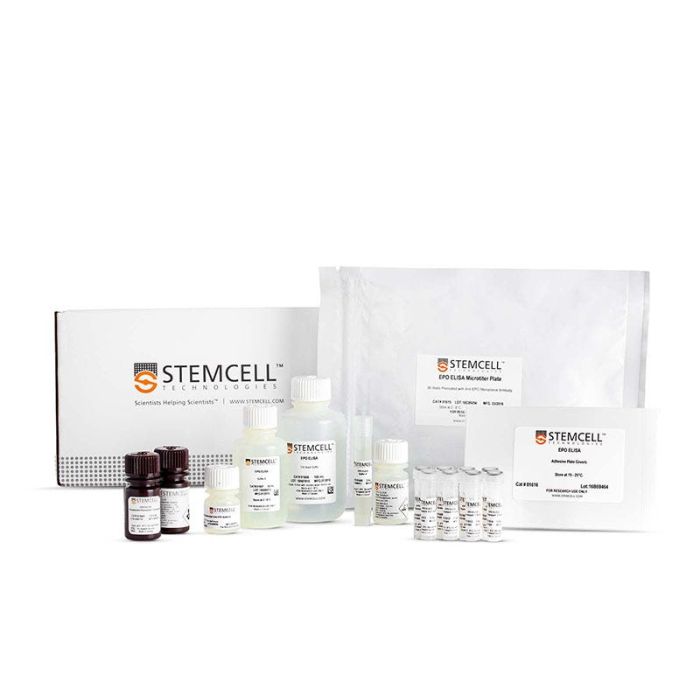
产品组分包括

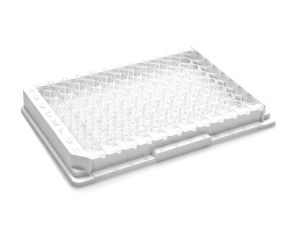
  • 预包被捕获抗体的96孔微孔板
    • (共12条,每条8个孔)
  • 检测缓冲液
  • 样品稀释剂
  • EPO标准品
    • 0 - 100 mU/mL,按重组DNA来源EPO国际标准(NIBSC代码87/684)校准
  • 标记的检测抗体
  • 辣根过氧化物酶偶联物
  • 四甲基联苯胺(TMB)底物溶液
  • 终止液
  • 10X洗涤缓冲液
  • 封板膜
  • 说明书

总览

糖蛋白EPO是红细胞生成的主要生理调节因子。EPO ELISA试剂盒是一种快速的三步酶联免疫吸附测定(ELISA)方法,用于定量测定天然和重组人EPO。该检测使用了两种针对人尿源性EPO的单克隆抗体。这些抗体结合EPO多肽上的两个不重叠的表位,对天然和重组EPO都表现出高亲和力结合。试剂盒的检测范围为1.6 ~ 100 mU/mL。EPO ELISA试剂盒的测定时间约为3小时。

分类
完整试剂盒
 
细胞类型
其他物种
 
种属

 
应用
ELISAs
 
CAS 编号
108-32-7,872-50-4,111-46-6,7664-93-9
 

产品说明书及文档

请在《产品说明书》中查找相关支持信息和使用说明,或浏览下方更多实验方案。

Document Type
Product Name
Catalog #
Lot #
Language
Catalog #
01630
Lot #
16E68690 or higher
Language
English
Document Type
Technical Manual
Catalog #
01630
Lot #
All
Language
English
Document Type
Safety Data Sheet 1
Catalog #
01630
Lot #
All
Language
English
Document Type
Safety Data Sheet 2
Catalog #
01630
Lot #
All
Language
English
Document Type
Safety Data Sheet 3
Catalog #
01630
Lot #
All
Language
English
Document Type
Safety Data Sheet 4
Catalog #
01630
Lot #
All
Language
English
Document Type
Safety Data Sheet 5
Catalog #
01630
Lot #
All
Language
English
Document Type
Safety Data Sheet 6
Catalog #
01630
Lot #
All
Language
English
Document Type
Safety Data Sheet 7
Catalog #
01630
Lot #
All
Language
English
Document Type
Safety Data Sheet 8
Catalog #
01630
Lot #
All
Language
English
Document Type
Safety Data Sheet 9
Catalog #
01630
Lot #
All
Language
English
Catalog #
01630
Lot #
All
Language
English
Catalog #
01630
Lot #
All
Language
English
Catalog #
01630
Lot #
All
Language
English
Catalog #
01630
Lot #
All
Language
English
Catalog #
01630
Lot #
All
Language
English
Catalog #
01630
Lot #
All
Language
English
Catalog #
01630
Lot #
All
Language
English

应用领域

本产品专为以下研究领域设计,适用于工作流程中的高亮阶段。探索这些工作流程,了解更多我们为各研究领域提供的其他配套产品。

相关材料与文献

技术资料 (4)

文献 (4)

The blood in systemic disorders. Spivak JL Lancet 2000 MAY

Abstract

* The high rate of proliferation required of the bone marrow renders it highly susceptible to the influence of external factors. * Anaemia is the most common haematological abnormality seen in systemic disorders. * In the anaemia of chronic disease,erythropoietin production is reduced and proliferation of erythroid progenitor cells is also impaired; this anaemia can generally be alleviated by correction of the underlying disease process. * The status of the endocrine system must always be considered in evaluation of a normocytic,normochromic anaemia. * Anaemia in infection can be due to host or parasite factors or to the treatment administered. * Anaemia due to malignant disease responds to erythropoietin therapy in many cases; failure to respond is a poor prognostic sign.
Immunochemical analysis of monoclonal antibodies to human erythropoietin. Wognum AW et al. Experimental hematology 1990 MAR

Abstract

We recently reported the development of three monoclonal antibodies (MoAbs) to biologically active human erythropoietin (Ep). In the present study,we investigated the epitope specificity of these three antibodies,as well as their reactivity with Eps derived from species other than man. All three antibodies reacted with the Ep polypeptide itself,rather than with its carbohydrate moieties. Moreover,all three antibodies recognized separate nonoverlapping epitopes. Further studies with reduced/alkylated Ep and with sodium dodecyl sulfate-denatured Ep suggested that two of the MoAbs,anti-Ep-2 and anti-Ep-16,were specific for conformational,nonlinear determinants on the Ep molecule,whereas the third MoAb,anti-Ep-26,appeared to recognize a linear epitope. However,anti-Ep-26 did not react with synthetic peptides representing the 26 amino-,the 99-129 mid-region,or the 10 carboxy-terminal residues of Ep,nor with trypsin-,chymotrypsin-,or V8 protease-digested fragments of Ep. When tested with Ep from different species,the neutralizing capabilities of the three MoAbs were clearly different. Comparing their effectiveness against baboon,ovine and murine Ep,antibody 2 was most effective at neutralizing baboon Ep,antibody 16 was most effective against murine Ep,and antibody 26 showed little reactivity with any of these nonhuman Eps. Because these various Eps readily stimulate across species barriers,it is likely that the receptor binding domain on Ep has remained relatively conserved during evolution. Our results therefore suggest that the neutralizing capacity of our three anti-Ep MoAbs is caused not by binding directly to the Ep receptor binding domain on Ep,but by binding to distant regions,causing conformational changes in Ep,or by binding to regions close to the binding site,steric hindrance.
Detection and isolation of the erythropoietin receptor using biotinylated erythropoietin. Wognum AW et al. Blood 1990 AUG

Abstract

Procedures have been developed to label human erythropoietin (Ep) with biotin to detect and isolate the Ep-receptor. The labeling method used the abundant carbohydrate groups on Ep and resulted in biologically active biotin-Ep (b-Ep) containing 8 to 10 biotins per Ep molecule. Specific binding of b-Ep to cells from spleens of mice made anemic by phenylhydrazine injections was demonstrated using 125I-labeled streptavidin. B-Ep,together with fluorescently tagged streptavidin,was found to specifically detect Ep-receptor-bearing cells by flow cytometry. This was demonstrated in several ways. First,approximately 90% of nucleated spleen cells from phenylhydrazine-treated mice were clearly fluorescent after staining with b-Ep and streptavidin-phycoerythrin,whereas only background fluorescence was detected using spleen cells from untreated mice. In addition,Ep-receptors were detected on 5% to 10% of normal mouse bone marrow cells,and these cells could be identified as erythroid in nature by separating the cells into subpopulations based on light-scatter properties. Third,Ep-receptor expression was found to correlate positively with expression of transferrin receptors,confirming the erythroid nature of these cells. B-Ep was also used to isolate Ep-receptors from monkey COS cells transfected with the murine Ep-receptor cDNA. In these experiments a cell-surface-bound protein of approximately 65 Kd and an intracellular protein of approximately 60 Kd were isolated from these cells. The procedures described in this report for detecting Ep-receptor expressing cells and for isolating the Ep-receptor should be valuable for purifying erythroid cells from heterogeneous cell populations,for elucidating the structure of the Ep-receptor,and for studying the biological activities of Ep at the cellular and molecular level.

更多信息

更多信息
物种
Cas Number 108-32-7, 872-50-4, 111-46-6, 7664-93-9
质量保证:

产品仅供研究使用,不用于针对人或动物的诊断或治疗。 欲获悉更多关于STEMCELL的质控信息,请访问 STEMCELL.CN/COMPLIANCE.
Copyright © 2026 by STEMCELL Technologies. All rights reserved.

在线联系