若您需要咨询产品或有任何技术问题,请通过官方电话 400 885 9050 或邮箱 info.cn@stemcell.com 与我们联系。

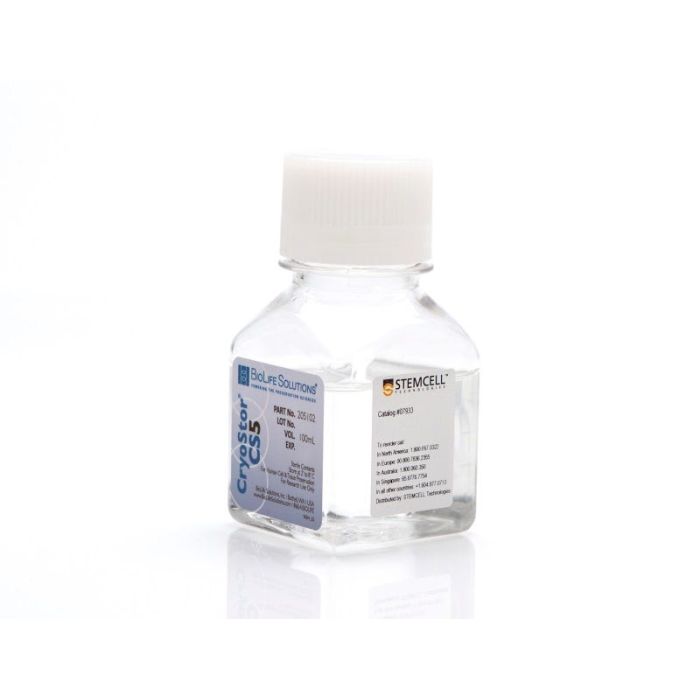
CryoStor®CS5

无动物成分,含有5% DMSO的冷冻保存培养基
只有 %1
¥3,502.00

产品号 #(选择产品)

产品号 #07933_C

无动物成分,含有5% DMSO的冷冻保存培养基

产品优势

  • 即用型
  • 无血清无蛋白质
  • 无动物成分
  • cGMP,采用USP级/最高质量组件制造
  • FDA主文件
  • 无菌无内毒素,基于细胞的质量控制测试

总览

使用即用型CryoStor®CS5,在低温(-80°C至-196°C)冷冻保存后,最大限度地提高解冻后细胞的回收率和活力。无血清,无动物成分,cGMP-制造,这种冻存培养基在冷冻和解冻过程以及储存中为细胞和组织提供安全的保护环境。可在CryoStor®CS5由USP级成分配制,含有5%的DMSO,根据用户需求有不同规格提供。

包含
• 5% 二甲基亚砜 (DMSO)
• 其他成分
 
细胞类型
CHO细胞,间充质干/祖细胞,其他物种,多能干细胞
 
种属
人,小鼠,非人灵长类,其他物种,大鼠
 
应用
冻存
 
品牌
CryoStor
 
研究领域
免疫,干细胞生物学
 
制剂类别
不含动物成分,无血清
 

产品说明书及文档

请在《产品说明书》中查找相关支持信息和使用说明,或浏览下方更多实验方案。

Document Type
Product Name
Catalog #
Lot #
Language
Product Name
CryoStor® CS5
Catalog #
07953, 07933, 07949
Lot #
All
Language
English
Document Type
Safety Data Sheet
Product Name
CryoStor® CS5
Catalog #
07953, 07933, 07949
Lot #
All
Language
English

相关材料与文献

技术资料 (10)

文献 (9)

Improved post-thaw recovery of peripheral blood stem/progenitor cells using a novel intracellular-like cryopreservation solution. Clarke DM et al. Cytotherapy 2009 JAN

Abstract

BACKGROUND AIMS Peripheral blood stem cells (PBSC) have become the preferred stem cell source for autologous hematopoietic transplantation. A critical aspect of this treatment modality is cryopreservation of the stem cell products,which permits temporal separation of the PBSC mobilization/collection phase from the subsequent high-dose therapy. While controlled rate-freezing and liquid nitrogen storage have become 'routine' practice in many cell-processing facilities,there is clearly room for improvement as current cryopreservation media formulations still result in significant loss and damage to the stem/progenitor cell populations essential for engraftment,and can also expose the patients to relatively undefined serum components and larger volumes of dimethylsulfoxide (DMSO) that can contribute to the morbidity and mortality of the transplant therapy. METHODS This study compared cryopreservation of PBSC in a novel intracellular-like,fully defined,serum- and protein-free preservation solution,CryoStor (BioLife Solutions Inc.),with a standard formulation used by the Fred Hutchinson Cancer Research Center (FHCRC). Briefly,human PBSC apheresis specimens were collected and 5 x 10(7) cells/1 mL sample vial were prepared for cryopreservation in the following solutions: (a) FHCRC standard,Normosol-R,5% human serum albumin (HAS) and 10% DMSO; and (b) CryoStor CS10 (final diluted concentration of 5% DMSO). A standard controlled-rate freezing program was employed,and frozen vials were stored in the vapor phase of a liquid nitrogen freezer for a minimum of 1 week. Vials were then thawed and evaluated for total nucleated cell count (TNC),viability,CD34 and granulocytes by flow cytometry,along with colony-forming activity in methylcellulose. RESULTS The PBSC samples frozen in CryoStor CS10 yielded significantly improved post-thaw recoveries for total viable CD34(+),colony-forming units (CFU) and granulocytes. Specifically,relative to the FHCRC standard formulation,cryopreservation with CS10 resulted in an average 1.8-fold increased recovery of viable CD34(+) cells (P=0.005),a 1.5-fold increase in CFU-granulocyte-macrophage (GM) numbers (P=0.030) and a 2.3-fold increase in granulocyte recovery (P=0.045). CONCLUSIONS This study indicates that use of CryoStor for cryopreservation can yield significantly improved recovery and in vitro functionality of stem/progenitor cells in PBSC products. In addition,it is important to note that these improved recoveries were obtained while not introducing any extra serum or serum-derived proteins,and reducing the final concentration/volume of DMSO by half. Further in vitro and in vivo studies are clearly necessary; however,these findings imply use of CryoStor for cryopreservation could result in improved engraftment for those patients with a lower content of CD34(+) cells in their PBSC collections,along with reducing the requirement for additional apheresis collections and decreasing the risk of adverse infusion reactions associated with higher exposure to DMSO.
Cryopreservation of adenovirus-transfected dendritic cells (DCs) for clinical use. Gü et al. International immunopharmacology 2012 MAY

Abstract

In this study,we examined the effects of cryoprotectant,freezing and thawing,and adenovirus (Adv) transduction on the viability,transgene expression,phenotype,and function of human dendritic cells (DCs). DCs were differentiated from cultured peripheral blood (PB) monocytes following Elutra isolation using granulocyte-macrophage colony-stimulating factor (GM-CSF) and interleukin-4 (IL-4) for 6 days and then transduced using an Adv vector with an IL-12 transgene. Fresh,cryopreserved,and thawed transduced immature DCs were examined for their: 1) cellular concentration and viability; 2) antigenicity using an allogeneic mixed lymphocyte reaction (MLR); 3) phenotype (HLA-DR and CD11c) and activation (CD83); and 4) transgene expression based on IL-12 secretion. Stability studies revealed that transduced DCs could be held in cryoprotectant for as long as 75 min at 2-8°C prior to freezing with little effect on their viability and cellularity. Further,cryopreservation,storage,and thawing reduced the viability of the transduced DCs by an average of 7.7%; and had no significant impact on DC phenotype and activation. In summary,cryopreservation,storage,and thawing had no significant effect on DC viability,function,and transgene expression by Adv-transduced DCs.
Phenotypic and functional attributes of lentivirus-modified CD19-specific human CD8+ central memory T cells manufactured at clinical scale. Wang X et al. Journal of immunotherapy (Hagerstown,Md. : 1997) 2012

Abstract

A key determinant of the therapeutic potency of adoptive T-cell transfer is the extent to which infused cells can persist and expand in vivo. Ex vivo propagated virus-specific and chimeric antigen receptor (CAR)-redirected antitumor CD8 effector T cells derived from CD45RA(-) CD62L(+) central memory (TCM) precursors engraft long-term and reconstitute functional memory after adoptive transfer. Here,we describe a clinical scale,closed system,immunomagnetic selection method to isolate CD8(+) T(CM) from peripheral blood mononuclear cells (PBMC). This method uses the CliniMACS device to first deplete CD14(+),CD45RA(+),and CD4(+) cells from PBMC,and then to positively select CD62L(+) cells. The average purity and yield of CD8(+) CD45RA(-) CD62L TCM obtained in full-scale qualification runs were 70% and 0.4% (of input PBMC),respectively. These CD8(+) T(CM) are responsive to anti-CD3/CD28 bead stimulation,and can be efficiently transduced with CAR encoding lentiviral vectors,and undergo sustained expansion in interleukin (IL)-2/IL-15 over 3-6 weeks. The resulting CD8(+) T(CM)-derived effectors are polyclonal,retain expression of CD62L and CD28,exhibit CAR-redirected antitumor effector function,and are capable of huIL-15-dependent in vivo homeostatic engraftment after transfer to immunodeficient NOD/Scid IL-2RgCnull mice. Adoptive therapy using purified T(CM) cells is now the subject of a Food and Drug Administration-authorized clinical trial for the treatment of CD19(+) B-cell malignancies,and 3 clinical cell products expressing a CD19-specific CAR for IND 14645 have already been successfully generated from lymphoma patients using this manufacturing platform.

更多信息

更多信息
物种 人, 其它物种, 大鼠, 小鼠, 非人灵长类
Contains • 5% dimethyl sulfoxide (DMSO) • Other ingredients
配方 不含动物成分, 无血清
质量保证:

产品仅供研究使用,不用于针对人或动物的诊断或治疗。 欲获悉更多关于STEMCELL的质控信息,请访问 STEMCELL.CN/COMPLIANCE.
Copyright © 2026 by STEMCELL Technologies. All rights reserved.

在线联系