若您需要咨询产品或有任何技术问题,请通过官方电话 400 885 9050 或邮箱 info.cn@stemcell.com 与我们联系。

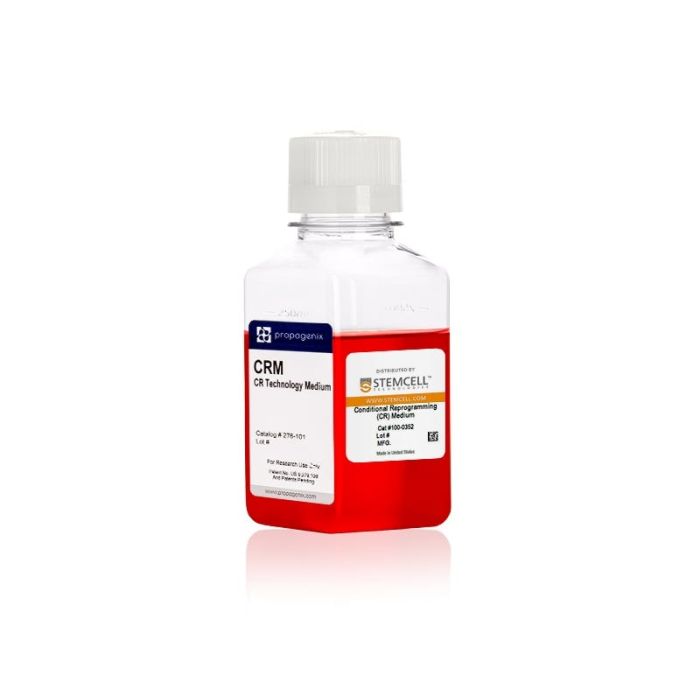
条件性重编程(CR)培养基

用于上皮细胞扩增的条件性重编程培养基
只有 %1
¥2,894.00

产品号 #(选择产品)

产品号 #100-0352_C

用于上皮细胞扩增的条件性重编程培养基

总览

条件性重编程(CR)培养基经过优化,可与3T3-J2辐照饲养细胞(产品号100-0353)配合使用,无需基因修饰即可扩增上皮细胞。研究表明,成熟上皮细胞在CR培养基作用下,可恢复组织特异性祖细胞表型,从而实现增殖(Liu X et al. 2012;Liu X et al. 2017)。这种条件性增殖能力在移除培养基后即会失活(Liu X et al. 2012;Liu X et al. 2017)。CR培养基适用于扩增健康或肿瘤组织(气道、视网膜、前列腺、乳腺、肠道、胰腺、肝胆管等)的原代上皮细胞(Liu X et al. 2012;Liu X et al. 2017;Suprynowicz FA et al. )。本产品不含抗生素,仅限研究使用。使用前需在CR培养基中添加霍乱毒素。了解更多信息,请阅读我们关于CR技术机制与应用的技术指南。

细胞类型
上皮细胞,乳腺细胞,前列腺细胞
 
种属

 
应用
细胞培养,分化,扩增
 
研究领域
上皮细胞研究,干细胞生物学
 

产品说明书及文档

请在《产品说明书》中查找相关支持信息和使用说明,或浏览下方更多实验方案。

Document Type
Product Name
Catalog #
Lot #
Language
Catalog #
100-0352
Lot #
All
Language
English
Document Type
Safety Data Sheet
Catalog #
100-0352
Lot #
All
Language
English

相关材料与文献

技术资料 (2)

文献 (8)

CRISPR-Cas9-mediated gene knockout in primary human airway epithelial cells reveals a proinflammatory role for MUC18 H. W. Chu et al. Gene Therapy 2015

Abstract

Targeted knockout of genes in primary human cells using CRISPR-Cas9-mediated genome-editing represents a powerful approach to study gene function and to discern molecular mechanisms underlying complex human diseases. We used lentiviral delivery of CRISPR-Cas9 machinery and conditional reprogramming culture methods to knockout the MUC18 gene in human primary nasal airway epithelial cells (AECs). Massively parallel sequencing technology was used to confirm that the genome of essentially all cells in the edited AEC populations contained coding region insertions and deletions (indels). Correspondingly,we found mRNA expression of MUC18 was greatly reduced and protein expression was absent. Characterization of MUC18 knockout cell populations stimulated with TLR2,3 and 4 agonists revealed that IL-8 (a proinflammatory chemokine) responses of AECs were greatly reduced in the absence of functional MUC18 protein. Our results show the feasibility of CRISPR-Cas9-mediated gene knockouts in AEC culture (both submerged and polarized),and suggest a proinflammatory role for MUC18 in airway epithelial response to bacterial and viral stimuli.
Pharmacological rescue of conditionally reprogrammed cystic fibrosis bronchial epithelial cells M. Gentzsch et al. American Journal of Respiratory Cell and Molecular Biology 2017

Abstract

Well-differentiated primary human bronchial epithelial (HBE) cell cultures are vital for cystic fibrosis (CF) research,particularly for the development of cystic fibrosis transmembrane conductance regulator (CFTR) modulator drugs. Culturing of epithelial cells with irradiated 3T3 fibroblast feeder cells plus the RhoA kinase inhibitor Y-27632 (Y),termed conditionally reprogrammed cell (CRC) technology,enhances cell growth and lifespan while preserving cell-of-origin functionality. We initially determined the electrophysiological and morphological characteristics of conventional versus CRC-expanded non-CF HBE cells. On the basis of these findings,we then created six CF cell CRC populations,three from sequentially obtained CF lungs and three from F508 del homozygous donors previously obtained and cryopreserved using conventional culture methods. Growth curves were plotted,and cells were subcultured,without irradiated feeders plus Y,into air-liquid interface conditions in nonproprietary and proprietary Ultroser G-containing media and were allowed to differentiate. Ussing chamber studies were performed after treatment of F508 del homozygous CF cells with the CFTR modulator VX-809. Bronchial epithelial cells grew exponentially in feeders plus Y,dramatically surpassing the numbers of conventionally grown cells. Passage 5 and 10 CRC HBE cells formed confluent mucociliary air-liquid interface cultures. There were differences in cell morphology and current magnitude as a function of extended passage,but the effect of VX-809 in increasing CFTR function was significant in CRC-expanded F508 del HBE cells. Thus,CRC technology expands the supply of functional primary CF HBE cells for testing CFTR modulators in Ussing chambers.
Conditionally reprogrammed normal and primary tumor prostate epithelial cells: A novel patient-derived cell model for studies of human prostate cancer O. A. Timofeeva et al. Oncotarget 2017

Abstract

Our previous study demonstrated that conditional reprogramming (CR) allows the establishment of patient-derived normal and tumor epithelial cell cultures from a variety of tissue types including breast,lung,colon and prostate. Using CR,we have established matched normal and tumor cultures,GUMC-29 and GUMC-30 respectively,from a patient's prostatectomy specimen. These CR cells proliferate indefinitely in vitro and retain stable karyotypes. Most importantly,only tumor-derived CR cells (GUMC-30) produced tumors in xenografted SCID mice,demonstrating maintenance of the critical tumor phenotype. Characterization of cells with DNA fingerprinting demonstrated identical patterns in normal and tumor CR cells as well as in xenografted tumors. By flow cytometry,both normal and tumor CR cells expressed basal,luminal,and stem cell markers,with the majority of the normal and tumor CR cells expressing prostate basal cell markers,CD44 and Trop2,as well as luminal marker,CD13,suggesting a transit-amplifying phenotype. Consistent with this phenotype,real time RT-PCR analyses demonstrated that CR cells predominantly expressed high levels of basal cell markers (KRT5,KRT14 and p63),and low levels of luminal markers. When the CR tumor cells were injected into SCID mice,the expression of luminal markers (AR,NKX3.1) increased significantly,while basal cell markers dramatically decreased. These data suggest that CR cells maintain high levels of proliferation and low levels of differentiation in the presence of feeder cells and ROCK inhibitor,but undergo differentiation once injected into SCID mice. Genomic analyses,including SNP and INDEL,identified genes mutated in tumor cells,including components of apoptosis,cell attachment,and hypoxia pathways. The use of matched patient-derived cells provides a unique in vitro model for studies of early prostate cancer.

更多信息

更多信息
物种
质量保证:

产品仅供研究使用,不用于针对人或动物的诊断或治疗。
Copyright © 2026 by STEMCELL Technologies. All rights reserved.

在线联系