Shetty DK et al. (MAR 2016)
Stem Cell Research 16 2 246--248
Generation of OCIAD1 inducible overexpression human embryonic stem cell line: BJNhem20-OCIAD1-Tet-On
Human embryonic stem cell line BJNhem20-OCIAD1-Tet-On was generated using non-viral method. The constructs pCAG-Tet-On and pTRE-Tight vector driving OCIAD1 expression were transfected using microporation procedure. pCAG-Tet-On cells can be used for inducible expression of any coding sequence cloned into pTRE-Tight vector. For example,in human embryonic stem cells,Tet-On system has been used to generate SOX2 overexpression cell line (Adachi et al.,2010).
View Publication
产品类型:
产品号#:
05850
05857
05870
05875
85850
85857
85870
85875
产品名:
mTeSR™1
mTeSR™1
Yang K et al. (JAN 2018)
Biosensors & bioelectronics 99 259--267
Mkit: A cell migration assay based on microfluidic device and smartphone.
Mobile sensing based on the integration of microfluidic device and smartphone,so-called MS2 technology,has enabled many applications over recent years,and continues to stimulate growing interest in both research communities and industries. In particular,it has been envisioned that MS2 technology can be developed for various cell functional assays to enable basic research and clinical applications. Toward this direction,in this paper,we describe the development of a MS2-based cell functional assay for testing cell migration (the Mkit). The system is constructed as an integrated test kit,which includes microfluidic chips,a smartphone-based imaging platform,the phone apps for image capturing and data analysis,and a set of reagent and accessories for performing the cell migration assay. We demonstrated that the Mkit can effectively measure purified neutrophil and cancer cell chemotaxis. Furthermore,neutrophil chemotaxis can be tested from a drop of whole blood using the Mkit with red blood cell (RBC) lysis. The effects of chemoattractant dose and gradient profile on neutrophil chemotaxis were also tested using the Mkit. In addition to research applications,we demonstrated the effective use of the Mkit for on-site test at the hospital and for testing clinical samples from chronic obstructive pulmonary disease patient. Thus,this developed Mkit provides an easy and integrated experimental platform for cell migration related research and potential medical diagnostic applications.
View Publication
产品类型:
产品号#:
19666
100-0404
产品名:
EasySep™ Direct人中性粒细胞分选试剂盒
RoboSep™ 人中性粒细胞分选试剂盒
Fortin JM et al. (MAR 2016)
Scientific Reports 2016 6 6 23579
Transplantation of Defined Populations of Differentiated Human Neural Stem Cell Progeny
Transplantation of Defined Populations of Differentiated Human Neural Stem Cell Progeny
View Publication
产品类型:
产品号#:
05750
05751
产品名:
NeuroCult™ NS-A 基础培养基(人)
NeuroCult™ NS-A 扩增试剂盒(人)
A. Chakraborty et al. (Aug 2025)
International Journal of Molecular Sciences 26 17
Cholesterol is an essential plasma membrane component,and altered cholesterol metabolism has been linked to cholesterol accumulation in the airways of COPD and cystic fibrosis patients. However,its role in airway epithelial differentiation is not well understood. Tandem mass spectrometry-based proteomic analysis of differentiating primary human bronchial epithelial cells (phBECs) revealed an overall inhibition of the cholesterol biosynthesis pathway. We hypothesized that excess cholesterol impairs the differentiation of phBECs into a fully functional bronchial epithelium. PhBECs were differentiated in the presence of 80 µM cholesterol for 21 days,the main airway cell type populations monitored using qRT-PCR and immunofluorescent stainings,and epithelial barrier integrity was analyzed via transepithelial electrical resistance measurements. Chronic cholesterol exposure led to a significant increase in CC10 + secretory cells at the expense of ciliated cells. Pathway enrichment analysis suggested the tumor protein p53 as a master regulator of genes during normal differentiation of phBECs. Chronic cholesterol exposure drastically impaired the nuclear translocation of p53. Our findings suggest that this inhibition underlies the cholesterol-induced expansion of CC10 + secretory cell populations at the expense of ciliated cells. In conclusion,we identify cholesterol as an important regulator of normal bronchial epithelial cell differentiation through inhibition of p53 nuclear translocation.
View Publication
产品类型:
产品号#:
05001
05021
05022
05040
产品名:
PneumaCult™-ALI 培养基
PneumaCult™-ALI 培养基含12 mm Transwell®插件
PneumaCult™-ALI 培养基含6.5 mm Transwell®插件
PneumaCult™-Ex Plus 培养基
A. G. Masoud et al. (jan 2020)
The Journal of clinical investigation 130 1 94--107
Apelin directs endothelial cell differentiation and vascular repair following immune-mediated injury.
Sustained,indolent immune injury of the vasculature of a heart transplant limits long-term graft and recipient survival. This injury is mitigated by a poorly characterized,maladaptive repair response. Vascular endothelial cells respond to proangiogenic cues in the embryo by differentiation to specialized phenotypes,associated with expression of apelin. In the adult,the role of developmental proangiogenic cues in repair of the established vasculature is largely unknown. We found that human and minor histocompatibility-mismatched donor mouse heart allografts with alloimmune-mediated vasculopathy upregulated expression of apelin in arteries and myocardial microvessels. In vivo,loss of donor heart expression of apelin facilitated graft immune cell infiltration,blunted vascular repair,and worsened occlusive vasculopathy in mice. In vitro,an apelin receptor agonist analog elicited endothelial nitric oxide synthase activation to promote endothelial monolayer wound repair and reduce immune cell adhesion. Thus,apelin acted as an autocrine growth cue to sustain vascular repair and mitigate the effects of immune injury. Treatment with an apelin receptor agonist after vasculopathy was established markedly reduced progression of arterial occlusion in mice. Together,these initial data identify proangiogenic apelin as a key mediator of coronary vascular repair and a pharmacotherapeutic target for immune-mediated injury of the coronary vasculature.
View Publication
产品类型:
产品号#:
06010
产品名:
IntestiCult™ 类器官生长培养基 (人)
(Jul 2024)
Nature Communications 15
Identification of unique cell type responses in pancreatic islets to stress
Diabetes involves the death or dysfunction of pancreatic ?-cells. Analysis of bulk sequencing from human samples and studies using in vitro and in vivo models suggest that endoplasmic reticulum and inflammatory signaling play an important role in diabetes progression. To better characterize cell type-specific stress response,we perform multiplexed single-cell RNA sequencing to define the transcriptional signature of primary human islet cells exposed to endoplasmic reticulum and inflammatory stress. Through comprehensive pair-wise analysis of stress responses across pancreatic endocrine and exocrine cell types,we define changes in gene expression for each cell type under different diabetes-associated stressors. We find that ?-,?-,and ductal cells have the greatest transcriptional response. We utilize stem cell-derived islets to study islet health through the candidate gene CIB1,which was upregulated under stress in primary human islets. Our findings provide insights into cell type-specific responses to diabetes-associated stress and establish a resource to identify targets for diabetes therapeutics. Endoplasmic reticulum and inflammatory stress are associated with diabetes. Maestas et al. use single-cell sequencing to profile primary human islets under stress and identified tissue and cell-type responses.
View Publication
产品类型:
产品号#:
85850
85857
产品名:
mTeSR™1
mTeSR™1
N. K. Lytle et al. ( 2019)
Cell 177 3 572--586.e22
A Multiscale Map of the Stem Cell State in Pancreatic Adenocarcinoma.
Drug resistance and relapse remain key challenges in pancreatic cancer. Here,we have used RNA sequencing (RNA-seq),chromatin immunoprecipitation (ChIP)-seq,and genome-wide CRISPR analysis to map the molecular dependencies of pancreatic cancer stem cells,highly therapy-resistant cells that preferentially drive tumorigenesis and progression. This integrated genomic approach revealed an unexpected utilization of immuno-regulatory signals by pancreatic cancer epithelial cells. In particular,the nuclear hormone receptor retinoic-acid-receptor-related orphan receptor gamma (ROR$\gamma$),known to drive inflammation and T cell differentiation,was upregulated during pancreatic cancer progression,and its genetic or pharmacologic inhibition led to a striking defect in pancreatic cancer growth and a marked improvement in survival. Further,a large-scale retrospective analysis in patients revealed that ROR$\gamma$ expression may predict pancreatic cancer aggressiveness,as it positively correlated with advanced disease and metastasis. Collectively,these data identify an orthogonal co-option of immuno-regulatory signals by pancreatic cancer stem cells,suggesting that autoimmune drugs should be evaluated as novel treatment strategies for pancreatic cancer patients.
View Publication


 EasySep™小鼠TIL(CD45)正选试剂盒





 抗小鼠CD4抗体,clone RM4-5
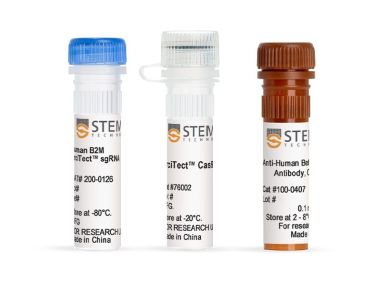 ArciTect™ 人 CRISPR 优化试剂盒 用于优化人细胞基因组编辑的完整试剂盒
 ImmunoCult™ 小鼠Treg分化添加物
 前列腺素E2(Prostaglandin E2) 前列腺素通路激活剂;激活前列腺素受体 EP1、EP2、EP3 和 EP4
 大豆胰蛋白酶抑制剂,ACF 用于抑制胰蛋白酶的活性
 沪公网安备31010102008431号