Biswas S et al. (OCT 2009)
Journal of immunology (Baltimore,Md. : 1950) 183 8 5050--8
Elevated levels of select gangliosides in T cells from renal cell carcinoma patients is associated with T cell dysfunction.
Increased expression of gangliosides by different tumor types including renal cell carcinoma (RCC) is thought to contribute to the immune suppression observed in cancer patients. In this study,we report an increase in apoptotic T cells from RCC patients compared with T cells from normal donors that coincided with the detection of T cells staining positive for GM2 and that the apoptosis was predominantly observed in the GM2(+) but not the GM2(-) T cell population. Ganglioside shedding from tumor rather than endogenous production accounts for GM2(+) T cells since there was no detectable level of mRNA for GM2 synthase in RCC patient T cells and in T cells from normal healthy donors after incubation with either purified GM2 or supernatant from RCC cell lines despite their staining positive for GM2. Moreover,reactive oxygen species as well as activated caspase 3,8,and 9 were predominantly elevated in GM2(+) but not GM2(-) T cells. Similarly,increased staining for GD2 and GD3 but not GD1a was detected with patient T cells with elevated levels of apoptosis in the GD2(+) and GD3(+) cells. These findings suggest that GM2,GD2,and GD3 play a significant role in immune dysfunction observed in RCC patient T cells.
View Publication
Domaica CI et al. (AUG 2009)
EMBO reports 10 8 908--15
Tumour-experienced T cells promote NK cell activity through trogocytosis of NKG2D and NKp46 ligands.
Natural killer (NK) cells trigger cytotoxicity and interferon (IFN)-gamma secretion on engagement of the natural-killer group (NKG)2D receptor or members of the natural cytotoxicity receptor (NCR) family,such as NKp46,by ligands expressed on tumour cells. However,it remains unknown whether T cells can regulate NK cell-mediated anti-tumour responses. Here,we investigated the early events occurring during T cell-tumour cell interactions,and their impact on NK cell functions. We observed that on co-culture with some melanomas,activated CD4(+) T cells promoted degranulation,and NKG2D- and NKp46-dependent IFN-gamma secretion by NK cells,probably owing to the capture of NKG2D and NKp46 ligands from the tumour-cell surface (trogocytosis). This effect was observed in CD4(+),CD8(+) and resting T cells,which showed substantial amounts of cell surface major histocompatibility complex class I chain-related protein A on co-culture with tumour cells. Our findings identify a new,so far,unrecognized mechanism by which effector T cells support NK cell function through the capture of specific tumour ligands with profound implications at the crossroad of innate and adaptive immunity.
View Publication


 EasySep™小鼠TIL(CD45)正选试剂盒




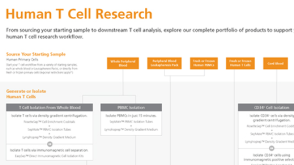 产品手册Human T Cell Research Product Workflow
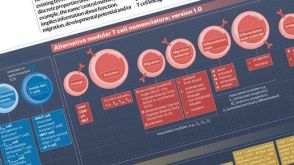 挂图T Cell Nomenclature: From Subsets to Modules A modular framework for classifying T cells by lineage, function, migration, differentiation, and antigen context.发布日期: 12/05/2025
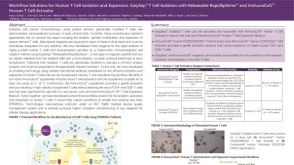 科学海报Workflow Solutions for Human T Cell Isolation and Expansion
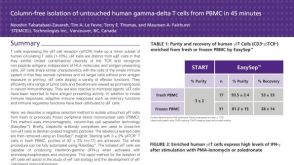 科学海报Immunomagnetic Cell Isolation of Human Gamma-Delta T Cells from PBMC




 沪公网安备31010102008431号