Li Y et al. (FEB 2016)
Journal of Immunology 196 4 1617--25
Hepatic Stellate Cells Directly Inhibit B Cells via Programmed Death-Ligand 1.
We demonstrated previously that mouse hepatic stellate cells (HSCs) suppress T cells via programmed death-ligand 1 (PD-L1),but it remains unknown whether they exert any effects on B cells,the other component of the adaptive immune system. In this study,we found that mouse HSCs directly inhibited B cells and that PD-L1 was also integrally involved. We found that HSCs inhibited the upregulation of activation markers on activated B cells,as well as the proliferation of activated B cells and their cytokine/Ig production in vitro,and that pharmaceutically or genetically blocking the interaction of PD-L1 with programmed cell death protein 1 impaired the ability of HSCs to inhibit B cells. To test the newly discovered B cell-inhibitory activity of HSCs in vivo,we developed a protocol of intrasplenic artery injection to directly deliver HSCs into the spleen. We found that local delivery of wild-type HSCs into the spleens of mice that had been immunized with 4-hydroxy-3-nitrophenylacetyl-Ficoll,a T cell-independent Ag,significantly suppressed Ag-specific IgM and IgG production in vivo,whereas splenic artery delivery of PD-L1-deficient HSCs failed to do so. In conclusion,in addition to inhibiting T cells,mouse HSCs concurrently inhibit B cells via PD-L1. This direct B cell-inhibitory activity of HSCs should contribute to the mechanism by which HSCs maintain the liver's immune homeostasis.
View Publication
Directed evolution of a recombinase that excises the provirus of most HIV-1 primary isolates with high specificity.
Current combination antiretroviral therapies (cART) efficiently suppress HIV-1 reproduction in humans,but the virus persists as integrated proviral reservoirs in small numbers of cells. To generate an antiviral agent capable of eradicating the provirus from infected cells,we employed 145 cycles of substrate-linked directed evolution to evolve a recombinase (Brec1) that site-specifically recognizes a 34-bp sequence present in the long terminal repeats (LTRs) of the majority of the clinically relevant HIV-1 strains and subtypes. Brec1 efficiently,precisely and safely removes the integrated provirus from infected cells and is efficacious on clinical HIV-1 isolates in vitro and in vivo,including in mice humanized with patient-derived cells. Our data suggest that Brec1 has potential for clinical application as a curative HIV-1 therapy.
View Publication
产品类型:
产品号#:
02697
17896
17896RF
17952
17952RF
21000
20119
20155
04435
04445
100-0696
产品名:
StemSpan™ CC110
EasySep™人脐带血CD34正选试剂盒II
RoboSep™ 人脐带血CD34正选试剂盒II
EasySep™人CD4+ T细胞分选试剂盒
RoboSep™ 人CD4+ T细胞分选试剂盒
RoboSep™- S
RoboSep™ 吸头组件抛光剂
RoboSep™分选管套装(9个塑料管)
MethoCult™ H4435 Enriched
MethoCult™ H4435 Enriched
EasySep™人CD4+ T细胞分离试剂盒
Chang SK et al. (JUN 2008)
Journal of immunology (Baltimore,Md. : 1950) 180 11 7394--403
B lymphocyte stimulator regulates adaptive immune responses by directly promoting dendritic cell maturation.
B lymphocyte stimulator (BLyS) is a well-known direct costimulator of adaptive immune cells,particularly B lineage cells. However,we have reported recently that BLyS is also able to activate monocytes. Other innate immune cells,such as dendritic cells (DCs),play a key role in the initiation of adaptive immune responses and the purpose of the current study was to assess whether there is a direct role for BLyS in modulating human DC functions. In this study,we show that BLyS induces DC activation and maturation. Thus,BLyS strongly induced up-regulation of surface costimulatory molecule expression and secretion of specific cytokines and chemokines in DCs. BLyS-stimulated DCs (BLyS-DCs) were also able to augment allogeneic CD4 T cell proliferation to a greater extent than control DCs. BLyS-DCs secreted elevated levels of the major Th1-polarizing cytokine,IL-12p70,and they promoted naive CD4 T cell differentiation into Th1 T cells. Regarding BLyS receptor expression,DCs primarily express cytoplasmic transmembrane activator and CAML interactor; however,low levels of cell surface transmembrane activator and CAML interactor are expressed as well. Collectively,our data suggest that BLyS may modulate adaptive immune cells indirectly by inducing DC maturation.
View Publication
产品类型:
产品号#:
19155
19155RF
21000
20119
20155
产品名:
RoboSep™- S
RoboSep™ 吸头组件抛光剂
RoboSep™分选管套装(9个塑料管)
Mian MF et al. (JUL 2010)
Molecular therapy : the journal of the American Society of Gene Therapy 18 7 1379--88
FimH can directly activate human and murine natural killer cells via TLR4.
Although the importance of natural killer (NK) cells in innate immune responses against tumors or viral infections are well documented,their ability to directly recognize pathogens is less well defined. We have recently reported FimH,a bacterial fimbrial protein,as a novel Toll-like receptor (TLR)4 ligand that potently induces antiviral responses. Here,we investigated whether FimH either directly or indirectly can activate human and murine NK cells. We demonstrate that FimH potently activates both human and murine NK cells in vitro to induce cytokines [interferon (IFN)-gamma and tumor necrosis factor (TNF)-alpha] and cytotoxicity. Importantly,NK cells directly recognize FimH-expressing pathogens as FimH(+),but not FimH(-),bacteria were able to activate human NK cells. FimH activation of NK cells required TLR4 and MyD88 signaling,as NK cells from both TLR4(-/-) and MyD88(-/-) mice as well as human NK-92 cells,which lack TLR4,were all unresponsive to FimH. In addition,TLR4 neutralization significantly abrogated the response of human NK cells to FimH. Activation of purified NK cells by FimH was independent of lipopolysaccharide (LPS) or other bacterial contaminations. These data demonstrate for the first time that highly purified NK cells directly recognize and respond to FimH via TLR4-MyD88 pathways to aid innate protection against cancer or microbial infections.
View Publication
Schneider E et al. (SEP 2009)
Journal of immunology (Baltimore,Md. : 1950) 183 6 3591--7
IL-33 activates unprimed murine basophils directly in vitro and induces their in vivo expansion indirectly by promoting hematopoietic growth factor production.
IL-33,a new member of the IL-1 family,has been described as an important inducer of Th2 cytokines and mediator of inflammatory responses. In this study,we demonstrate that murine basophils sorted directly from the bone marrow,without prior exposure to IL-3 or Fc(epsilon)R cross-linking,respond to IL-33 alone by producing substantial amounts of histamine,IL-4,and IL-6. These cells express ST2 constitutively and generate a cytokine profile that differs from their IL-3-induced counterpart by a preferential production of IL-6. In vivo,IL-33 promotes basophil expansion in the bone marrow (BM) through an indirect mechanism of action depending on signaling through the beta(c) chain shared by receptors for IL-3,GM-CSF,and IL-5. IL-3 can still signal through its specific beta(IL-3) chain in these mutant mice,which implies that it is not the unique growth-promoting mediator in this setup,but requires IL-5 and/or GMCSF. Our results support a major role of the latter growth factor,which is readily generated by total BM cells as well as sorted basophils in response to IL-33 along with low amounts of IL-3. Furthermore,GM-CSF amplifies IL-3-induced differentiation of basophils from BM cells,whereas IL-5 that is also generated in vivo,affects neither their functions nor their growth in vitro or in vivo. In conclusion,our data provide the first evidence that IL-33 not only activates unprimed basophils directly,but also promotes their expansion in vivo through induction of GM-CSF and IL-3.
View Publication
产品类型:
产品号#:
18755
18755RF
产品名:
EasySep™小鼠CD49b正选试剂盒
RoboSep™ 小鼠CD49b正选试剂盒含滤芯吸头
Pereira RC et al. ( 2016)
Frontiers in immunology 7 415
Human Articular Chondrocytes Regulate Immune Response by Affecting Directly T Cell Proliferation and Indirectly Inhibiting Monocyte Differentiation to Professional Antigen-Presenting Cells.
Autologous chondrocyte implantation is the current gold standard cell therapy for cartilage lesions. However,in some instances,the heavily compromised health of the patient can either impair or limit the recovery of the autologous chondrocytes and a satisfactory outcome of the implant. Allogeneic human articular chondrocytes (hAC) could be a good alternative,but the possible immunological incompatibility between recipient and hAC donor should be considered. Herein,we report that allogeneic hAC inhibited T lymphocyte response to antigen-dependent and -independent proliferative stimuli. This effect was maximal when T cells and hAC were in contact and it was not relieved by the addition of exogenous lymphocyte growth factor interleukin (IL)-2. More important,hAC impaired the differentiation of peripheral blood monocytes induced with granulocyte monocyte colony-stimulating factor and IL-4 (Mo) to professional antigen-presenting cells,such as dendritic cells (DC). Indeed,a marked inhibition of the onset of the CD1a expression and an ineffective downregulation of CD14 antigens was observed in Mo-hAC co-cultures. Furthermore,compared to immature or mature DC,Mo from Mo-hAC co-cultures did not trigger an efficacious allo-response. The prostaglandin (PG) E2 present in the Mo-hAC co-culture conditioned media is a putative candidate of the hAC-mediated inhibition of Mo maturation. Altogether,these findings indicate that allogeneic hAC inhibit,rather than trigger,immune response and strongly suggest that an efficient chondrocyte implantation could be possible also in an allogeneic setting.
View Publication
产品类型:
产品号#:
17951
17951RF
17952
17952RF
18099
18099RF
100-0695
100-0696
产品名:
EasySep™人T细胞分选试剂盒
RoboSep™ 人T细胞分选试剂盒
EasySep™人CD4+ T细胞分选试剂盒
RoboSep™ 人CD4+ T细胞分选试剂盒
EasySep™人T细胞分选试剂盒
EasySep™人CD4+ T细胞分离试剂盒
L. Starck et al. ( 2014)
The Journal of Immunology 192 206-213
Immunotherapy with TCR-Redirected T Cells: Comparison of TCR-Transduced and TCR-Engineered Hematopoietic Stem Cell-Derived T Cells
Redirecting Ag specificity by transfer of TCR genes into PBLs is an attractive method to generate large numbers of cytotoxic T cells for immunotherapy of cancer and viral diseases. However,transferred TCR chains can pair with endogenous TCR chains,resulting in the formation of mispaired TCR dimers and decreased or unspecific reactivity. TCR gene transfer into hematopoietic stem cells (HSCs) is an alternative to create T cells with desired Ag specificity,because in this case expression of endogenous TCR chains is then less likely owing to allelic exclusion. We generated TCR-transduced T cells from peripheral T cells using the lymphocytic choriomeningitis virus-specific P14 TCR. After transfer of the P14 TCR genes into HSCs and subsequent reconstitution of irradiated mice,TCR-engineered HSC-derived T cells were produced. We then compared the Ag-specific T cell populations with P14 TCR-transgenic T cells for their therapeutic efficiency in three in vivo models. In this study,we demonstrate that TCR-transduced T cells and TCR-engineered HSC-derived T cells are comparable in controlling lymphocytic choriomeningitis virus infection in mice and suppress growth of B16 tumor cells expressing the cognate Ag in a comparable manner.
View Publication
产品类型:
产品号#:
18756
18756RF
产品名:
EasySep™小鼠SCA1正选试剂盒
RoboSep™ 小鼠SCA1正选试剂盒含滤芯吸头
Addo MM et al. (FEB 2003)
Journal of virology 77 3 2081--92
Comprehensive epitope analysis of human immunodeficiency virus type 1 (HIV-1)-specific T-cell responses directed against the entire expressed HIV-1 genome demonstrate broadly directed responses, but no correlation to viral load.
Cellular immune responses play a critical role in the control of human immunodeficiency virus type 1 (HIV-1); however,the breadth of these responses at the single-epitope level has not been comprehensively assessed. We therefore screened peripheral blood mononuclear cells (PBMC) from 57 individuals at different stages of HIV-1 infection for virus-specific T-cell responses using a matrix of 504 overlapping peptides spanning all expressed HIV-1 proteins in a gamma interferon-enzyme-linked immunospot (Elispot) assay. HIV-1-specific T-cell responses were detectable in all study subjects,with a median of 14 individual epitopic regions targeted per person (range,2 to 42),and all 14 HIV-1 protein subunits were recognized. HIV-1 p24-Gag and Nef contained the highest epitope density and were also the most frequently recognized HIV-1 proteins. The total magnitude of the HIV-1-specific response ranged from 280 to 25,860 spot-forming cells (SFC)/10(6) PBMC (median,4,245) among all study participants. However,the number of epitopic regions targeted,the protein subunits recognized,and the total magnitude of HIV-1-specific responses varied significantly among the tested individuals,with the strongest and broadest responses detectable in individuals with untreated chronic HIV-1 infection. Neither the breadth nor the magnitude of the total HIV-1-specific CD8+-T-cell responses correlated with plasma viral load. We conclude that a peptide matrix-based Elispot assay allows for rapid,sensitive,specific,and efficient assessment of cellular immune responses directed against the entire expressed HIV-1 genome. These data also suggest that the impact of T-cell responses on control of viral replication cannot be explained by the mere quantification of the magnitude and breadth of the CD8+-T-cell response,even if a comprehensive pan-genome screening approach is applied.
View Publication


 EasySep™小鼠TIL(CD45)正选试剂盒





 产品手册EasySep™细胞分选技术 - 更高效地分离细胞
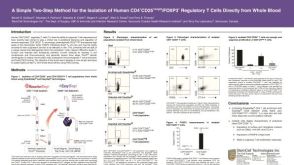 科学海报Isolation of Human CD4+CD25+Bright/Foxp3+ Regulatory T Cells Directly from Whole Blood


 沪公网安备31010102008431号