若您需要咨询产品或有任何技术问题,请通过官方电话 400 885 9050 或邮箱 info.cn@stemcell.com 与我们联系。

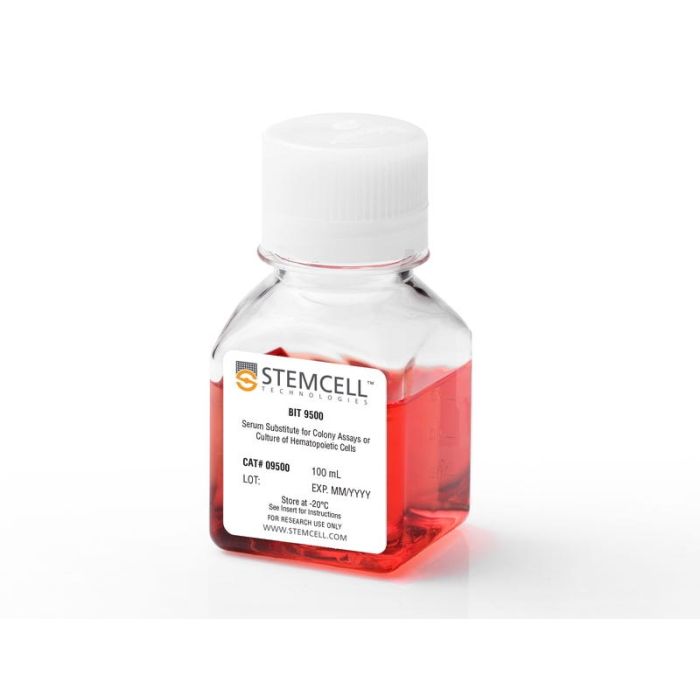
BIT 9500血清替代物

不含血清的细胞培养基添加物
只有 %1
¥5,258.00

产品号 #(选择产品)

产品号 #09500_C

不含血清的细胞培养基添加物

总览

专为需要化学成分明确的无血清培养基应用而开发。该产品包含牛血清白蛋白(BSA)、胰岛素和转铁蛋白,溶于Iscove's MDM中。它包含预先筛选批次的BSA,专门选用于支持人造血祖细胞在无血清培养基配方中的最佳生长。同时,该产品也适用于在无血清条件下小鼠造血祖细胞的培养。

包含
• 牛血清白蛋白
• 重组人胰岛素
• 人转铁蛋白(铁饱和)
• Iscove's MDM
 
分类
添加剂
 
细胞类型
造血干/祖细胞,杂交瘤细胞,其他物种,多能干细胞
 
种属
人,小鼠
 
应用
细胞培养
 
制剂类别
无血清
 

产品说明书及文档

请在《产品说明书》中查找相关支持信息和使用说明,或浏览下方更多实验方案。

Document Type
Product Name
Catalog #
Lot #
Language
Catalog #
09500
Lot #
All
Language
English
Document Type
Safety Data Sheet
Catalog #
09500
Lot #
All
Language
English

应用领域

本产品专为以下研究领域设计,适用于工作流程中的高亮阶段。探索这些工作流程,了解更多我们为各研究领域提供的其他配套产品。

相关材料与文献

技术资料 (1)

文献 (48)

Neutrophil elastase enzymatically antagonizes the in vitro action of G-CSF: implications for the regulation of granulopoiesis. El Ouriaghli F et al. Blood 2003 MAR

Abstract

There is evidence that neutrophil production is a balance between the proliferative action of granulocyte-colony-stimulating factor (G-CSF) and a negative feedback from mature neutrophils (the chalone). Two neutrophil serine proteases have been implicated in granulopoietic regulation: pro-proteinase 3 inhibits granulocyte macrophage-colony-forming unit (CFU-GM) growth,and elastase mutations cause cyclic and congenital neutropenia. We further studied the action of the neutrophil serine proteases (proteinase 3,elastase,azurocidin,and cathepsin G) on granulopoiesis in vitro. Elastase inhibited CFU-GM in methylcellulose culture. In serum-free suspension cultures of CD34+ cells,elastase completely abrogated the proliferation induced by G-CSF but not that of GM-CSF or stem cell factor (SCF). The blocking effect of elastase was prevented by inhibition of its enzymatic activity with phenylmethylsulfonyl fluoride (PMSF) or heat treatment. When exposed to enzymatically active elastase,G-CSF,but not GM-CSF or SCF,was rapidly cleaved and rendered inactive. These results support a role for neutrophil elastase in providing negative feedback to granulopoiesis by direct antagonism of G-CSF.
Identification of a novel class of human adherent CD34- stem cells that give rise to SCID-repopulating cells. Kuç et al. Blood 2003 FEB

Abstract

Here we describe the in vitro generation of a novel adherent cell fraction derived from highly enriched,mobilized CD133(+) peripheral blood cells after their culture with Flt3/Flk2 ligand and interleukin-6 for 3 to 5 weeks. These cells lack markers of hematopoietic stem cells,endothelial cells,mesenchymal cells,dendritic cells,and stromal fibroblasts. However,all adherent cells expressed the adhesion molecules VE-cadherin,CD54,and CD44. They were also positive for CD164 and CD172a (signal regulatory protein-alpha) and for a stem cell antigen defined by the recently described antibody W7C5. Adherent cells can either spontaneously or upon stimulation with stem cell factor give rise to a transplantable,nonadherent CD133(+)CD34(-) stem cell subset. These cells do not generate in vitro hematopoietic colonies. However,their transplantation into nonobese diabetic/severe combined immunodeficiency (NOD/SCID) mice induced substantially higher long-term multilineage engraftment compared with that of freshly isolated CD34(+) cells,suggesting that these cells are highly enriched in SCID-repopulating cells. In addition to cells of the myeloid lineage,nonadherent CD34(-) cells were able to give rise to human cells with B-,T-,and natural killer-cell phenotype. Hence,these cells possess a distinct in vivo differentiation potential compared with that of CD34(+) stem cells and may therefore provide an alternative to CD34(+) progenitor cells for transplantation.
Detection, isolation, and stimulation of quiescent primitive leukemic progenitor cells from patients with acute myeloid leukemia (AML). Guan Y et al. Blood 2003 APR

Abstract

Although many acute myeloid leukemia (AML) colony-forming cells (CFCs) and long-term culture-initiating cells (LTC-ICs) directly isolated from patients are actively cycling,quiescent progenitors are present in most samples. In the current study,(3)H-thymidine ((3)H-Tdr) suicide assays demonstrated that most NOD/SCID mouse leukemia-initiating cells (NOD/SL-ICs) are quiescent in 6 of 7 AML samples. AML cells in G(0),G(1),and S/G(2)+M were isolated from 4 of these samples using Hoechst 33342/pyroninY staining and cell sorting. The progenitor content of each subpopulation was consistent with the (3)H-Tdr suicide results,with NOD/SL-ICs found almost exclusively among G(0) cells while the cycling status of AML CFCs and LTC-ICs was more heterogeneous. Interestingly,after 72 hours in serum-free culture with or without Steel factor (SF),Flt-3 ligand (FL),and interleukin-3 (IL-3),most G(0) AML cells entered active cell cycle (percentage of AML cells remaining in G(0) at 72 hours,1.2% to 37%,and 0% to 7.6% in cultures without and with growth factors [GFs],respectively) while G(0) cells from normal lineage-depleted bone marrow remained quiescent in the absence of GF. All 4 AML samples showed evidence of autocrine production of 2 or more of SF,FL,IL-3,and granulocyte-macrophage colony-stimulating factor (GM-CSF). In addition,3 of 4 samples contained an internal tandem duplication of the FLT3 gene. In summary,quiescent leukemic cells,including NOD/SL-ICs,are present in most AML patients. Their spontaneous entry into active cell cycle in short-term culture might be explained by the deregulated GF signaling present in many AMLs.

更多信息

更多信息
物种 人, 小鼠
Contains • Bovine serum albumin • Recombinant human insulin • Human transferrin (iron-saturated) • Iscove's MDM
配方 无血清

质量保证:

本产品仅供科研使用,除非另有说明,不得用于人体或动物的诊断或治疗用途。如需了解 STEMCELL 的质量体系,请访问 www.stemcell.cn/compliance

Copyright © 2026 by STEMCELL Technologies. All rights reserved.

在线联系