若您需要咨询产品或有任何技术问题,请通过官方电话 400 885 9050 或邮箱 info.cn@stemcell.com 与我们联系。

抗人SSEA-4抗体,克隆号MC-813-70

靶向人、小鼠、大鼠SSEA-4的小鼠单克隆IgG3抗体

只有 %1
¥2,092.00

产品号 #(选择产品)

产品号 #60062_C

靶向人、小鼠、大鼠SSEA-4的小鼠单克隆IgG3抗体

总览

MC-813-70 抗体与阶段特异性胚胎抗原-4 (SSEA-4) 发生反应,SSEA-4 是一种糖脂类碳水化合物抗原,表达于人胚胎癌细胞 (EC)、胚胎生殖细胞 (EG)、未分化胚胎干细胞 (ES) 和诱导多能干细胞 (iPS) 表面,以及部分间充质干细胞和恒河猴胚胎干细胞系。未分化的小鼠 EC、EG、ES 和 iPS 细胞均未观察到免疫反应。人 EC、ES 和 iPS 细胞分化后,SSEA-4 的表达下调。相反,小鼠 EC、ES 或 iPS 细胞的分化可能伴随 SSEA-4 表达的增加。

该抗体克隆已验证可用于标记在 mTeSR™1(产品号 #85850)和 TeSR™2(产品号 #05860)中生长的人 ES 和 iPS 细胞,并且已验证可用于使用 EasySep™ 试剂盒分选的细胞的纯度评估,包括 EasySep™ 人 ES/iPS 细胞 TRA-1-60 正选试剂盒(产品号 #18166)和 EasySep™ hESC/hiPSC SSEA-4 正选试剂盒(产品号 #18165;可能会观察到部分阻断)。

分类
一抗
 
靶抗原
SSEA-4
 
别名
阶段特异性胚胎抗原-4
 
反应种属
猫、鸡、犬、人、小鼠、兔、大鼠、恒河猴
 
偶联
Alexa Fluor 488,生物素,FITC,PE,未偶联
 
宿主物种
小鼠
 
细胞类型
多能干细胞
 
种属
人,小鼠,非人灵长类,其他物种,大鼠
 
应用
细胞分选,ELISAs,流式细胞术,免疫细胞化学,免疫荧光,免疫组化
 
研究领域
干细胞生物学
 
克隆
MC-813-70
 
Gene ID
330401
 
Isotype
IgG3, κ轻链
 

实验数据

Data for Alexa Fluor® 488-Conjugated

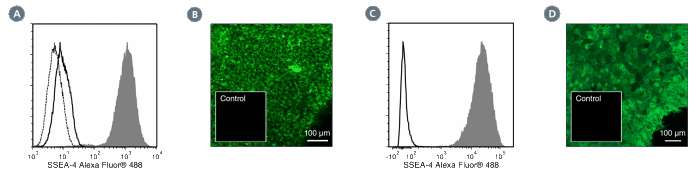
Figure 1. Data for Alexa Fluor® 488-Conjugated

(A) Flow cytometry analysis of human ES cells (filled histogram) or HT1080 fibrosarcoma cells (negative control, dashed line histogram) labeled with Anti-Human SSEA-4 Antibody, Clone MC-813-70, Alexa Fluor® 488. Labeling of human ES cells with a mouse IgG3, kappa Alexa Fluor® 488 isotype control antibody is shown (solid line histogram).
(B) Human ES cells were cultured in mTeSR™1 on BD Matrigel™-coated glass slides, then fixed and stained with Anti-Human SSEA-4 Antibody, Clone MC-813-70, Alexa Fluor® 488. Inset shows cells labeled with a mouse IgG3, kappa, Alexa Fluor® 488 isotype control antibody.
(C) Flow cytometry analysis of human iPS cells labeled with Anti-Human SSEA-4 Antibody, Clone MC-813-70, Alexa Fluor® 488 (filled histogram) or a mouse IgG3, kappa Alexa Fluor® 488 isotype control antibody (open histogram).
(D) Human iPS cells were cultured in mTeSR™1 on BD Matrigel™-coated glass slides, then fixed and stained with Anti-Human SSEA-4 Antibody, Clone MC-813-70, Alexa Fluor® 488. Inset shows cells labeled with a mouse IgG3, kappa Alexa Fluor® 488 isotype control antibody.

Data for Biotin-Conjugated

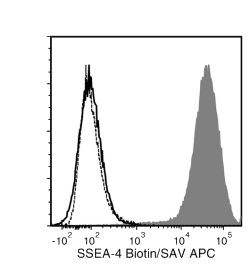
Figure 2. Data for Biotin-Conjugated

Flow cytometry analysis of human ES cells (filled histogram) or HT1080 fibrosarcoma cells (negative control, dashed line histogram) labeled with Anti-Human SSEA-4 Antibody, Clone MC-813-70, Biotin followed by streptavidin (SAV) APC (filled histogram). Labeling of human ES cells with a mouse IgG3, kappa biotin isotype control antibody followed by SAV APC is shown (solid line histogram).

Data for FITC-Conjugated

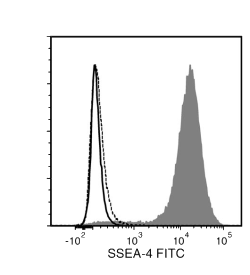
Figure 3. Data for FITC-Conjugated

Flow cytometry analysis of human ES cells (filled histogram) or HT1080 fibrosarcoma cells (negative control, dashed line histogram) labeled with Anti- Human SSEA-4 Antibody, Clone MC-813-70, FITC (filled histogram). Labeling of human ES cells with a mouse IgG3, kappa FITC isotype control antibody is shown (solid line histogram).

Data for PE-Conjugated

Figure 4. Data for PE-Conjugated

(A) Flow cytometry analysis of human ES cells (filled histogram) or HT1080 fibrosarcoma cells (negative control, dashed line histogram) labeled with Anti-Human SSEA-4 Antibody, Clone MC-813-70, PE. Labeling of human ES cells with a mouse IgG3, kappa PE isotype control antibody is shown (solid line histogram).
(B) Human ES cells were cultured in mTeSR™1 on BD Matrigel™-coated glass slides, then fixed and stained with Anti-Human SSEA-4 Antibody, Clone MC-813-70, PE. Inset shows cells labeled with a mouse IgG3, kappa, PE isotype control antibody.
(C) Flow cytometry analysis of human iPS cells labeled with Anti-Human SSEA-4 Antibody, Clone MC-813-70, PE (filled histogram) or a mouse IgG3, kappa PE isotype control antibody (open histogram).

Data for Unconjugated

Figure 5. Data for Unconjugated

(A) Flow cytometry analysis of human ES cells (filled histogram) or HT1080 fibrosarcoma cells (negative control, dashed line histogram) labeled with Anti-Human SSEA-4 Antibody, Clone MC-813-70 followed by goat anti-mouse IgG, FITC. Labeling of human ES cells with a mouse IgG3, kappa isotype control antibody followed by goat anti-mouse IgG FITC is shown (solid line histogram).
(B) Human ES cells were cultured in mTeSR™1 on BD Matrigel™-coated glass slides, then fixed and stained with Anti-Human SSEA-4 Antibody, Clone MC-813-70, followed by goat anti-mouse IgG, FITC. Inset shows cells labeled with a mouse IgG3, kappa isotype control antibody.
(C) Flow cytometry analysis of human iPS cells labeled with Anti-Human SSEA-4 Antibody, Clone MC-813-70 followed by goat anti-mouse IgG FITC (filled histogram) or a mouse IgG3, kappa isotype control antibody followed by goat anti-mouse IgG FITC (open histogram).

产品说明书及文档

请在《产品说明书》中查找相关支持信息和使用说明,或浏览下方更多实验方案。

Document Type
Product Name
Catalog #
Lot #
Language
Catalog #
60062FI.1, 60062FI
Lot #
All
Language
English
Catalog #
60062BT
Lot #
All
Language
English
Catalog #
60062PE.1, 60062PE
Lot #
All
Language
English
Document Type
Safety Data Sheet
Catalog #
60062FI.1, 60062FI
Lot #
All
Language
English
Document Type
Safety Data Sheet
Catalog #
60062BT
Lot #
All
Language
English
Document Type
Safety Data Sheet
Catalog #
60062PE.1, 60062PE
Lot #
All
Language
English

应用领域

本产品专为以下研究领域设计,适用于工作流程中的高亮阶段。探索这些工作流程,了解更多我们为各研究领域提供的其他配套产品。

相关材料与文献

技术资料 (3)

文献 (6)

Intrinsic Immunity Shapes Viral Resistance of Stem Cells. Wu X et al. Cell 2018 JAN

Abstract

Stem cells are highly resistant to viral infection compared to their differentiated progeny; however, the mechanism is mysterious. Here, we analyzed gene expression in mammalian stem cells and cells at various stages of differentiation. We find that, conserved across species, stem cells express a subset of genes previously classified as interferon (IFN) stimulated genes (ISGs) but that expression is intrinsic, as stem cells are refractory to interferon. This intrinsic ISG expression varies in a cell-type-specific manner, and many ISGs decrease upon differentiation, at which time cells become IFN responsive, allowing induction of a broad spectrum of ISGs by IFN signaling. Importantly, we show that intrinsically expressed ISGs protect stem cells against viral infection. We demonstrate the in vivo importance of intrinsic ISG expression for protecting stem cells and their differentiation potential during viral infection. These findings have intriguing implications for understanding stem cell biology and the evolution of pathogen resistance.
Simple suspension culture system of human iPS cells maintaining their pluripotency for cardiac cell sheet engineering. Haraguchi Y et al. Journal of Tissue Engineering and Regenerative Medicine 2015 DEC

Abstract

In this study, a simple three-dimensional (3D) suspension culture method for the expansion and cardiac differentiation of human induced pluripotent stem cells (hiPSCs) is reported. The culture methods were easily adapted from two-dimensional (2D) to 3D culture without any additional manipulations. When hiPSCs were directly applied to 3D culture from 2D in a single-cell suspension, only a few aggregated cells were observed. However, after 3 days, culture of the small hiPSC aggregates in a spinner flask at the optimal agitation rate created aggregates which were capable of cell passages from the single-cell suspension. Cell numbers increased to approximately 10-fold after 12 days of culture. The undifferentiated state of expanded hiPSCs was confirmed by flow cytometry, immunocytochemistry and quantitative RT-PCR, and the hiPSCs differentiated into three germ layers. When the hiPSCs were subsequently cultured in a flask using cardiac differentiation medium, expression of cardiac cell-specific genes and beating cardiomyocytes were observed. Furthermore, the culture of hiPSCs on Matrigel-coated dishes with serum-free medium containing activin A, BMP4 and FGF-2 enabled it to generate robust spontaneous beating cardiomyocytes and these cells expressed several cardiac cell-related genes, including HCN4, MLC-2a and MLC-2v. This suggests that the expanded hiPSCs might maintain the potential to differentiate into several types of cardiomyocytes, including pacemakers. Moreover, when cardiac cell sheets were fabricated using differentiated cardiomyocytes, they beat spontaneously and synchronously, indicating electrically communicative tissue. This simple culture system might enable the generation of sufficient amounts of beating cardiomyocytes for use in cardiac regenerative medicine and tissue engineering.
OCT4 as a target of miR-34a stimulates p63 but inhibits p53 to promote human cell transformation Ng WL et al. Cell death & disease 2014 JAN

Abstract

Human cell transformation is a key step for oncogenic development, which involves multiple pathways; however, the mechanism remains unclear. To test our hypothesis whether cell oncogenic transformation shares some mechanisms with the process of reprogramming non-stem cells to induced pluripotent stem cells (iPSC), we studied the relationship among the key factors for promoting or inhibiting iPSC in radiation-transformed human epithelial cell lines derived from different tissues (lung, breast and colon). We unexpectedly found that p63 and OCT4 were highly expressed (accompanied by low expressed p53 and miR-34a) in all transformed cell lines examined when compared with their non-transformed counterparts. We further elucidated the relationship of these factors: the 3p strand of miR-34a directly targeted OCT4 by binding to the 3′ untranslated region (3′-UTR) of OCT4 and, OCT4, in turn, stimulated p63 but inhibited p53 expression by binding to a specific region of the p63 or p53 promoter. Moreover, we revealed that the effects of OCT4 on promoting cell oncogenic transformation were by affecting p63 and p53. These results support that a positive loop exists in human cells: OCT4 upregulation as a consequence of inhibition of miR-34a, promotes p63 but suppresses p53 expression, which further stimulates OCT4 upregulation by downregulating miR-34a. This functional loop contributes significantly to cell transformation and, most likely, also to the iPSC process.

更多信息

更多信息
物种 人类, 其它物种, 大鼠, 小鼠, 非人灵长类
克隆 MC-813-70
Gene Id 330401
Alternative Names Stage-specific embryonic antigen-4
同种型/isotype IgG3, kappa

法律声明:

Alexa Fluor is a registered trademark of Life Technologies Corporation. Antibodies conjugated to Alexa Fluor® are licensed for internal research use only and sale is expressly conditioned on the buyer not using the antibody for manufacturing, performing a service or medical test, or otherwise generating revenue. For use other than research, contact Life Technologies Corporation, 5791 Van Allen Way, Carlsbad, CA 92008 USA or outlicensing@lifetech.com.

质量声明:

产品仅供研究使用,不用于针对人或动物的诊断或治疗。 欲获悉更多关于STEMCELL的质控信息,请访问 STEMCELL.CN/COMPLIANCE.

Copyright © 2026 by STEMCELL Technologies. All rights reserved.

在线联系