若您需要咨询产品或有任何技术问题,请通过官方电话 400 885 9050 或邮箱 info.cn@stemcell.com 与我们联系。

STEMdiff™ 造血试剂盒

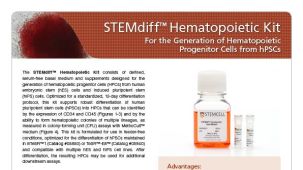
用于将人ES细胞或iPS细胞分化为造血祖细胞
只有 %1
¥9,958.00

产品号 #(选择产品)

产品号 #05310_C

用于将人ES细胞或iPS细胞分化为造血祖细胞

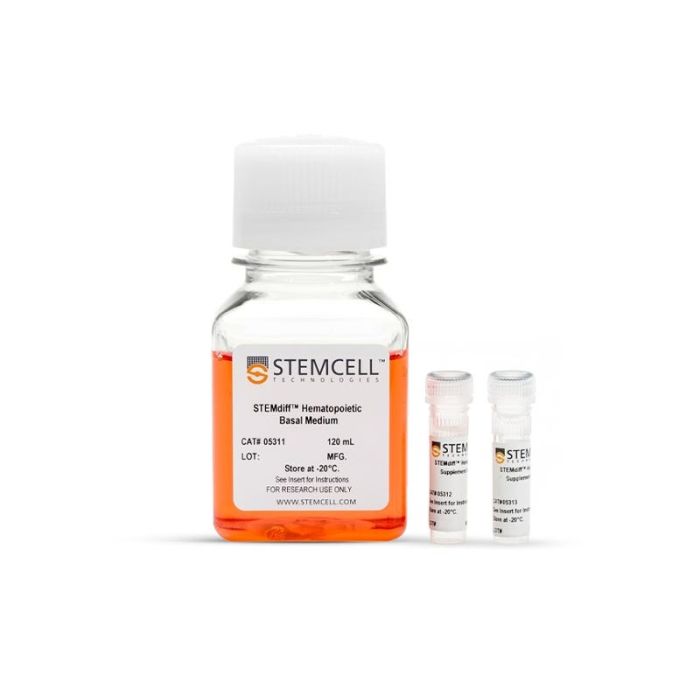
产品组分包括

  • STEMdiff™ 造血基础培养基,120 mL
  • STEMdiff™ 造血补充剂 A (200X),225 µL
  • STEMdiff™ 造血补充剂 B (200X),375 µL
Need a high-quality cell source? Use the hiPSC SCTi003-A (female) or SCTi004-A (male) control lines, manufactured with mTeSR™ Plus.

What Our Scientist Says

We developed the STEMdiff™ Hematopoietic Kit so scientists like you can have a reliable source of hPSC-derived hematopoietic progenitor cells for their research.

Marta WalasekSenior Scientist
Marta Walasek, Senior Scientist

总览

使用 STEMdiff™ 造血试剂盒可从人胚胎干细胞(ES)和诱导多能干细胞(iPS)生成功能性造血祖细胞。该产品采用简便且可重复的培养方案,在无血清、无饲养层的条件下进行分化,可获得表达 CD34、CD45 和 CD43 的造血祖细胞。
该稳健的两阶段分化方案首先诱导细胞向中胚层分化,随后进一步分化为造血祖细胞。经过 12 天培养后,可获得含有25% 至 65%(平均为 43%)的 CD34⁺CD45⁺ 祖细胞的造血细胞群,其中包括在集落形成单位 (CFU) 测定中能够形成功能性造血集落的祖细胞。

STEMdiff™ 造血试剂盒已针对以下培养基中维持的人多能细胞的分化进行了优化:

• mTeSR™1(目录号 85850)

• mTeSR™ Plus(目录号 100-0276)

• TeSR™-E8™(目录号 05990)

分类
专用培养基
 
细胞类型
造血干/祖细胞,多能干细胞
 
种属

 
应用
细胞培养,分化
 
品牌
STEMdiff
 
研究领域
干细胞生物学
 
制剂类别
无血清
 

实验数据

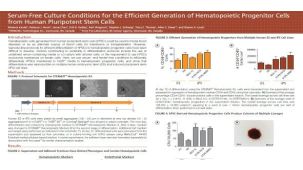
Hematopoietic Cell Differentiation Protocol

Figure 1. Hematopoietic Differentiation Protocol

On Day -1, harvest and seed human ES/iPS cell colonies as small aggregates in mTeSR™1, mTeSR™ Plus, or TeSR™-E8. After one day, TeSR™ medium is replaced with Medium A (STEMdiff™ Hematopoietic Basal Medium containing Supplement A) to begin inducing the cells towards a mesoderm-like state (day 0). On day 2, a half medium change is performed with fresh Medium A. On day 3, the medium is changed to Medium B (STEMdiff™ Hematopoietic Basal Medium containing Supplement B) with half medium changes on days 5, 7 and 10, to promote further differentiation into hematopoietic cells. Typically, by day 12, large numbers of HPCs can be harvested from the culture supernatant.

Morphology of hPSC-Derived HPCs

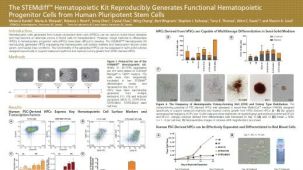
Figure 2. Morphology of hPSC-Derived HPCs

Representative images of (A) hES (H1) cells and (B) hiPS (WLS-1C) cells on Day 12 of differentiation to HPCs using the STEMdiff™ Hematopoietic Kit. Differentiated cells exhibit typical HPC morphology as round cells that float freely in suspension.

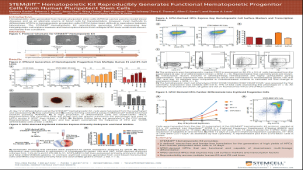
Efficient and Robust Generation of CD34+CD45+/CD43+ HPCs

Figure 3. Efficient and Robust Generation of CD34+CD45+/CD43+ HPCs

hES and hiPS cells were cultured for 12 days in single wells of 12-well plates using the STEMdiff™ Hematopoietic Kit. At the end of the culture period, cells in suspension were harvested and analyzed by flow cytometry for expression of hematopoietic cell surface markers: CD34, CD45 and CD43. (A,B) Example flow cytometry plots for hematopoietic cell surface-marker analysis of cultures of hES (H1 and H9) and hiPS (STiPS-M001) cells. (C,D) Percentages and total numbers of CD34+CD45+ cells in cultures of hES (H1 and H9) or hiPS (WLS-1C, STiPS-F016, STiPS-M001 and STiPS-B004) cells are shown. Data shown as mean ± SEM; n ≥ 3.

hPSC-Derived HPCs Produce Colonies of Multiple Lineages

Figure 4. hPSC-Derived HPCs Produce Colonies of Multiple Lineages

Cells in suspension were harvested from the cultures on Day 12 of the hematopoietic differentiation protocol and assessed in colony-forming unit (CFU) assays using MethoCult™ H4435 Enriched (Catalog #04435) methylcellulose-based medium. (A) CFU frequencies in cultures of 6 different hPSC lines. (Data shown as mean ± SEM; n ≥ 3.) The CFU frequencies were variable between the different cell lines, with on average approximately 120 CFU per 10,000 hPSC-derived HPCs plated. (B) The progenitor cell types observed included granulocyte/macrophage (CFU-M, CFU-G and CFU-GM), erythroid (BFU-E and CFU-E) and occasional mixed (CFU-GEMM) colonies. Representative colony images are shown at 40X magnification.

Density plots showing CD34+ and CD45+ expression and percentage of cells co-expressing CD34+ and CD45+ and graphs showing total number of viable cells harvested.

Figure 5. Generation of Hematopoietic Progenitor Cells from hPSCs Maintained in mTeSR™ Plus

Human ES (H1, H9) and iPS (STiPS-M001, WLS-1C) cell lines maintained in mTeSR™1 (daily feeds) or mTeSR™ Plus (restricted feeds) were differentiated to hematopoietic progenitor cells using the STEMdiff™ Hematopoietic Kit. At the end of the differentiation period, cells were harvested from the supernatant and analyzed by flow cytometry for co-expression of CD34+ and CD45+ . (A) Representative density plots showing CD34+ and CD45+ expression, (B) percentage of cells co-expressing CD34+ and CD45+ , and (C) total number of viable cells harvested are shown. Data are expressed as the mean (± SEM); n=4.

产品说明书及文档

请在《产品说明书》中查找相关支持信息和使用说明,或浏览下方更多实验方案。

Document Type
Product Name
Catalog #
Lot #
Language
Catalog #
05310
Lot #
All
Language
English
Document Type
Safety Data Sheet 1
Catalog #
05310
Lot #
All
Language
English
Document Type
Safety Data Sheet 2
Catalog #
05310
Lot #
All
Language
English
Document Type
Safety Data Sheet 3
Catalog #
05310
Lot #
All
Language
English

应用领域

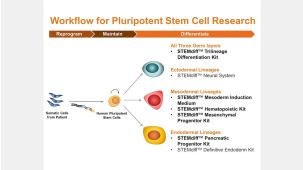
本产品专为以下研究领域设计,适用于工作流程中的高亮阶段。探索这些工作流程,了解更多我们为各研究领域提供的其他配套产品。

相关材料与文献

技术资料 (22)

文献 (31)

Novel regulators of heparan sulfate proteoglycans modulate cellular uptake of α-synuclein fibrils B. Vanderperre et al. Communications Biology 2025 Oct

Abstract

Synucleinopathies are characterized by the accumulation and propagation of α-synuclein (α-syn) aggregates throughout the brain, leading to neuronal dysfunction and death. In this study, we used an unbiased FACS-based genome-wide CRISPR/Cas9 knockout screening to identify genes that regulate the entry and accumulation of α-syn preformed fibrils (PFFs) in cells. We identified key genes and pathways specifically implicated in α-syn PFFs intracellular accumulation, including heparan sulfate proteoglycans (HSPG) biosynthesis and Golgi trafficking. All confirmed hits affected heparan sulfate (HS), a post-translational modification known to act as a receptor for proteinaceous aggregates including α-syn and tau. Intriguingly, deletion of SLC39A9 and C3orf58 genes, encoding respectively a Golgi-localized exporter of Zn 2+ , and the Golgi-localized putative kinase DIPK2A, specifically impaired the uptake of α-syn PFFs, by preventing the binding of PFFs to the cell surface. Mass spectrometry-based analysis of HS chains in SLC39A9 -/- and C3orf58 -/- cells indicated major defects in HS homeostasis. Additionally, Golgi accumulation of NDST1, a prime HSPG biosynthetic enzyme, was detected in C3orf58 -/- cells. Interestingly, C3orf58 -/- human iPSC-derived microglia and dopaminergic neurons exhibited a strong reduction in their ability to internalize α-syn PFFs. Altogether, our data identifies new modulators of HSPGs that regulate α-syn PFFs cell surface binding and uptake. Subject terms: Cellular neuroscience, Glycobiology
Alzheimer's disease–associated PLCG2 variants alter microglial state and function in human induced pluripotent stem cell–derived microglia‐like cells L. M. Bedford et al. Alzheimer's & Dementia 2025 Oct

Abstract

Variants of phospholipase C gamma 2 (PLCG2), a key microglial immune signaling protein, are genetically linked to Alzheimer's disease (AD) risk. Understanding how PLCG2 variants alter microglial function is critical for identifying mechanisms that drive neurodegeneration or resiliency in AD. Induced pluripotent stem cell (iPSC) –derived microglia carrying the protective PLCG2 P522R or risk‐conferring PLCG2 M28L variants, or loss of PLCG2, were generated to ascertain the impact on microglial transcriptome and function. Protective PLCG2 P522R microglia showed significant transcriptomic similarity to isogenic controls. In contrast, risk‐conferring PLCG2 M28L microglia shared similarities with PLCG2 KO microglia, with functionally reduced TREM2 expression, blunted inflammatory responses, and increased proliferation and cell death. Uniquely, PLCG2 P522R microglia showed elevated cytokine secretion after lipopolysaccharide (LPS) stimulation and were protected from apoptosis. These findings demonstrate that PLCG2 variants drive distinct microglia transcriptomes that influence microglial functional responses that could contribute to AD risk and protection. Targeting PLCG2‐mediated signaling may represent a powerful therapeutic strategy to modulate neuroinflammation. The impact of Alzheimer's disease protective‐ and risk‐associated variants of phospholipase C gamma 2 (PLCG2) on the transcriptome and function of induced pluripotent stem cell (iPSC) –derived microglia was investigated. PLCG2 risk variant microglia exhibited a basal transcriptional profile similar to PLCG2‐deficient microglia but significantly different from isotype control and the transcriptionally similar PLCG2 protective variant microglia. PLCG2 risk variant and PLCG2‐deficient microglia show decreased levels of triggering receptor expressed on myeloid cells 2 (TREM2). The differential transcriptional pathways of protective and risk‐associated PLCG2 variant microglia functionally affect proliferation, apoptosis, and immune response. Protective PLCG2 microglia show resilience to apoptosis and increased cytokine/chemokine secretion upon exposure to lipopolysaccharide (LPS).
A neuroimmune cerebral assembloid model to study the pathophysiology of familial Alzheimer’s disease A. Becerra-Calixto et al. Journal of Neuroinflammation 2025 Oct

Abstract

Alzheimer’s disease (AD) is the leading cause of dementia globally. The accumulation of amyloid and tau proteins, neuronal cell death and neuroinflammation are seen with AD progression, resulting in memory and cognitive impairment. Microglia are crucial for AD progression as they engage with neural cells and protein aggregates to regulate amyloid pathology and neuroinflammation. Recent studies indicate that microglia contribute to the propagation of amyloid beta (Aβ) via their immunomodulatory functions including Aβ phagocytosis and inflammatory cytokine production. Three-dimensional cell culture techniques provide the opportunity to study pathophysiological changes in AD in human-derived samples that are difficult to recapitulate in animal models (e.g., transgenic mice). However, these models often lack immune cells such as microglia, which play a critical role in AD pathophysiology. In this study, we developed a neuroimmune assembloid model by integrating cerebral organoids (COs) with induced microglia-like cells (iMGs) derived from human induced pluripotent stem cells from familial AD patient with PSEN2 mutation. After 120 days in culture, we found that iMGs were successfully integrated within the COs. Interestingly, our assembloids displayed histological, functional and transcriptional features of the pro-inflammatory environment seen in AD, including amyloid plaque-like and neurofibrillary tangle-like structures, reduced microglial phagocytic capability, and enhanced neuroinflammatory and apoptotic gene expression. In conclusion, our neuroimmune assembloid model effectively replicates the inflammatory phenotype and amyloid pathology seen in AD. The online version contains supplementary material available at 10.1186/s12974-025-03544-x.

更多信息

更多信息
物种 人类
配方 无血清
质量保证:

产品仅供研究使用,不用于针对人或动物的诊断或治疗。 欲获悉更多关于STEMCELL的质控信息,请访问 STEMCELL.CN/COMPLIANCE.
Copyright © 2025 by STEMCELL Technologies. All rights reserved.

在线联系