MMTV-Wnt1 and -DeltaN89beta-catenin induce canonical signaling in distinct progenitors and differentially activate Hedgehog signaling within mammary tumors.
Canonical Wnt/beta-catenin signaling regulates stem/progenitor cells and,when perturbed,induces many human cancers. A significant proportion of human breast cancer is associated with loss of secreted Wnt antagonists and mice expressing MMTV-Wnt1 and MMTV-DeltaN89beta-catenin develop mammary adenocarcinomas. Many studies have assumed these mouse models of breast cancer to be equivalent. Here we show that MMTV-Wnt1 and MMTV-DeltaN89beta-catenin transgenes induce tumors with different phenotypes. Using axin2/conductin reporter genes we show that MMTV-Wnt1 and MMTV-DeltaN89beta-catenin activate canonical Wnt signaling within distinct cell-types. DeltaN89beta-catenin activated signaling within a luminal subpopulation scattered along ducts that exhibited a K18(+)ER(-)PR(-)CD24(high)CD49f(low) profile and progenitor properties. In contrast,MMTV-Wnt1 induced canonical signaling in K14(+) basal cells with CD24/CD49f profiles characteristic of two distinct stem/progenitor cell-types. MMTV-Wnt1 produced additional profound effects on multiple cell-types that correlated with focal activation of the Hedgehog pathway. We document that large melanocytic nevi are a hitherto unreported hallmark of early hyperplastic Wnt1 glands. These nevi formed along the primary mammary ducts and were associated with Hedgehog pathway activity within a subset of melanocytes and surrounding stroma. Hh pathway activity also occurred within tumor-associated stromal and K14(+)/p63(+) subpopulations in a manner correlated with Wnt1 tumor onset. These data show MMTV-Wnt1 and MMTV-DeltaN89beta-catenin induce canonical signaling in distinct progenitors and that Hedgehog pathway activation is linked to melanocytic nevi and mammary tumor onset arising from excess Wnt1 ligand. They further suggest that Hedgehog pathway activation maybe a critical component and useful indicator of breast tumors arising from unopposed Wnt1 ligand.
View Publication
产品号#:
05610
产品名:
EpiCult™-B 小鼠培养基
Luo M et al. (JAN 2009)
Cancer research 69 2 466--74
Mammary epithelial-specific ablation of the focal adhesion kinase suppresses mammary tumorigenesis by affecting mammary cancer stem/progenitor cells.
Focal adhesion kinase (FAK) has been implicated in the development of cancers,including those of the breast. Nevertheless,the molecular and cellular mechanisms by which FAK promotes mammary tumorigenesis in vivo are not well understood. Here,we show that targeted deletion of FAK in mouse mammary epithelium significantly suppresses mammary tumorigenesis in a well-characterized breast cancer model. Ablation of FAK leads to the depletion of a subset of bipotent cells in the tumor that express both luminal marker keratin 8/18 and basal marker keratin 5. Using mammary stem/progenitor markers,including aldehyde dehydrogenase,CD24,CD29,and CD61,we further revealed that ablation of FAK reduced the pool of cancer stem/progenitor cells in primary tumors of FAK-targeted mice and impaired their self-renewal and migration in vitro. Finally,through transplantation in NOD-SCID mice,we found that cancer stem/progenitor cells isolated from FAK-targeted mice have compromised tumorigenicity and impaired maintenance in vivo. Together,these results show a novel function of FAK in maintaining the mammary cancer stem/progenitor cell population and provide a novel mechanism by which FAK may promote breast cancer development and progression.
View Publication
产品号#:
18556
18556RF
产品名:
Croker AK et al. (AUG 2009)
Journal of cellular and molecular medicine 13 8B 2236--52
High aldehyde dehydrogenase and expression of cancer stem cell markers selects for breast cancer cells with enhanced malignant and metastatic ability.
Cancer stem cells (CSCs) have recently been identified in leukaemia and solid tumours; however,the role of CSCs in metastasis remains poorly understood. This dearth of knowledge about CSCs and metastasis is due largely to technical challenges associated with the use of primary human cancer cells in pre-clinical models of metastasis. Therefore,the objective of this study was to develop suitable pre-clinical model systems for studying stem-like cells in breast cancer metastasis,and to test the hypothesis that stem-like cells play a key role in metastatic behaviour. We assessed four different human breast cancer cell lines (MDA-MB-435,MDA-MB-231,MDA-MB-468,MCF-7) for expression of prospective CSC markers CD44/CD24 and CD133,and for functional activity of aldehyde dehydrogenase (ALDH),an enzyme involved in stem cell self-protection. We then used fluorescence-activated cell sorting and functional assays to characterize differences in malignant/metastatic behaviour in vitro (proliferation,colony-forming ability,adhesion,migration,invasion) and in vivo (tumorigenicity and metastasis). Sub-populations of cells demonstrating stem-cell-like characteristics (high expression of CSC markers and/or high ALDH) were identified in all cell lines except MCF-7. When isolated and compared to ALDH(low)CD44(low/-) cells,ALDH(hi)CD44(+)CD24(-) (MDA-MB-231) and ALDH(hi)CD44(+)CD133(+) (MDA-MB-468) cells demonstrated increased growth (P textless 0.05),colony formation (P textless 0.05),adhesion (P textless 0.001),migration (P textless 0.001) and invasion (P textless 0.001). Furthermore,following tail vein or mammary fat pad injection of NOD/SCID/IL2gamma receptor null mice,ALDH(hi)CD44(+)CD24(-) and ALDH(hi)CD44(+)CD133(+) cells showed enhanced tumorigenicity and metastasis relative to ALDH(low)CD44(low/-) cells (P textless 0.05). These novel results suggest that stem-like ALDH(hi)CD44(+)CD24(-) and ALDH(hi)CD44(+)CD133(+) cells may be important mediators of breast cancer metastasis.
View Publication
产品号#:
01700
01705
01702
产品名:
ALDEFLUOR™ 试剂盒
ALDEFLUOR™ DEAB试剂, 1.5 mM, 1 mL
ALDEFLUOR™检测缓冲液
Ginestier C et al. (NOV 2007)
Cell stem cell 1 5 555--67
ALDH1 is a marker of normal and malignant human mammary stem cells and a predictor of poor clinical outcome.
Application of stem cell biology to breast cancer research has been limited by the lack of simple methods for identification and isolation of normal and malignant stem cells. Utilizing in vitro and in vivo experimental systems,we show that normal and cancer human mammary epithelial cells with increased aldehyde dehydrogenase activity (ALDH) have stem/progenitor properties. These cells contain the subpopulation of normal breast epithelium with the broadest lineage differentiation potential and greatest growth capacity in a xenotransplant model. In breast carcinomas,high ALDH activity identifies the tumorigenic cell fraction,capable of self-renewal and of generating tumors that recapitulate the heterogeneity of the parental tumor. In a series of 577 breast carcinomas,expression of ALDH1 detected by immunostaining correlated with poor prognosis. These findings offer an important new tool for the study of normal and malignant breast stem cells and facilitate the clinical application of stem cell concepts.
View Publication
产品号#:
01700
01705
01702
产品名:
ALDEFLUOR™ 试剂盒
ALDEFLUOR™ DEAB试剂, 1.5 mM, 1 mL
ALDEFLUOR™检测缓冲液
Wang H et al. (JAN 2012)
Journal of translational medicine 10 1 167
Oncolytic vaccinia virus GLV-1h68 strain shows enhanced replication in human breast cancer stem-like cells in comparison to breast cancer cells.
BACKGROUND: Recent data suggest that cancer stem cells (CSCs) play an important role in cancer,as these cells possess enhanced tumor-forming capabilities and are responsible for relapses after apparently curative therapies have been undertaken. Hence,novel cancer therapies will be needed to test for both tumor regression and CSC targeting. The use of oncolytic vaccinia virus (VACV) represents an attractive anti-tumor approach and is currently under evaluation in clinical trials. The purpose of this study was to demonstrate whether VACV does kill CSCs that are resistant to irradiation and chemotherapy. METHODS: Cancer stem-like cells were identified and separated from the human breast cancer cell line GI-101A by virtue of increased aldehyde dehydrogenase 1 (ALDH1) activity as assessed by the ALDEFLUOR assay and cancer stem cell-like features such as chemo-resistance,irradiation-resistance and tumor-initiating were confirmed in cell culture and in animal models. VACV treatments were applied to both ALDEFLUOR-positive cells in cell culture and in xenograft tumors derived from these cells. Moreover,we identified and isolated CD44(+)CD24(+)ESA(+) cells from GI-101A upon an epithelial-mesenchymal transition (EMT). These cells were similarly characterized both in cell culture and in animal models. RESULTS: We demonstrated for the first time that the oncolytic VACV GLV-1h68 strain replicated more efficiently in cells with higher ALDH1 activity that possessed stem cell-like features than in cells with lower ALDH1 activity. GLV-1h68 selectively colonized and eventually eradicated xenograft tumors originating from cells with higher ALDH1 activity. Furthermore,GLV-1h68 also showed preferential replication in CD44(+)CD24(+)ESA(+) cells derived from GI-101A upon an EMT induction as well as in xenograft tumors originating from these cells that were more tumorigenic than CD44(+)CD24(-)ESA(+) cells. CONCLUSIONS: Taken together,our findings indicate that GLV-1h68 efficiently replicates and kills cancer stem-like cells. Thus,GLV-1h68 may become a promising agent for eradicating both primary and metastatic tumors,especially tumors harboring cancer stem-like cells that are resistant to chemo and/or radiotherapy and may be responsible for recurrence of tumors.
View Publication
产品号#:
01700
01705
05620
01702
产品名:
ALDEFLUOR™ 试剂盒
ALDEFLUOR™ DEAB试剂, 1.5 mM, 1 mL
MammoCult™ 人源培养基套装
ALDEFLUOR™检测缓冲液
Xiao Y et al. (JAN 2011)
Oncogene 30 3 287--300
The lymphovascular embolus of inflammatory breast cancer exhibits a Notch 3 addiction.
Inflammatory breast carcinoma (IBC) is characterized by exaggerated lymphovascular invasion (LVI),recapitulated in our human xenograft,MARY-X. This model exhibited lymphovascular emboli in vivo and corresponding spheroids in vitro. Owing to the morphological and gene profile resemblance of these spheroids to embryonal blastocysts,we wondered whether they might exhibit embryonic stem cell signaling. Specifically we investigated Notch and observed selective Notch 3 activation by expression profiling,reverse transcriptase- and real-time PCR,western blot and immunofluorescence in vitro,and immunohistochemistry in vivo. Notch 3 intracellular domain (N3icd) and six target genes,HES-5,HEY-1,c-Myc,Deltex-1,NRARP and PBX1,markedly increased in MARY-X. In addition,a significant percentage of MARY-X cells expressed aldehyde dehydrogenase (ALDH),a stem cell marker. Only the ALDH(+) cells were capable of secondary spheroidgenesis,tumorigenicity and self-renewal. Inhibiting Notch 3 activation in vitro with γ-secretase inhibitors (GSIs) or small interfering RNA resulted in a downregulation of Notch target genes,including CD133,and an induction of caspase 3-mediated apoptosis. Transfection of N3icd but not Notch 1 intracellular domain into normal human mammary epithelial cells resulted in increased expression of Notch target genes and induction of spheroidgenesis. GSI in vivo resulted in inhibitory but diffusion-limited effects on Notch 3 signaling,resulting in xenograft growth reduction. The lymphovascular emboli of human IBC exhibited dual N3icd and ALDH1 immunoreactivities independently of molecular subtype. This Notch 3 addiction of lymphovascular emboli might be exploited in future therapeutic strategies.
View Publication
产品号#:
01700
01705
01701
01702
产品名:
ALDEFLUOR™ 试剂盒
ALDEFLUOR™ DEAB试剂, 1.5 mM, 1 mL
ALDEFLUOR™检测缓冲液
Kryczek I et al. (JAN 2012)
International journal of cancer. Journal international du cancer 130 1 29--39
Expression of aldehyde dehydrogenase and CD133 defines ovarian cancer stem cells.
Identification of cancer stem cells is crucial for advancing cancer biology and therapy. Several markers including CD24,CD44,CD117,CD133,the G subfamily of ATP-binding cassette transporters (ABCG),epithelial specific antigen (ESA) and aldehyde dehydrogenase (ALDH) are used to identify and investigate human epithelial cancer stem cells in the literature. We have now systemically analyzed and compared the expression of these markers in fresh ovarian epithelial carcinomas. Although the expression levels of these markers were unexpectedly variable and partially overlapping in fresh ovarian cancer cells from different donors,we reliably detected important levels of CD133 and ALDH in the majority of fresh ovarian cancer. Furthermore,most of these stem cell markers including CD133 and ALDH were gradually lost following in vitro passage of primary tumor cells. However,the expression of ALDH and CD133,but not CD24,CD44 and CD117,could be partially rescued by the in vitro serum-free and sphere cultures and by the in vivo passage in the immune-deficient xenografts. ALDH+ and CD133+ cells formed three-dimensional spheres more efficiently than their negative counterparts. These sphere-forming cells expressed high levels of stem cell core gene transcripts and could be expanded and form additional spheres in long-term culture. ALDH+,CD133+ and ALDH+ CD133+ cells from fresh tumors developed larger tumors more rapidly than their negative counterparts. This property was preserved in the xenografted tumors. Altogether,the data suggest that ALDH+ and CD133+ cells are enriched with ovarian cancer-initiating (stem) cells and that ALDH and CD133 may be widely used as reliable markers to investigate ovarian cancer stem cell biology.
View Publication
产品号#:
01700
01705
01701
01702
18555
18555RF
18551
18551RF
18561
产品名:
ALDEFLUOR™ 试剂盒
ALDEFLUOR™ DEAB试剂, 1.5 mM, 1 mL
ALDEFLUOR™检测缓冲液
Liu C-G et al. (JUN 2011)
Annals of surgery 253 6 1165--71
Clinical implications of stem cell gene Oct-4 expression in breast cancer.
PURPOSE: To explore the expression of stem cell genes in breast cancer and the relationship between stem cell gene expression and clinical and pathological characteristics and prognosis of breast cancer. BACKGROUND: By now,stem cell differentiation-related genes and the relationship between the genes and clinic-pathological characteristics and prognosis of breast cancer are still unclear. MATERIALS AND METHODS: CD44+/CD24- tumor cells were selected by Flow cytometry. The differential expression of genes between CD44+/CD24- tumor cells and non-CD44+/CD24- tumor cells were detected by RT(2) Profiler™ PCR Array. The expression of stem cell gene Octamer-4 (Oct-4) was analyzed by immunohistochemistry staining and the relationship between Oct-4 and clinicopathological parameters of breast cancer was determined. RESULTS: Seven different genes including stem cell differentiation-related factors (CD44,Oct-4,and nestin),cell cycle regulators (APC and CDC2),and growth factors (HGF and TGF) were detected as significantly differently expressed between CD44+/CD24- tumor cells and non-CD44+/CD24- tumor cells. Oct-4 protein expressed significantly higher in cancerous tissues than adjacent-tumor tissues (P = 0.001). Moreover,we observed that the expression of Oct-4 protein was related to histological type,lymph node status and molecular type of breast cancer (P = 0.001,0.006,and 0.001,respectively). After survival analysis,the cases with highly expressed Oct-4 protein attained a significantly poorer postoperative disease-specific survival than those with none/low expressed Oct-4 protein (P = 0.001). In the Cox regression test,tumor size,histological type,disease stage,lymph node metastasis,Her-2 and Oct-4 were detected as the independent prognostic factors (P = 0.031,0.012,0.001,0.002,0.030,and 0.003,respectively). CONCLUSIONS: Oct-4 was highly expressed in CD44+/CD24- tumor cells,and may be a potential biomarker for the initiation,progression,and differentiation of breast cancer.
View Publication
产品号#:
05620
产品名:
MammoCult™ 人源培养基套装
Miller TW et al. (APR 2011)
Clinical cancer research : an official journal of the American Association for Cancer Research 17 7 2024--34
A gene expression signature from human breast cancer cells with acquired hormone independence identifies MYC as a mediator of antiestrogen resistance.
PURPOSE: Although most patients with estrogen receptor α (ER)-positive breast cancer initially respond to endocrine therapy,many ultimately develop resistance to antiestrogens. However,mechanisms of antiestrogen resistance and biomarkers predictive of such resistance are underdeveloped. EXPERIMENTAL DESIGN: We adapted four ER(+) human breast cancer cell lines to grow in an estrogen-depleted medium. A gene signature of estrogen independence was developed by comparing expression profiles of long-term estrogen-deprived (LTED) cells to their parental counterparts. We evaluated the ability of the LTED signature to predict tumor response to neoadjuvant therapy with an aromatase inhibitor and disease outcome following adjuvant tamoxifen. We utilized Gene Set Analysis (GSA) of LTED cell gene expression profiles and a loss-of-function approach to identify pathways causally associated with resistance to endocrine therapy. RESULTS: The LTED gene expression signature was predictive of high tumor cell proliferation following neoadjuvant therapy with anastrozole and letrozole,each in different patient cohorts. This signature was also predictive of poor recurrence-free survival in two studies of patients treated with adjuvant tamoxifen. Bioinformatic interrogation of expression profiles in LTED cells revealed a signature of MYC activation. The MYC activation signature and high MYC protein levels were both predictive of poor outcome following tamoxifen therapy. Finally,knockdown of MYC inhibited LTED cell growth. CONCLUSIONS: A gene expression signature derived from ER(+) breast cancer cells with acquired hormone independence predicted tumor response to aromatase inhibitors and associated with clinical markers of resistance to tamoxifen. Activation of the MYC pathway was associated with this resistance.
View Publication
产品号#:
05620
产品名:
MammoCult™ 人源培养基套装
Qiao Y et al. (APR 2011)
Cancer research 71 8 3076--86
FOXQ1 regulates epithelial-mesenchymal transition in human cancers.
Epithelial-mesenchymal transition (EMT) in cancer cells plays a pivotal role in determining metastatic prowess,but knowledge of EMT regulation remains incomplete. In this study,we defined a critical functional role for the Forkhead transcription factor FOXQ1 in regulating EMT in breast cancer cells. FOXQ1 expression was correlated with high-grade basal-like breast cancers and was associated with poor clinical outcomes. RNAi-mediated suppression of FOXQ1 expression in highly invasive human breast cancer cells reversed EMT,reduced invasive ability,and alleviated other aggressive cancer phenotypes manifested in 3-dimensional Matrigel (BD Biosciences) culture. Conversely,enforced expression of FOXQ1 in differentiated human mammary epithelial cells (HMLER) or epithelial cancer cell lines provoked an epithelial to mesenchymal morphologic change,gain of stem cell-like properties,and acquisition of resistance to chemotherapy-induced apoptosis. Mechanistic investigations revealed that FOXQ1-induced EMT was associated with transcriptional inactivation of the epithelial regulator E-cadherin (CDH1). Our findings define a key role for FOXQ1 in regulating EMT and aggressiveness in human cancer.
View Publication
产品号#:
05620
产品名:
MammoCult™ 人源培养基套装
Stingl J et al. (MAR 2006)
Nature 439 7079 993--7
Purification and unique properties of mammary epithelial stem cells.
Elucidation of the cellular and molecular mechanisms that maintain mammary epithelial tissue integrity is of broad interest and paramount to the design of more effective treatments for breast cancer. Evidence from both in vitro and in vivo experiments suggests that mammary cell differentiation is a hierarchical process originating in an uncommitted stem cell with self-renewal potential. However,analysis of the properties and regulation of mammary stem cells has been limited by a lack of methods for their prospective isolation. Here we report the use of multi-parameter cell sorting and limiting dilution transplant analysis to demonstrate the purification of a rare subset of adult mouse mammary cells that are able individually to regenerate an entire mammary gland within 6 weeks in vivo while simultaneously executing up to ten symmetrical self-renewal divisions. These mammary stem cells are phenotypically distinct from and give rise to mammary epithelial progenitor cells that produce adherent colonies in vitro. The mammary stem cells are also a rapidly cycling population in the normal adult and have molecular features indicative of a basal position in the mammary epithelium.
View Publication


 EasySep™小鼠TIL(CD45)正选试剂盒




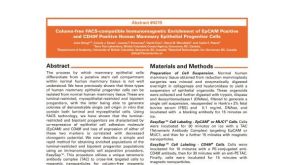 科学海报Column-Free Enrichment of EPCAM Positive and CD49F Positive Human Mammary Epithelial Progenitor Cells
 沪公网安备31010102008431号