Ishikawa S and Ito S ( 2016)
Toxicology in Vitro 38 170--178
Repeated whole cigarette smoke exposure alters cell differentiation and augments secretion of inflammatory mediators in air-liquid interface three-dimensional co-culture model of human bronchial tissue
In vitro models of human bronchial epithelium are useful for toxicological testing because of their resemblance to in vivo tissue. We constructed a model of human bronchial tissue which has a fibroblast layer embedded in a collagen matrix directly below a fully-differentiated epithelial cell layer. The model was applied to whole cigarette smoke (CS) exposure repeatedly from an air-liquid interface culture while bronchial epithelial cells were differentiating. The effects of CS exposure on differentiation were determined by histological and gene expression analyses on culture day 21. We found a decrease in ciliated cells and perturbation of goblet cell differentiation. We also analyzed the effects of CS exposure on the inflammatory response,and observed a significant increase in secretion of IL-8,GRO-α,IL-1β,and GM-CSF. Interestingly,secretion of these mediators was augmented with repetition of whole CS exposure. Our data demonstrate the usefulness of our bronchial tissue model for in vitro testing and the importance of exposure repetition in perturbing the differentiation and inflammation processes.
View Publication
产品号#:
05001
05021
05022
产品名:
PneumaCult™-ALI 培养基
PneumaCult™-ALI 培养基含12 mm Transwell®插件
PneumaCult™-ALI 培养基含6.5 mm Transwell®插件
Molinski SV et al. ( 2017)
EMBO Molecular Medicine 9 9 1224--1243
Orkambi® and amplifier co-therapy improves function from a rare CFTR mutation in gene edited cells and patient tissue
The combination therapy of lumacaftor and ivacaftor (Orkambi®) is approved for patients bearing the major cystic fibrosis (CF) mutation: ΔF508 It has been predicted that Orkambi® could treat patients with rarer mutations of similar theratype"; however a standardized approach confirming efficacy in these cohorts has not been reported. Here we demonstrate that patients bearing the rare mutation: c.3700 A>G causing protein misprocessing and altered channel function-similar to ΔF508-CFTR are unlikely to yield a robust Orkambi® response. While in silico and biochemical studies confirmed that this mutation could be corrected and potentiated by lumacaftor and ivacaftor respectively this combination led to a minor in vitro response in patient-derived tissue. A CRISPR/Cas9-edited bronchial epithelial cell line bearing this mutation enabled studies showing that an "amplifier" compound effective in increasing the levels of immature CFTR protein augmented the Orkambi® response. Importantly this "amplifier" effect was recapitulated in patient-derived nasal cultures-providing the first evidence for its efficacy in augmenting Orkambi® in tissues harboring a rare CF-causing mutation. We propose that this multi-disciplinary approach including creation of CRISPR/Cas9-edited cells to profile modulators together with validation using primary tissue will facilitate therapy development for patients with rare CF mutations.
View Publication
产品号#:
05001
05021
05022
产品名:
PneumaCult™-ALI 培养基
PneumaCult™-ALI 培养基含12 mm Transwell®插件
PneumaCult™-ALI 培养基含6.5 mm Transwell®插件
Reeves SR et al. ( 2016)
Journal of Histochemistry and Cytochemistry 64 6 364--80
Subepithelial Accumulation of Versican in a Cockroach Antigen-Induced Murine Model of Allergic Asthma.
The extracellular matrix (ECM) is an important contributor to the asthmatic phenotype. Recent studies investigating airway inflammation have demonstrated an association between hyaluronan (HA) accumulation and inflammatory cell infiltration of the airways. The ECM proteoglycan versican interacts with HA and is important in the recruitment and activation of leukocytes during inflammation. We investigated the role of versican in the pathogenesis of asthmatic airway inflammation. Using cockroach antigen (CRA)-sensitized murine models of allergic asthma,we demonstrate increased subepithelial versican in the airways of CRA-treated mice that parallels subepithelial increases in HA and leukocyte infiltration. During the acute phase,CRA-treated mice displayed increased gene expression of the four major versican isoforms,as well as increased expression of HA synthases. Furthermore,in a murine model that examines both acute and chronic CRA exposure,versican staining peaked 8 days following CRA challenge and preceded subepithelial leukocyte infiltration. We also assessed versican and HA expression in differentiated primary human airway epithelial cells from asthmatic and healthy children. Increases in the expression of versican isoforms and HA synthases in these epithelial cells were similar to those of the murine model. These data indicate an important role for versican in the establishment of airway inflammation in asthma.
View Publication
产品号#:
05001
05021
05022
产品名:
PneumaCult™-ALI 培养基
PneumaCult™-ALI 培养基含12 mm Transwell®插件
PneumaCult™-ALI 培养基含6.5 mm Transwell®插件
Solleti SK et al. ( 2017)
Scientific Reports 7 1 1--10
MicroRNA expression profiling defines the impact of electronic cigarettes on human airway epithelial cells
While all forms of tobacco exposure have negative health effects,the significance of exposure to electronic cigarettes (eCig) is not fully understood. Here,we studied the global effects of eCig on the micro RNA (miRNA) transcriptome in human lung epithelial cells. Primary human bronchial epithelial (NHBE) cells differentiated at air-liquid interface were exposed to eCig liquid. Exposure of NHBE to any eCig liquid resulted in the induction of oxidative stress-response genes including GCLM,GCLC,GPX2,NQO1 and HO-1. Vaporization of,and/or the presence of nicotine in,eCig liquid was associated with a greater response. We identified 578 miRNAs dysregulated by eCig exposure in NHBE,and 125 miRNA affected by vaporization of eCig liquid. Nicotine containing eCig vapor displayed the most profound effects upon miRNA expression. We selected 8 miRNAs (29A,140,126,374A,26A-2,147B,941 and 589) for further study. We validated increased expression of multiple miRNAs,including miR126,following eCig exposure. We also found significant reduction in the expression of two miR126 target genes,MYC and MRGPRX3,following exposure. These data demonstrated that eCig exposure has profound effects upon gene expression in human lung epithelial cells,some of which are epigenetically programmed at the level of miRNA regulation.
View Publication
产品号#:
05001
05021
05022
产品名:
PneumaCult™-ALI 培养基
PneumaCult™-ALI 培养基含12 mm Transwell®插件
PneumaCult™-ALI 培养基含6.5 mm Transwell®插件
Stevenson C et al. (AUG 2017)
Inflammation research : official journal of the European Histamine Research Society ... [et al.] 66 8 691--700
OBJECTIVE To evaluate the effects of MUC18 on IL-13-mediated airway inflammatory responses in human airway epithelial cells and in mice. MATERIALS Primary normal human tracheobronchial epithelial (HTBE) cells,wild-type (WT) and Muc18 knockout (KO) mice,and mouse tracheal epithelial cells (mTECs) were utilized. TREATMENT Cultured HTBE cells treated with MUC18 siRNA or MUC18 expressing lentivirus were incubated with IL-13 (10 ng/mL) for 24 h. Mice were intranasally instilled with 500 ng of IL-13 for 3 days. mTECs were treated with IL-13 (10 ng/mL) for 3 days. METHODS PCR was used to measure mRNA expression. Western Blot and ELISAs were used to quantify protein expression. Cytospins of bronchoalveolar lavage (BAL) cells were used to obtain leukocyte differentials. RESULTS MUC18 siRNA reduced IL-13-mediated eotaxin-3 (183 ± 44 vs. 380 ± 59 pg/mL,p < 0.05),while MUC18 overexpression increased IL-13-mediated eotaxin-3 (95 ± 3 vs. 58 ± 3 pg/mL,p < 0.05) in HTBE cells. IL-13-treated Muc18 KO mice had a lower percentage of neutrophils in BAL than WT mice (25 ± 3 vs. 35 ± 3%,p = 0.0565). CONCLUSIONS These results implicate MUC18 as a potential enhancer of airway inflammation in a type 2 cytokine (e.g.,IL-13) milieu.
View Publication
Development of a primary human co-culture model of inflamed airway mucosa
Neutrophil breach of the mucosal surface is a common pathological consequence of infection. We present an advanced co-culture model to explore neutrophil transepithelial migration utilizing airway mucosal barriers differentiated from primary human airway basal cells and examined by advanced imaging. Human airway basal cells were differentiated and cultured at air-liquid interface (ALI) on the underside of 3 μm pore-sized transwells,compatible with the study of transmigrating neutrophils. Inverted ALIs exhibit beating cilia and mucus production,consistent with conventional ALIs,as visualized by micro-optical coherence tomography (μOCT). μOCT is a recently developed imaging modality with the capacity for real time two- A nd three-dimensional analysis of cellular events in marked detail,including neutrophil transmigratory dynamics. Further,the newly devised and imaged primary co-culture model recapitulates key molecular mechanisms that underlie bacteria-induced neutrophil transepithelial migration previously characterized using cell line-based models. Neutrophils respond to imposed chemotactic gradients,and migrate in response to Pseudomonas aeruginosa infection of primary ALI barriers through a hepoxilin A3-directed mechanism. This primary cell-based co-culture system combined with μOCT imaging offers significant opportunity to probe,in great detail,micro-anatomical and mechanistic features of bacteria-induced neutrophil transepithelial migration and other important immunological and physiological processes at the mucosal surface.
View Publication
产品号#:
05001
05021
05022
产品名:
PneumaCult™-ALI 培养基
PneumaCult™-ALI 培养基含12 mm Transwell®插件
PneumaCult™-ALI 培养基含6.5 mm Transwell®插件
Yu Z et al. ( 2017)
Toxicology in Vitro 42 April 319--328
Prediction of delivery of organic aerosols onto air-liquid interface cells in vitro using an electrostatic precipitator
To better characterize biological responses to atmospheric organic aerosols,the efficient delivery of aerosol to in vitro lung cells is necessary. In this study,chamber generated secondary organic aerosol (SOA) entered the commercialized exposure chamber (CULTEX® Radial Flow System Compact) where it interfaced with an electrostatic precipitator (ESP) (CULTEX® Electrical Deposition Device) and then deposited on a particle collection plate. This plate contained human lung cells (BEAS-2B) that were cultured on a membrane insert to produce an air-liquid interface (ALI). To augment in vitro assessment using the ESP exposure device,the particle dose was predicted for various sampling parameters such as particle size,ESP deposition voltage,and sampling flowrate. The dose model was evaluated against the experimental measured mass of collected airborne particles. The high flowrate used in this study increased aerosol dose but failed to achieve cell stability. For example,RNA in the ALI BEAS-2B cells in vitro was stable at 0.15 L/minute but decayed at high flowrates. The ESP device and the resulting model were applied to in vitro studies (i.e.,viability and IL-8 expression) of toluene SOA using ALI BEAS-2B cells with a flowrate of 0.15 L/minute,and no cellular RNA decay occurred.
View Publication


 EasySep™小鼠TIL(CD45)正选试剂盒




 技术窍门气液界面培养人支气管上皮细胞的关键步骤
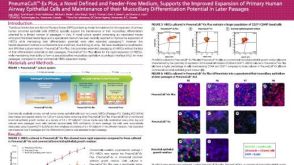 科学海报PneumaCult™-Ex Plus, a Novel Defined and Feeder-Free Medium, Supports the Improved Expansion of Primary Human Airway Epithelial Cells

 沪公网安备31010102008431号