Shikotra A et al. ( 2017)
Journal of immunology (Baltimore,Md. : 1950) 198 8 3307--3317
A CEACAM6-High Airway Neutrophil Phenotype and CEACAM6-High Epithelial Cells Are Features of Severe Asthma.
Severe asthma represents a major unmet clinical need; understanding the pathophysiology is essential for the development of new therapies. Using microarray analysis,we previously found three immunological clusters in asthma: Th2-high,Th17-high,and Th2/17-low. Although new therapies are emerging for Th2-high disease,identifying molecular pathways in Th2-low disease remains an important goal. Further interrogation of our previously described microarray dataset revealed upregulation of gene expression for carcinoembryonic Ag cell adhesion molecule (CEACAM) family members in the bronchi of patients with severe asthma. Our aim was therefore to explore the distribution and cellular localization of CEACAM6 using immunohistochemistry on bronchial biopsy tissue obtained from patients with mild-to-severe asthma and healthy control subjects. Human bronchial epithelial cells were used to investigate cytokine and corticosteroid in vitro regulation of CEACAM6 gene expression. CEACAM6 protein expression in bronchial biopsies was increased in airway epithelial cells and lamina propria inflammatory cells in severe asthma compared with healthy control subjects. CEACAM6 in the lamina propria was localized to neutrophils predominantly. Neutrophil density in the bronchial mucosa was similar across health and the spectrum of asthma severity,but the percentage of neutrophils expressing CEACAM6 was significantly increased in severe asthma,suggesting the presence of an altered neutrophil phenotype. CEACAM6 gene expression in cultured epithelial cells was upregulated by wounding and neutrophil elastase. In summary,CEACAM6 expression is increased in severe asthma and primarily associated with airway epithelial cells and tissue neutrophils. CEACAM6 may contribute to the pathology of treatment-resistant asthma via neutrophil and airway epithelial cell-dependent pathways.
View Publication
产品号#:
05001
05021
05022
产品名:
PneumaCult™-ALI 培养基
PneumaCult™-ALI 培养基含12 mm Transwell®插件
PneumaCult™-ALI 培养基含6.5 mm Transwell®插件
Ishikawa S et al. ( 2017)
Respiratory Research 18 1 1--11
A 3D epithelial-mesenchymal co-culture model of human bronchial tissue recapitulates multiple features of airway tissue remodeling by TGF-β1 treatment
BACKGROUND: The collagen gel contraction assay measures gel size to assess the contraction of cells embedded in collagen gel matrices. Using the assay with lung fibroblasts is useful in studying the lung tissue remodeling process in wound healing and disease development. However,the involvement of bronchial epithelial cells in this process should also be investigated. METHODS: We applied a layer of mucociliary differentiated bronchial epithelial cells onto collagen gel matrices with lung fibroblasts. This co-culture model enables direct contact between epithelial and mesenchymal cells. We stimulated the culture with transforming growth factor (TGF) beta1 as an inducer of tissue remodeling for 21 days,and measured gel size,histological changes,and expression of factors related to extracellular matrix homeostasis. RESULTS: TGF-beta1 exerted a concentration-dependent effect on collagen gel contraction and on contractile myofibroblasts in the mesenchymal collagen layer. TGF-beta1 also induced expression of the mesenchymal marker vimentin in the basal layer of the epithelium,suggesting the induction of epithelial-mesenchymal transition. In addition,the expression of various genes encoding extracellular matrix proteins was upregulated. Fibrotic tenascin-C accumulated in the sub-epithelial region of the co-culture model. CONCLUSION: Our findings indicate that TGF-beta1 can affect both epithelial and mesenchymal cells,and induce gel contraction and structural changes. Our novel in vitro co-culture model will be a useful tool for investigating the roles of epithelial cells,fibroblasts,and their interactions in the airway remodeling process.
View Publication
Efficient Derivation of Functional Human Airway Epithelium from Pluripotent Stem Cells via Temporal Regulation of Wnt Signaling.
Effective derivation of functional airway organoids from induced pluripotent stem cells (iPSCs) would provide valuable models of lung disease and facilitate precision therapies for airway disorders such as cystic fibrosis. However,limited understanding of human airway patterning has made this goal challenging. Here,we show that cyclical modulation of the canonical Wnt signaling pathway enables rapid directed differentiation of human iPSCs via an NKX2-1+progenitor intermediate into functional proximal airway organoids. We find that human NKX2-1+progenitors have high levels of Wnt activation but respond intrinsically to decreases in Wnt signaling by rapidly patterning into proximal airway lineages at the expense of distal fates. Using this directed approach,we were able to generate cystic fibrosis patient-specific iPSC-derived airway organoids with a defect in forskolin-induced swelling that is rescued by gene editing to correct the disease mutation. Our approach has many potential applications in modeling and drug screening for airway diseases.
View Publication
产品号#:
05001
05021
05022
产品名:
PneumaCult™-ALI 培养基
PneumaCult™-ALI 培养基含12 mm Transwell®插件
PneumaCult™-ALI 培养基含6.5 mm Transwell®插件
Solleti SK et al. ( 2017)
Scientific Reports 7 1 1--10
MicroRNA expression profiling defines the impact of electronic cigarettes on human airway epithelial cells
While all forms of tobacco exposure have negative health effects,the significance of exposure to electronic cigarettes (eCig) is not fully understood. Here,we studied the global effects of eCig on the micro RNA (miRNA) transcriptome in human lung epithelial cells. Primary human bronchial epithelial (NHBE) cells differentiated at air-liquid interface were exposed to eCig liquid. Exposure of NHBE to any eCig liquid resulted in the induction of oxidative stress-response genes including GCLM,GCLC,GPX2,NQO1 and HO-1. Vaporization of,and/or the presence of nicotine in,eCig liquid was associated with a greater response. We identified 578 miRNAs dysregulated by eCig exposure in NHBE,and 125 miRNA affected by vaporization of eCig liquid. Nicotine containing eCig vapor displayed the most profound effects upon miRNA expression. We selected 8 miRNAs (29A,140,126,374A,26A-2,147B,941 and 589) for further study. We validated increased expression of multiple miRNAs,including miR126,following eCig exposure. We also found significant reduction in the expression of two miR126 target genes,MYC and MRGPRX3,following exposure. These data demonstrated that eCig exposure has profound effects upon gene expression in human lung epithelial cells,some of which are epigenetically programmed at the level of miRNA regulation.
View Publication
产品号#:
05001
05021
05022
产品名:
PneumaCult™-ALI 培养基
PneumaCult™-ALI 培养基含12 mm Transwell®插件
PneumaCult™-ALI 培养基含6.5 mm Transwell®插件
Reeves SR et al. ( 2016)
Journal of Histochemistry and Cytochemistry 64 6 364--80
Subepithelial Accumulation of Versican in a Cockroach Antigen-Induced Murine Model of Allergic Asthma.
The extracellular matrix (ECM) is an important contributor to the asthmatic phenotype. Recent studies investigating airway inflammation have demonstrated an association between hyaluronan (HA) accumulation and inflammatory cell infiltration of the airways. The ECM proteoglycan versican interacts with HA and is important in the recruitment and activation of leukocytes during inflammation. We investigated the role of versican in the pathogenesis of asthmatic airway inflammation. Using cockroach antigen (CRA)-sensitized murine models of allergic asthma,we demonstrate increased subepithelial versican in the airways of CRA-treated mice that parallels subepithelial increases in HA and leukocyte infiltration. During the acute phase,CRA-treated mice displayed increased gene expression of the four major versican isoforms,as well as increased expression of HA synthases. Furthermore,in a murine model that examines both acute and chronic CRA exposure,versican staining peaked 8 days following CRA challenge and preceded subepithelial leukocyte infiltration. We also assessed versican and HA expression in differentiated primary human airway epithelial cells from asthmatic and healthy children. Increases in the expression of versican isoforms and HA synthases in these epithelial cells were similar to those of the murine model. These data indicate an important role for versican in the establishment of airway inflammation in asthma.
View Publication
Ishikawa S and Ito S ( 2016)
Toxicology in Vitro 38 170--178
Repeated whole cigarette smoke exposure alters cell differentiation and augments secretion of inflammatory mediators in air-liquid interface three-dimensional co-culture model of human bronchial tissue
In vitro models of human bronchial epithelium are useful for toxicological testing because of their resemblance to in vivo tissue. We constructed a model of human bronchial tissue which has a fibroblast layer embedded in a collagen matrix directly below a fully-differentiated epithelial cell layer. The model was applied to whole cigarette smoke (CS) exposure repeatedly from an air-liquid interface culture while bronchial epithelial cells were differentiating. The effects of CS exposure on differentiation were determined by histological and gene expression analyses on culture day 21. We found a decrease in ciliated cells and perturbation of goblet cell differentiation. We also analyzed the effects of CS exposure on the inflammatory response,and observed a significant increase in secretion of IL-8,GRO-α,IL-1β,and GM-CSF. Interestingly,secretion of these mediators was augmented with repetition of whole CS exposure. Our data demonstrate the usefulness of our bronchial tissue model for in vitro testing and the importance of exposure repetition in perturbing the differentiation and inflammation processes.
View Publication


 EasySep™小鼠TIL(CD45)正选试剂盒




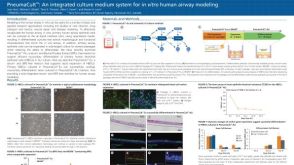 科学海报PneumaCult™: an Integrated Culture Medium System for in Vitro Human Airway Modeling


 沪公网安备31010102008431号