Micropatterning Facilitates the Long-Term Growth and Analysis of iPSC-Derived Individual Human Neurons and Neuronal Networks
The discovery of induced pluripotent stem cells (iPSCs) and their application to patient-specific disease models offers new opportunities for studying the pathophysiology of neurological disorders. However,current methods for culturing iPSC-derived neuronal cells result in clustering of neurons,which precludes the analysis of individual neurons and defined neuronal networks. To address this challenge,cultures of human neurons on micropatterned surfaces are developed that promote neuronal survival over extended periods of time. This approach facilitates studies of neuronal development,cellular trafficking,and related mechanisms that require assessment of individual neurons and specific network connections. Importantly,micropatterns support the long-term stability of cultured neurons,which enables time-dependent analysis of cellular processes in living neurons. The approach described in this paper allows mechanistic studies of human neurons,both in terms of normal neuronal development and function,as well as time-dependent pathological processes,and provides a platform for testing of new therapeutics in neuropsychiatric disorders.
View Publication
产品号#:
05711
100-1281
产品名:
NeuroCult™ SM1 神经添加物
NeuroCult™ SM1 神经添加物
Ferreira JS et al. (JUN 2015)
The Journal of neuroscience : the official journal of the Society for Neuroscience 35 22 8462--79
GluN2B-Containing NMDA Receptors Regulate AMPA Receptor Traffic through Anchoring of the Synaptic Proteasome.
NMDA receptors play a central role in shaping the strength of synaptic connections throughout development and in mediating synaptic plasticity mechanisms that underlie some forms of learning and memory formation in the CNS. In the hippocampus and the neocortex,GluN1 is combined primarily with GluN2A and GluN2B,which are differentially expressed during development and confer distinct molecular and physiological properties to NMDA receptors. The contribution of each subunit to the synaptic traffic of NMDA receptors and therefore to their role during development and in synaptic plasticity is still controversial. We report a critical role for the GluN2B subunit in regulating NMDA receptor synaptic targeting. In the absence of GluN2B,the synaptic levels of AMPA receptors are increased and accompanied by decreased constitutive endocytosis of GluA1-AMPA receptor. We used quantitative proteomic analysis to identify changes in the composition of postsynaptic densities from GluN2B(-/-) mouse primary neuronal cultures and found altered levels of several ubiquitin proteasome system components,in particular decreased levels of proteasome subunits. Enhancing the proteasome activity with a novel proteasome activator restored the synaptic levels of AMPA receptors in GluN2B(-/-) neurons and their endocytosis,revealing that GluN2B-mediated anchoring of the synaptic proteasome is responsible for fine tuning AMPA receptor synaptic levels under basal conditions.
View Publication
产品号#:
05711
100-1281
产品名:
NeuroCult™ SM1 神经添加物
NeuroCult™ SM1 神经添加物
E. Hangen et al. (JUL 2018)
Cell reports 24 4 1001--1012.e3
Neuronal Activity and Intracellular Calcium Levels Regulate Intracellular Transport of Newly Synthesized AMPAR.
Regulation of AMPA receptor (AMPAR) trafficking is a key modulator of excitatory synaptic transmission; however,intracellular vesicular transport of newly synthesized AMPARs has been little studied due to technical limitations. By combining molecular tools with imaging strategies in cultured rat hippocampal neurons,we found that vesicles containing newly synthesized,GluA1-subunit-containing AMPARs are transported antero- and retrogradely at a mean speed of 1.5 mu$m.s-1. Synaptic activity and variations in intracellular calcium levels bidirectionally modulate GluA1 transport. Chemical long-term potentiation (cLTP) initially induces a halt in GluA1 transport,followed by a sustained increase,while acute glutamate uncaging on synaptic spines arrests vesicular movements. GluA1 phosphomimetic mutants preferentially travel to the dendritic tip,probably to replenish extrasynaptic pools,distal to the soma. Our findings indicate that AMPAR intracellular transport is highly regulated during synaptic plasticity and likely controls AMPAR numbers at the plasma membrane.
View Publication
Lippmann ES et al. (APR 2014)
Stem Cells 32 4 1032--1042
Defined human pluripotent stem cell culture enables highly efficient neuroepithelium derivation without small molecule inhibitors.
The embryonic neuroepithelium gives rise to the entire central nervous system in vivo,making it an important tissue for developmental studies and a prospective cell source for regenerative applications. Current protocols for deriving homogenous neuroepithelial cultures from human pluripotent stem cells (hPSCs) consist of either embryoid body-mediated neuralization followed by a manual isolation step or adherent differentiation using small molecule inhibitors. Here,we report that hPSCs maintained under chemically defined,feeder-independent,and xeno-free conditions can be directly differentiated into pure neuroepithelial cultures ([mt]90% Pax6(+)/N-cadherin(+) with widespread rosette formation) within 6 days under adherent conditions,without small molecule inhibitors,and using only minimalistic medium consisting of Dulbecco's modified Eagle's medium/F-12,sodium bicarbonate,selenium,ascorbic acid,transferrin,and insulin (i.e.,E6 medium). Furthermore,we provide evidence that the defined culture conditions enable this high level of neural conversion in contrast to hPSCs maintained on mouse embryonic fibroblasts (MEFs). In addition,hPSCs previously maintained on MEFs could be rapidly converted to a neural compliant state upon transfer to these defined conditions while still maintaining their ability to generate all three germ layers. Overall,this fully defined and scalable protocol should be broadly useful for generating therapeutic neural cells for regenerative applications.
View Publication
产品号#:
05850
05857
05870
05875
85850
85857
85870
85875
产品名:
mTeSR™1
mTeSR™1
Basma H et al. (MAR 2014)
American journal of physiology. Lung cellular and molecular physiology 306 6 L552--65
Reprogramming of COPD lung fibroblasts through formation of induced pluripotent stem cells.
Reprogramming somatic cells to induced pluripotent stem cells (iPSCs) eliminates many epigenetic modifications that characterize differentiated cells. In this study,we tested whether functional differences between chronic obstructive pulmonary disease (COPD) and non-COPD fibroblasts could be reduced utilizing this approach. Primary fibroblasts from non-COPD and COPD patients were reprogrammed to iPSCs. Reprogrammed iPSCs were positive for oct3/4,nanog,and sox2,formed embryoid bodies in vitro,and induced teratomas in nonobese diabetic/severe combined immunodeficient mice. Reprogrammed iPSCs were then differentiated into fibroblasts (non-COPD-i and COPD-i) and were assessed either functionally by chemotaxis and gel contraction or for gene expression by microarrays and compared with their corresponding primary fibroblasts. Primary COPD fibroblasts contracted three-dimensional collagen gels and migrated toward fibronectin less robustly than non-COPD fibroblasts. In contrast,redifferentiated fibroblasts from iPSCs derived from the non-COPD and COPD fibroblasts were similar in response in both functional assays. Microarray analysis identified 1,881 genes that were differentially expressed between primary COPD and non-COPD fibroblasts,with 605 genes differing by more than twofold. After redifferentiation,112 genes were differentially expressed between COPD-i and non-COPD-i with only three genes by more than twofold. Similar findings were observed with microRNA (miRNA) expression: 56 miRNAs were differentially expressed between non-COPD and COPD primary cells; after redifferentiation,only 3 miRNAs were differentially expressed between non-COPD-i and COPD-i fibroblasts. Interestingly,of the 605 genes that were differentially expressed between COPD and non-COPD fibroblasts,293 genes were changed toward control after redifferentiation. In conclusion,functional and epigenetic alterations of COPD fibroblasts can be reprogrammed through formation of iPSCs.
View Publication
产品号#:
05850
05857
05870
05875
85850
85857
85870
85875
产品名:
mTeSR™1
mTeSR™1
Lippmann ES et al. (FEB 2014)
Scientific reports 4 February 2014 4160
A retinoic acid-enhanced, multicellular human blood-brain barrier model derived from stem cell sources.
Blood-brain barrier (BBB) models are often used to investigate BBB function and screen brain-penetrating therapeutics,but it has been difficult to construct a human model that possesses an optimal BBB phenotype and is readily scalable. To address this challenge,we developed a human in vitro BBB model comprising brain microvascular endothelial cells (BMECs),pericytes,astrocytes and neurons derived from renewable cell sources. First,retinoic acid (RA) was used to substantially enhance BBB phenotypes in human pluripotent stem cell (hPSC)-derived BMECs,particularly through adherens junction,tight junction,and multidrug resistance protein regulation. RA-treated hPSC-derived BMECs were subsequently co-cultured with primary human brain pericytes and human astrocytes and neurons derived from human neural progenitor cells (NPCs) to yield a fully human BBB model that possessed significant tightness as measured by transendothelial electrical resistance (˜5,000 $\$(2)). Overall,this scalable human BBB model may enable a wide range of neuroscience studies.
View Publication


 EasySep™小鼠TIL(CD45)正选试剂盒




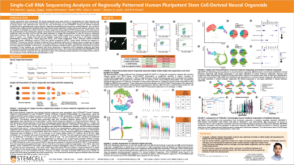 科学海报Single-Cell RNA Sequencing Analysis of Regionally Patterned Human Pluripotent Stem Cell-Derived Neural Organoids
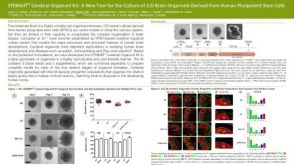 科学海报STEMdiff™ Cerebral Organoid Kit: A New Tool for the Culture of 3D Brain Organoids Derived from hPSCs


 沪公网安备31010102008431号