Er JC et al. (FEB 2015)
Angewandte Chemie - International Edition 54 8 2442--2446
Neuo: A fluorescent chemical probe for live neuron labeling
To address existing limitations in live neuron imaging,we have developed NeuO,a novel cell-permeable fluorescent probe with an unprecedented ability to label and image live neurons selectively over other cells in the brain. NeuO enables robust live neuron imaging and isolation in vivo and in vitro across species; its versatility and ease of use sets the basis for its development in a myriad of neuronal targeting applications.
View Publication
产品号#:
01801
产品名:
NeuroFluor™ NeuO
M. Ortiz-Virumbrales et al. (dec 2017)
Acta neuropathologica communications 5 1 77
CRISPR/Cas9-Correctable mutation-related molecular and physiological phenotypes in iPSC-derived Alzheimer's PSEN2 N141I neurons.
Basal forebrain cholinergic neurons (BFCNs) are believed to be one of the first cell types to be affected in all forms of AD,and their dysfunction is clinically correlated with impaired short-term memory formation and retrieval. We present an optimized in vitro protocol to generate human BFCNs from iPSCs,using cell lines from presenilin 2 (PSEN2) mutation carriers and controls. As expected,cell lines harboring the PSEN2 N141I mutation displayed an increase in the A$\beta$42/40 in iPSC-derived BFCNs. Neurons derived from PSEN2 N141I lines generated fewer maximum number of spikes in response to a square depolarizing current injection. The height of the first action potential at rheobase current injection was also significantly decreased in PSEN2 N141I BFCNs. CRISPR/Cas9 correction of the PSEN2 point mutation abolished the electrophysiological deficit,restoring both the maximal number of spikes and spike height to the levels recorded in controls. Increased A$\beta$42/40 was also normalized following CRISPR/Cas-mediated correction of the PSEN2 N141I mutation. The genome editing data confirms the robust consistency of mutation-related changes in A$\beta$42/40 ratio while also showing a PSEN2-mutation-related alteration in electrophysiology.
View Publication
产品号#:
17854
17854RF
17858
17858RF
17952
17952RF
05790
05792
05793
05794
05795
17754
17861
17877
17877RF
17856
17856RF
100-0694
100-0696
100-1569
85850
85857
产品名:
EasySep™人CD19正选试剂盒II
RoboSep™ 人CD19正选试剂盒II
EasySep™人CD14正选试剂盒II
RoboSep™ 人CD14正选试剂盒II
EasySep™人CD4+ T细胞分选试剂盒
RoboSep™ 人CD4+ T细胞分选试剂盒
BrainPhys™神经元培养基
BrainPhys™神经元培养基和SM1试剂盒
BrainPhys™ 神经元培养基N2-A和SM1试剂盒
BrainPhys™原代神经元试剂盒
BrainPhys™ hPSC 神经元试剂盒
EasySep™ Release人CD19 正选试剂盒
EasySep™人Pan-CD25正选和去除试剂盒
EasySep™人CD138正选试剂盒 II
RoboSep™ 人CD138正选试剂盒 II
EasySep™人CD34正选试剂盒 II
EasySep™人CD34正选试剂盒 II
EasySep™人CD14正选试剂盒II
EasySep™人CD4+ T细胞分离试剂盒
EasySep™人CD34正选试剂盒 II
mTeSR™1
mTeSR™1
Rajasingh S et al. (AUG 2015)
PloS one 10 8 e0134093
Generation of Functional Cardiomyocytes from Efficiently Generated Human iPSCs and a Novel Method of Measuring Contractility.
Human induced pluripotent stem cells (iPSCs) derived cardiomyocytes (iCMCs) would provide an unlimited cell source for regenerative medicine and drug discoveries. The objective of our study is to generate functional cardiomyocytes from human iPSCs and to develop a novel method of measuring contractility of CMCs. In a series of experiments,adult human skin fibroblasts (HSF) and human umbilical vein endothelial cells (HUVECs) were treated with a combination of pluripotent gene DNA and mRNA under specific conditions. The iPSC colonies were identified and differentiated into various cell lineages,including CMCs. The contractile activity of CMCs was measured by a novel method of frame-by-frame cross correlation (particle image velocimetry-PIV) analysis. Our treatment regimen transformed 4% of HSFs into iPSC colonies at passage 0,a significantly improved efficiency compared with use of either DNA or mRNA alone. The iPSCs were capable of differentiating both in vitro and in vivo into endodermal,ectodermal and mesodermal cells,including CMCs with<88% of cells being positive for troponin T (CTT) and Gata4 by flow cytometry. We report a highly efficient combination of DNA and mRNA to generate iPSCs and functional iCMCs from adult human cells. We also report a novel approach to measure contractility of iCMCs.
View Publication
产品号#:
05832
05833
05835
05839
产品名:
STEMdiff™ 神经花环选择试剂
STEMdiff™神经前体细胞培养基
STEMdiff™ 神经诱导培养基
STEMdiff™ 神经诱导培养基
Xia G et al. (JUN 2015)
Stem cells (Dayton,Ohio) 33 6 1829--38
Genome modification leads to phenotype reversal in human myotonic dystrophy type 1 induced pluripotent stem cell-derived neural stem cells.
Myotonic dystrophy type 1 (DM1) is caused by expanded CTG repeats in the 3'-untranslated region (3' UTR) of the DMPK gene. Correcting the mutation in DM1 stem cells would be an important step toward autologous stem cell therapy. The objective of this study is to demonstrate in vitro genome editing to prevent production of toxic mutant transcripts and reverse phenotypes in DM1 stem cells. Genome editing was performed in DM1 neural stem cells (NSCs) derived from human DM1 induced pluripotent stem (iPS) cells. An editing cassette containing SV40/bGH polyA signals was integrated upstream of the CTG repeats by TALEN-mediated homologous recombination (HR). The expression of mutant CUG repeats transcript was monitored by nuclear RNA foci,the molecular hallmarks of DM1,using RNA fluorescence in situ hybridization. Alternative splicing of microtubule-associated protein tau (MAPT) and muscleblind-like (MBNL) proteins were analyzed to further monitor the phenotype reversal after genome modification. The cassette was successfully inserted into DMPK intron 9 and this genomic modification led to complete disappearance of nuclear RNA foci. MAPT and MBNL 1,2 aberrant splicing in DM1 NSCs were reversed to normal pattern in genome-modified NSCs. Genome modification by integration of exogenous polyA signals upstream of the DMPK CTG repeat expansion prevents the production of toxic RNA and leads to phenotype reversal in human DM1 iPS-cells derived stem cells. Our data provide proof-of-principle evidence that genome modification may be used to generate genetically modified progenitor cells as a first step toward autologous cell transfer therapy for DM1.
View Publication
Micropatterning Facilitates the Long-Term Growth and Analysis of iPSC-Derived Individual Human Neurons and Neuronal Networks
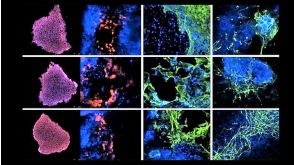
The discovery of induced pluripotent stem cells (iPSCs) and their application to patient-specific disease models offers new opportunities for studying the pathophysiology of neurological disorders. However,current methods for culturing iPSC-derived neuronal cells result in clustering of neurons,which precludes the analysis of individual neurons and defined neuronal networks. To address this challenge,cultures of human neurons on micropatterned surfaces are developed that promote neuronal survival over extended periods of time. This approach facilitates studies of neuronal development,cellular trafficking,and related mechanisms that require assessment of individual neurons and specific network connections. Importantly,micropatterns support the long-term stability of cultured neurons,which enables time-dependent analysis of cellular processes in living neurons. The approach described in this paper allows mechanistic studies of human neurons,both in terms of normal neuronal development and function,as well as time-dependent pathological processes,and provides a platform for testing of new therapeutics in neuropsychiatric disorders.
View Publication


 EasySep™小鼠TIL(CD45)正选试剂盒




 实验方案How to Generate AssemBloids™ from hPSC-Derived Dorsal and Ventral Forebrain Organoid Co-Cultures

 沪公网安备31010102008431号