Haploinsufficiency for ribosomal protein genes causes selective activation of p53 in human erythroid progenitor cells.
Haploinsufficiency for ribosomal protein genes has been implicated in the pathophysiology of Diamond-Blackfan anemia (DBA) and the 5q-syndrome,a subtype of myelodysplastic syndrome. The p53 pathway is activated by ribosome dysfunction,but the molecular basis for selective impairment of the erythroid lineage in disorders of ribosome function has not been determined. We found that p53 accumulates selectively in the erythroid lineage in primary human hematopoietic progenitor cells after expression of shRNAs targeting RPS14,the ribosomal protein gene deleted in the 5q-syndrome,or RPS19,the most commonly mutated gene in DBA. Induction of p53 led to lineage-specific accumulation of p21 and consequent cell cycle arrest in erythroid progenitor cells. Pharmacologic inhibition of p53 rescued the erythroid defect,whereas nutlin-3,a compound that activates p53 through inhibition of HDM2,selectively impaired erythropoiesis. In bone marrow biopsies from patients with DBA or del(5q) myelodysplastic syndrome,we found an accumulation of nuclear p53 staining in erythroid progenitor cells that was not present in control samples. Our findings indicate that the erythroid lineage has a low threshold for the induction of p53,providing a basis for the failure of erythropoiesis in the 5q-syndrome,DBA,and perhaps other bone marrow failure syndromes.
View Publication
产品号#:
03334
03434
03444
产品名:
MethoCult™ M3334
MethoCult™ GF M3434
MethoCult™ GF M3434
Ye B-Q et al. (NOV 2010)
Journal of immunology (Baltimore,Md. : 1950) 185 10 6294--305
Slit2 regulates attractive eosinophil and repulsive neutrophil chemotaxis through differential srGAP1 expression during lung inflammation.
Directional migration of leukocytes is an essential step in leukocyte trafficking during inflammatory responses. However,the molecular mechanisms governing directional chemotaxis of leukocytes remain poorly understood. The Slit family of guidance cues has been implicated for inhibition of leuocyte migration. We report that Clara cells in the bronchial epithelium secreted Slit2,whereas eosinophils and neutrophils expressed its cell-surface receptor,Robo1. Compared to neutrophils,eosinophils exhibited a significantly lower level of Slit-Robo GTPase-activating protein 1 (srGAP1),leading to activation of Cdc42,recruitment of PI3K to Robo1,enhancment of eotaxin-induced eosinophil chemotaxis,and exaggeration of allergic airway inflammation. Notably,OVA sensitization elicited a Slit2 gradient at so-called bronchus-alveoli axis,with a higher level of Slit2 in the bronchial epithelium and a lower level in the alveolar tissue. Aerosol administration of rSlit2 accelerated eosinophil infiltration,whereas i.v. administered Slit2 reduced eosinophil deposition. In contrast,Slit2 inactivated Cdc42 and suppressed stromal cell-derived factor-1α-induced chemotaxis of neutrophils for inhibiting endotoxin-induced lung inflammation,which were reversed by blockade of srGAP1 binding to Robo1. These results indicate that the newly identified Slit2 gradient at the bronchus-alveoli axis induces attractive PI3K signaling in eosinophils and repulsive srGAP1 signaling in neutrophils through differential srGAP1 expression during lung inflammation.
View Publication
产品号#:
19256
19256RF
产品名:
Cowburn AS et al. (JUN 2011)
American journal of respiratory cell and molecular biology 44 6 879--87
Granulocyte/macrophage colony-stimulating factor causes a paradoxical increase in the BH3-only pro-apoptotic protein Bim in human neutrophils.
Neutrophil apoptosis is essential for the resolution of inflammation but is delayed by several inflammatory mediators. In such terminally differentiated cells it has been uncertain whether these agents can inhibit apoptosis through transcriptional regulation of anti-death (Bcl-X(L),Mcl-1,Bcl2A1) or BH3-only (Bim,Bid,Puma) Bcl2-family proteins. We report that granulocyte/macrophage colony-stimulating factor (GM-CSF) and tumor necrosis factor (TNF)-α prevent the normal time-dependent loss of Mcl-1 and Bcl2A1 in neutrophils,and we demonstrate that they cause an NF-κB-dependent increase in Bcl-X(L) transcription/translation. We show that GM-CSF and TNF-α increase and/or maintain mRNA levels for the pro-apoptotic BH3-only protein Bid and that GM-CSF has a similar NF-κB-dependent effect on Bim transcription and BimEL expression. The in-vivo relevance of these findings was indicated by demonstrating that GM-CSF is the dominant neutrophil survival factor in lung lavage from patients with ventilator-associated pneumonia,confirming an increase in lung neutrophil Bim mRNA. Finally GM-CSF caused mitochondrial location of Bim and a switch in phenotype to a cell that displays accelerated caspase-9-dependent apoptosis. This study demonstrates the capacity of neutrophil survival agents to induce a paradoxical increase in the pro-apoptotic proteins Bid and Bim and suggests that this may function to facilitate rapid apoptosis at the termination of the inflammatory cycle.
View Publication
产品号#:
19257
19257RF
21000
20119
20155
产品名:
RoboSep™- S
RoboSep™ 吸头组件抛光剂
RoboSep™分选管套装(9个塑料管)
Taylor D et al. (MAY 2011)
Journal of immunology (Baltimore,Md. : 1950) 186 10 5956--67
Prevention of bone marrow cell apoptosis and regulation of hematopoiesis by type I IFNs during systemic responses to pneumocystis lung infection.
We recently demonstrated that lack of type I IFN signaling (IFNAR knockout) in lymphocyte-deficient mice (IFrag(-/-)) results in bone marrow (BM) failure after Pneumocystis lung infection,whereas lymphocyte-deficient mice with intact IFNAR (RAG(-/-)) had normal hematopoiesis. In the current work,we performed studies to define further the mechanisms involved in the induction of BM failure in this system. BM chimera experiments revealed that IFNAR expression was required on BM-derived but not stroma-derived cells to prevent BM failure. Signals elicited after day 7 postinfection appeared critical in determining BM cell fate. We observed caspase-8- and caspase-9-mediated apoptotic cell death,beginning with neutrophils. Death of myeloid precursors was associated with secondary oxidative stress,and decreasing colony-forming activity in BM cell cultures. Treatment with N-acetylcysteine could slow the progression of,but not prevent,BM failure. Type I IFN signaling has previously been shown to expand the neutrophil life span and regulate the expression of some antiapoptotic factors. Quantitative RT-PCR demonstrated reduced mRNA abundance for the antiapoptotic factors BCL-2,IAP2,MCL-1,and others in BM cells from IFrag(-/-) compared with that in BM cells from RAG(-/-) mice at day 7. mRNA and protein for the proapoptotic cytokine TNF-α was increased,whereas mRNA for the growth factors G-CSF and GM-CSF was reduced. In vivo anti-TNF-α treatment improved precursor cell survival and activity in culture. Thus,we propose that lack of type I IFN signaling results in decreased resistance to inflammation-induced proapoptotic stressors and impaired replenishment by precursors after systemic responses to Pneumocystis lung infection. Our finding may have implications in understanding mechanisms underlying regenerative BM depression/failure during complex immune deficiencies such as AIDS.
View Publication
产品号#:
03534
产品名:
MethoCult™ GF M3534
Zou J et al. (MAY 2011)
Blood 117 21 5561--5572
Oxidase-deficient neutrophils from X-linked chronic granulomatous disease iPS cells: functional correction by zinc finger nuclease-mediated safe harbor targeting.
We have developed induced pluripotent stem cells (iPSCs) from a patient with X-linked chronic granulomatous disease (X-CGD),a defect of neutrophil microbicidal reactive oxygen species (ROS) generation resulting from gp91(phox) deficiency. We demonstrated that mature neutrophils differentiated from X-CGD iPSCs lack ROS production,reproducing the pathognomonic CGD cellular phenotype. Targeted gene transfer into iPSCs,with subsequent selection and full characterization to ensure no off-target changes,holds promise for correction of monogenic diseases without the insertional mutagenesis caused by multisite integration of viral or plasmid vectors. Zinc finger nuclease-mediated gene targeting of a single-copy gp91(phox) therapeutic minigene into one allele of the safe harbor" AAVS1 locus in X-CGD iPSCs without off-target inserts resulted in sustained expression of gp91(phox) and substantially restored neutrophil ROS production. Our findings demonstrate how precise gene targeting may be applied to correction of X-CGD using zinc finger nuclease and patient iPSCs."
View Publication
产品号#:
05850
05857
05870
05875
09600
09650
85850
85857
85870
85875
产品名:
StemSpan™ SFEM
StemSpan™ SFEM
mTeSR™1
mTeSR™1
Benarafa C et al. (JUL 2011)
Journal of leukocyte biology 90 1 21--9
SerpinB1 protects the mature neutrophil reserve in the bone marrow.
SerpinB1 is among the most efficient inhibitors of neutrophil serine proteases--NE,CG,and PR-3--and we investigated here its role in neutrophil development and homeostasis. We found that serpinB1 is expressed in all human bone marrow leukocytes,including stem and progenitor cells. Expression levels were highest in the neutrophil lineage and peaked at the promyelocyte stage,coincident with the production and packaging of the target proteases. Neutrophil numbers were decreased substantially in the bone marrow of serpinB1(-/-) mice. This cellular deficit was associated with an increase in serum G-CSF levels. On induction of acute pulmonary injury,neutrophils were recruited to the lungs,causing the bone marrow reserve pool to be completely exhausted in serpinB1(-/-) mice. Numbers of myeloid progenitors were normal in serpinB1(-/-) bone marrow,coincident with the absence of target protease expression at these developmental stages. Maturation arrest of serpinB1(-/-) neutrophils was excluded by the normal CFU-G growth in vitro and the normal expression in mature neutrophils of early and late differentiation markers. Normal absolute numbers of proliferating neutrophils and pulse-chase kinetic studies in vivo showed that the bone marrow deficit in serpinB1(-/-) mice was largely restricted to mature,postmitotic neutrophils. Finally,upon overnight culture,apoptosis and necrosis were greater in purified bone marrow neutrophils from serpinB1(-/-) compared with WT mice. Collectively,these findings demonstrate that serpinB1 sustains a healthy neutrophil reserve that is required in acute immune responses.
View Publication
产品号#:
03434
03444
产品名:
MethoCult™ GF M3434
MethoCult™ GF M3434
Walter DH et al. (FEB 2011)
Circulation. Cardiovascular interventions 4 1 26--37
Intraarterial administration of bone marrow mononuclear cells in patients with critical limb ischemia: a randomized-start, placebo-controlled pilot trial (PROVASA).
BACKGROUND: Critical limb ischemia due to peripheral arterial occlusive disease is associated with a severely increased morbidity and mortality. There is no effective pharmacological therapy available. Injection of autologous bone marrow-derived mononuclear cells (BM-MNC) is a promising therapeutic option in patients with critical limb ischemia,but double-blind,randomized trials are lacking. METHODS AND RESULTS: Forty patients with critical limb ischemia were included in a multicenter,phase II,double-blind,randomized-start trial to receive either intraarterial administration of BM-MNC or placebo followed by active treatment with BM-MNC (open label) after 3 months. Intraarterial administration of BM-MNC did not significantly increase ankle-brachial index and,thus,the trial missed its primary end point. However,cell therapy was associated with significantly improved ulcer healing (ulcer area,3.2±4.7 cm(2) to 1.89±3.5 cm(2) [P=0.014] versus placebo,2.92±3.5 cm(2) to 2.89±4.1 cm(2) [P=0.5]) and reduced rest pain (5.2±1.8 to 2.2±1.3 [P=0.009] versus placebo,4.5±2.4 to 3.9±2.6 [P=0.3]) within 3 months. Limb salvage and amputation-free survival rates did not differ between the groups. Repeated BM-MNC administration and higher BM-MNC numbers and functionality were the only independent predictors of improved ulcer healing. Ulcer healing induced by repeated BM-MNC administration significantly correlated with limb salvage (r=0.8; Ptextless0.001). CONCLUSIONS: Intraarterial administration of BM-MNC is safe and feasible and accelerates wound healing in patients without extensive gangrene and impending amputation. These exploratory findings of this pilot trial need to be confirmed in a larger randomized trial in patients with critical limb ischemia and stable ulcers.
View Publication
Y. Kuwano et al. (MAY 2016)
Journal of Immunology 196 9 3828--33
G$\alpha$i2 and G$\alpha$i3 Differentially Regulate Arrest from Flow and Chemotaxis in Mouse Neutrophils.
Leukocyte recruitment to inflammation sites progresses in a multistep cascade. Chemokines regulate multiple steps of the cascade,including arrest,transmigration,and chemotaxis. The most important chemokine receptor in mouse neutrophils is CXCR2,which couples through G$\alpha$i2- and G$\alpha$i3-containing heterotrimeric G proteins. Neutrophils arrest in response to CXCR2 stimulation. This is defective in G$\alpha$i2-deficient neutrophils. In this study,we show that G$\alpha$i3-deficient neutrophils showed reduced transmigration but normal arrest in mice. We also tested G$\alpha$i2- or G$\alpha$i3-deficient neutrophils in a CXCL1 gradient generated by a microfluidic device. G$\alpha$i3-,but not G$\alpha$i2-,deficient neutrophils showed significantly reduced migration and directionality. This was confirmed in a model of sterile inflammation in vivo. G$\alpha$i2-,but not G$\alpha$i3-,deficient neutrophils showed decreased Ca(2+) flux in response to CXCR2 stimulation. Conversely,G$\alpha$i3-,but not G$\alpha$i2-,deficient neutrophils exhibited reduced AKT phosphorylation upon CXCR2 stimulation. We conclude that G$\alpha$i2 controls arrest and G$\alpha$i3 controls transmigration and chemotaxis in response to chemokine stimulation of neutrophils.
View Publication
产品号#:
19762
19762RF
20155
产品名:
EasySep™小鼠中性粒细胞富集试剂盒
RoboSep™ 小鼠中性粒细胞富集试剂盒含滤芯吸头
RoboSep™分选管套装(9个塑料管)
Bü et al. (OCT 1999)
Blood 94 7 2343--56
The monoclonal antibody 97A6 defines a novel surface antigen expressed on human basophils and their multipotent and unipotent progenitors.
Basophils (Ba) and mast cells (MC) are important effector cells of inflammatory reactions. Both cell types derive from CD34(+) hematopoietic progenitors. However,little is known about the cell subsets that become committed to and give rise to Ba and/or MC. We have generated a monoclonal antibody (MoAb),97A6,that specifically detects human Ba,MC (lung,skin),and their CD34(+) progenitors. Other mature hematopoietic cells (neutrophils,eosinophils,monocytes,lymphocytes,platelets) did not react with MoAb 97A6,and sorting of 97A6(+) peripheral blood (PB) and bone marrow (BM) cells resulted in an almost pure population (textgreater98%) of Ba. Approximately 1% of CD34(+) BM and PB cells was found to be 97A6(+). Culture of sorted CD34(+)97A6(+) BM cells in semisolid medium containing phytohemagglutinin-stimulated leukocyte supernatant for 16 days (multilineage assay) resulted in the formation of pure Ba colonies (10 of 40),Ba-eosinophil colonies (7 of 40),Ba-macrophage colonies (3 of 40),and multilineage Ba-eosinophil-macrophage and/or neutrophil colonies (12 of 40). In contrast,no Ba could be cultured from CD34(+)97A6(-) cells. Liquid culture of CD34(+) PB cells in the presence of 100 ng/mL interleukin (IL)-3 (Ba progenitor assay) resulted in an increase of 97A6(+) cells,starting from 1% of day-0 cells to almost 70% (basophils) after day 7. Culture of sorted BM CD34(+)97A6(+) cells in the presence of 100 ng/mL stem cell factor (SCF) for 35 days (mast cell progenitor assay) resulted in the growth of MC (textgreater30% on day 35). Anti-IgE-induced IgE receptor cross-linking on Ba for 15 minutes resulted in a 4-fold to 5-fold upregulation of 97A6 antigen expression. These data show that the 97A6-reactive antigen plays a role in basophil activation and is expressed on multipotent CD34(+) progenitors,MC progenitors,Ba progenitors,as well as on mature Ba and tissue MC. The lineage-specificity of MoAb 97A6 suggests that this novel marker may be a useful tool to isolate and analyze Ba/MC and their progenitors.
View Publication
产品号#:
产品名:
挂图
Human Immune Cytokines
Infographic of key cytokines for expansion, differentiation and characterization of major immune cell types
Valayer A et al. (SEP 2016)
Journal of leukocyte biology
Neutrophils can disarm NK cell response through cleavage of NKp46.
Polymorphonuclear neutrophils (PMNs) can contribute to the regulation of the host immune response by crosstalk with innate and adaptive leukocytes,including NK cells. Mechanisms by which this immunoregulation process occurs remain incompletely understood. Here,we focused on the effect of human neutrophil-derived serine proteases on NKp46,a crucial activating receptor expressed on NK cells. We used flow cytometry,Western blotting,and mass spectrometry (MS) analysis to reveal that cathepsin G [CG; and not elastase or proteinase 3 (PR3)] induces a time- and concentration-dependent,down-regulatory effect on NKp46 expression through a restricted proteolytic mechanism. We also used a functional assay to demonstrate that NKp46 cleavage by CG severely impairs NKp46-mediated responses of NK cells,including IFN-γ production and cell degranulation. Importantly,sputa of cystic fibrosis (CF) patients,which have high concentrations of CG,also alter NKp46 on NK cells. Hence,we have identified a new immunoregulatory mechanism of neutrophils that proteolytically disarms NK cell responses.
View Publication


 EasySep™小鼠TIL(CD45)正选试剂盒





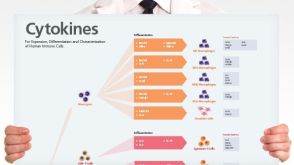 挂图Human Immune Cytokines Infographic of key cytokines for expansion, differentiation and characterization of major immune cell types
 沪公网安备31010102008431号