A. Reuter et al. ( 2015)
The Journal of Immunology 194 2696-2705
Criteria for Dendritic Cell Receptor Selection for Efficient Antibody-Targeted Vaccination
Ab-targeted vaccination involves targeting a receptor of choice expressed by dendritic cells (DCs) with Ag-coupled Abs. Currently,there is little consensus as to which criteria determine receptor selection to ensure superior Ag presentation and immunity. In this study,we investigated parameters of DC receptor internalization and determined how they impact Ag presentation outcomes. First,using mixed bone marrow chimeras,we established that Ag-targeted,but not nontargeted,DCs are responsible for Ag presentation in settings of Ab-targeted vaccination in vivo. Next,we analyzed parameters of DEC205 (CD205),Clec9A,CD11c,CD11b,and CD40 endocytosis and obtained quantitative measurements of internalization speed,surface turnover,and delivered Ag load. Exploiting these parameters in MHC class I (MHC I) and MHC class II (MHC II) Ag presentation assays,we showed that receptor expression level,proportion of surface turnover,or speed of receptor internalization did not impact MHC I or MHC II Ag presentation efficiency. Furthermore,the Ag load delivered to DCs did not correlate with the efficiency of MHC I or MHC II Ag presentation. In contrast,targeting Ag to CD8(+) or CD8(-) DCs enhanced MHC I or MHC II Ag presentation,respectively. Therefore,receptor expression levels,speed of internalization,and/or the amount of Ag delivered can be excluded as major determinants that dictate Ag presentation efficiency in setting of Ab-targeted vaccination.
View Publication
Lelaidier M et al. (OCT 2015)
Oncotarget 6 30 29440--55
TRAIL-mediated killing of acute lymphoblastic leukemia by plasmacytoid dendritic cell-activated natural killer cells.
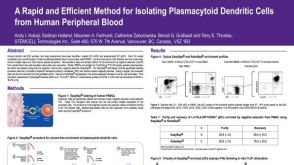
Acute lymphoblastic leukemia (ALL) still frequently recurs after hematopoietic stem cell transplantation (HSCT),underscoring the need to improve the graft-versus-leukemia (GvL) effect. Natural killer (NK) cells reconstitute in the first months following HSCT when leukemia burden is at its lowest,but ALL cells have been shown to be resistant to NK cell-mediated killing. We show here that this resistance is overcome by NK cell stimulation with TLR-9-activated plasmacytoid dendritic cells (pDCs). NK cell priming with activated pDCs resulted in TRAIL and CD69 up-regulation on NK cells and IFN-γ production. NK cell activation was dependent on IFN-α produced by pDCs,but was not reproduced by IFN-α alone. ALL killing was further enhanced by inhibition of KIR engagement. We showed that ALL lysis was mainly mediated by TRAIL engagement,while the release of cytolytic granules was involved when ALL expressed NK cell activating receptor ligands. Finally,adoptive transfers of activated-pDCs in ALL-bearing humanized mice delayed the leukemia onset and cure 30% of mice. Our data therefore demonstrate that TLR-9 activated pDCs are a powerful tool to overcome ALL resistance to NK cell-mediated killing and to reinforce the GvL effect of HSCT. These results open new therapeutic avenues to prevent relapse in children with ALL.
View Publication
产品号#:
19062
19062RF
19055
19055RF
产品名:
EasySep™人浆细胞样DC富集试剂盒
RoboSep™ 人浆细胞样DC富集试剂盒含滤芯吸头
EasySep™人NK细胞富集试剂盒
RoboSep™ 人NK细胞富集试剂盒含滤芯吸头
Grimaldi JC et al. (JUN 1999)
Journal of Leukocyte Biology 65 6 846--53
Depletion of eosinophils in mice through the use of antibodies specific for C-C chemokine receptor 3 (CCR3).
We have generated rat monoclonal antibodies specific for the mouse eotaxin receptor,C-C chemokine receptor 3 (CCR3). Several anti-CCR3 mAbs proved to be useful for in vivo depletion of CCR3-expressing cells and immunofluorescent staining. In vivo CCR3 mAbs of the IgG2b isotype substantially depleted blood eosinophil levels in Nippostrongyus brasiliensis-infected mice. Repeated anti-CCR3 mAb treatment in these mice significantly reduced tissue eosinophilia in the lung tissue and bronchoalveolar lavage fluid. Flow cytometry revealed that mCCR3 was expressed on eosinophils but not on stem cells,dendritic cells,or cells from the thymus,lymph node,or spleen of normal mice. Unlike human Th2 cells,mouse Th2 cells did not express detectable levels of CCR3 nor did they give a measurable response to eotaxin. None of the mAbs were antagonists or agonists of CCR3 calcium mobilization. To our knowledge,the antibodies described here are the first mAbs reported to be specific for mouse eosinophils and to be readily applicable for the detection,isolation,and in vivo depletion of eosinophils.
View Publication
产品号#:
03800
03801
03802
03803
03804
03805
03806
产品名:
ClonaCell™-HY杂交瘤试剂盒
ClonaCell™-HY培养基A
ClonaCell™-HY 培养基 B
ClonaCell™-HY 培养基 C
ClonaCell™-HY 培养基 D
ClonaCell™-HY 培养基 E
ClonaCell™-HY PEG
Chen Y et al. (JUL 2009)
Journal of immunology (Baltimore,Md. : 1950) 183 2 1346--59
Regulation of dendritic cells and macrophages by an anti-apoptotic cell natural antibody that suppresses TLR responses and inhibits inflammatory arthritis.
Although natural Abs (NAbs) are present from birth,little is known about what drives their selection and whether they have housekeeping functions. The prototypic T15-NAb,first identified because of its protective role in infection,is representative of a special type of NAb response that specifically recognizes and forms complexes with apoptotic cells and which promotes cell-corpse engulfment by phagocytes. We now show that this T15-NAb IgM-mediated clearance process is dependent on the recruitment of C1q and mannose-binding lectin,which have known immune modulatory activities that also provide eat me" signals for enhancing phagocytosis. Further investigation revealed that the addition of T15-NAb significantly suppressed in vitro LPS-induced TNF-alpha and IL-6 secretion by the macrophage-like cell line�
View Publication
产品号#:
09600
09650
产品名:
StemSpan™ SFEM
StemSpan™ SFEM
Costantini C et al. (JAN 2009)
Immunobiology 214 9-10 828--34
On the co-purification of 6-sulfo LacNAc(+) dendritic cells (slanDC) with NK cells enriched from human blood.
The ability of NK cells to directly recognize pathogens and be activated via Toll-like receptors (TLR) is increasingly recognized. Nevertheless,controversial results on the NK cell ability to be directly activated by lipopolysaccharide (LPS),the ligand of TLR4,have been recently reported. To start elucidating the reasons explaining the contrasting observations of the literature,we focused on the potential role of currently used NK cell purification procedures to condition putative NK cell responsiveness to LPS. To do so,human NK cells were isolated by negative selection,using three different commercial kits,to be comparatively evaluated for the production of IFNgamma in response to ultra-pure LPS and/or IL-2. Despite the lack of surface TLR4,we found that two out of the three NK cell-enriched populations released IFNgamma (and one of the two,IL-12p70 as well) in response to the LPS plus IL-2 combination,whereas the last one did not. However,the two LPS plus IL-2-responsive NK cell populations were found variably contaminated with 6-sulfo LacNAc(+) dendritic cells (slanDC),demonstrated responsible for triggering,via the production of IL-12p70 in response to LPS,the release of IFNgamma by IL-2-stimulated NK cells. Accordingly,slanDC depletion completely abrogated the capacity to produce both IL-12p70 and IFNgamma in response to LPS plus IL-2 by slanDC-containing NK cells. Taken together,our data uncover that two commercially available kits,specifically designed to isolate NK cells by negative selection,also co-purify variable amounts of slanDC. The latter cells may dramatically affect the outcome of experiments carried on to evaluate NK cell responsiveness to TLR agonists such as LPS.
View Publication
产品号#:
19055
19055RF
产品名:
EasySep™人NK细胞富集试剂盒
RoboSep™ 人NK细胞富集试剂盒含滤芯吸头
Guilliams M et al. (MAR 2010)
Blood 115 10 1958--68
Skin-draining lymph nodes contain dermis-derived CD103(-) dendritic cells that constitutively produce retinoic acid and induce Foxp3(+) regulatory T cells.
Small intestinal CD103(+) dendritic cells (DCs) have the selective ability to promote de novo generation of regulatory T cells via the production of retinoic acid (RA). Considering that aldehyde dehydrogenase (ALDH) activity controls the production of RA,we used a flow cytometry-based assay to measure ALDH activity at the single-cell level and to perform a comprehensive analysis of the RA-producing DC populations present in lymphoid and nonlymphoid mouse tissues. RA-producing DCs were primarily of the tissue-derived,migratory DC subtype and can be readily found in the skin and in the lungs as well as in their corresponding draining lymph nodes. The RA-producing skin-derived DCs were capable of triggering the generation of regulatory T cells,a finding demonstrating that the presence of RA-producing,tolerogenic DCs is not restricted to the intestinal tract as previously thought. Unexpectedly,the production of RA by skin DCs was restricted to CD103(-) DCs,indicating that CD103 expression does not constitute a universal" marker for RA-producing mouse DCs. Finally�
View Publication
产品号#:
01700
01705
01702
产品名:
ALDEFLUOR™ 试剂盒
ALDEFLUOR™ DEAB试剂, 1.5 mM, 1 mL
ALDEFLUOR™检测缓冲液
Krummen M et al. (JUL 2010)
Journal of leukocyte biology 88 1 189--99
Release of IL-12 by dendritic cells activated by TLR ligation is dependent on MyD88 signaling, whereas TRIF signaling is indispensable for TLR synergy.
Recently,it has been shown that certain combinations of TLR ligands act in synergy to induce the release of IL-12 by DCs. In this study,we sought to define the critical parameters underlying TLR synergy. Our data show that TLR ligands act synergistically if MyD88- and TRIF-dependent ligands are combined. TLR4 uses both of these adaptor molecules,thus activation via TLR4 proved to be a synergistic event on its own. TLR synergy did not affect all aspects of DC activation but enhanced primarily the release of certain cytokines,particularly IL-12,whereas the expression of costimulatory molecules remained unchanged. Consequently,synergistic activation of DC did not affect their ability to induce T cell proliferation but resulted in T(H)1-biased responses in vitro and in vivo. Furthermore,we examined the impact of TLR ligand combinations on primary DC in vitro but observed only modest effects with a combination of CpG + Poly (I:C). However,noticeable synergy in terms of IL-12 production by DCs was detectable in vivo after systemic administration of CpG + Poly (I:C). Finally,we show that synergy is partially dependent on IFNAR signaling but does not require the release of IFNs to the enviroment,suggesting an autocrine action of type I IFNs.
View Publication


 EasySep™小鼠TIL(CD45)正选试剂盒





 沪公网安备31010102008431号