Lapter S et al. (MAR 2007)
Stem cells (Dayton,Ohio) 25 3 761--70
Structure and implied functions of truncated B-cell receptor mRNAs in early embryo and adult mesenchymal stem cells: Cdelta replaces Cmu in mu heavy chain-deficient mice.
Stem cells exhibit a promiscuous gene expression pattern. We show herein that the early embryo and adult MSCs express B-cell receptor component mRNAs. To examine possible bearings of these genes on the expressing cells,we studied immunoglobulin mu chain-deficient mice. Pregnant mu chain-deficient females were found to produce a higher percentage of defective morulae compared with control females. Structure analysis indicated that the mu mRNA species found in embryos and in mesenchyme consist of the constant region of the mu heavy chain that encodes a recombinant 50-kDa protein. In situ hybridization localized the constant mu gene expression to loose mesenchymal tissues within the day-12.5 embryo proper and the yolk sac. In early embryo and in adult mesenchyme from mu-deficient mice,delta replaced mu chain,implying a possible requirement of these alternative molecules for embryo development and mesenchymal functions. Indeed,overexpression of the mesenchymal-truncated mu heavy chain in 293T cells resulted in specific subcellular localization and in G(1) growth arrest. The lack of such occurrence following overexpression of a complete,rearranged form of mu chain suggests that the mesenchymal version of this mRNA may possess unique functions.
View Publication
产品号#:
05501
05502
产品名:
Muguruma Y et al. (MAR 2006)
Blood 107 5 1878--87
Reconstitution of the functional human hematopoietic microenvironment derived from human mesenchymal stem cells in the murine bone marrow compartment.
Hematopoiesis is maintained by specific interactions between both hematopoietic and nonhematopoietic cells. Whereas hematopoietic stem cells (HSCs) have been extensively studied both in vitro and in vivo,little is known about the in vivo characteristics of stem cells of the nonhematopoietic component,known as mesenchymal stem cells (MSCs). Here we have visualized and characterized human MSCs in vivo following intramedullary transplantation of enhanced green fluorescent protein-marked human MSCs (eGFP-MSCs) into the bone marrow (BM) of nonobese diabetic/severe combined immunodeficiency (NOD/SCID) mice. Between 4 to 10 weeks after transplantation,eGFP-MSCs that engrafted in murine BM integrated into the hematopoietic microenvironment (HME) of the host mouse. They differentiated into pericytes,myofibroblasts,BM stromal cells,osteocytes in bone,bone-lining osteoblasts,and endothelial cells,which constituted the functional components of the BM HME. The presence of human MSCs in murine BM resulted in an increase in functionally and phenotypically primitive human hematopoietic cells. Human MSC-derived cells that reconstituted the HME appeared to contribute to the maintenance of human hematopoiesis by actively interacting with primitive human hematopoietic cells.
View Publication
产品号#:
04034
04044
产品名:
MethoCult™ H4034 Optimum
MethoCult™ H4034 Optimum
Maes C et al. (MAY 2006)
The Journal of clinical investigation 116 5 1230--42
Placental growth factor mediates mesenchymal cell development, cartilage turnover, and bone remodeling during fracture repair.
Current therapies for delayed- or nonunion bone fractures are still largely ineffective. Previous studies indicated that the VEGF homolog placental growth factor (PlGF) has a more significant role in disease than in health. Therefore we investigated the role of PlGF in a model of semi-stabilized bone fracture healing. Fracture repair in mice lacking PlGF was impaired and characterized by a massive accumulation of cartilage in the callus,reminiscent of delayed- or nonunion fractures. PlGF was required for the early recruitment of inflammatory cells and the vascularization of the fracture wound. Interestingly,however,PlGF also played a role in the subsequent stages of the repair process. Indeed in vivo and in vitro findings indicated that PlGF induced the proliferation and osteogenic differentiation of mesenchymal progenitors and stimulated cartilage turnover by particular MMPs. Later in the process,PlGF was required for the remodeling of the newly formed bone by stimulating osteoclast differentiation. As PlGF expression was increased throughout the process of bone repair and all the important cell types involved expressed its receptor VEGFR-1,the present data suggest that PlGF is required for mediating and coordinating the key aspects of fracture repair. Therefore PlGF may potentially offer therapeutic advantages for fracture repair.
View Publication
产品号#:
03534
03334
03434
03444
18753
18753RF
产品名:
MethoCult™ GF M3534
MethoCult™ M3334
MethoCult™ GF M3434
MethoCult™ GF M3434
Zhang H et al. (NOV 2005)
American journal of physiology. Heart and circulatory physiology 289 5 H2089--96
Increasing donor age adversely impacts beneficial effects of bone marrow but not smooth muscle myocardial cell therapy.
We evaluated the impact of donor age on the efficacy of myocardial cellular therapy for ischemic cardiomyopathy. Characteristics of smooth muscle cells (SMC),bone marrow stromal cells (MSCs),and skeletal muscle cells (SKMCs) from young,adult,and old rats were compared in vitro. Three weeks after coronary ligation,3.5 million SMCs (n = 11) or MSCs (n = 9) from old syngenic rats or culture medium (n = 6) were injected into the ischemic region. Five weeks after implantation,cardiac function was assessed by echocardiography and the Langendorff apparatus. In the in vitro study,the numbers and proliferation of MSCs from fresh bone marrow and SKMCs from fresh tissue but not SMCs were markedly diminished in old animals (P textless 0.05 both groups). SKMCs from old animals did not reach confluence. After treatment with 5-azacytidine (azacitidine),the myogenic potential of old MSCs was decreased compared with young MSCs. In the in vivo study,both SMC and MSC transplantation induced significant angiogenesis compared with media injections (P textless 0.05 both groups). Transplantation of SMCs but not MSCs prevented scar thinning (P = 0.03) and improved ejection fraction and fractional shortening (P textless 0.05). Load-independent indices of cardiac function in a Langendorff preparation confirmed improved function in the aged SMC group (P = 0.01) but not in the MSC group compared with the control group. In conclusion,donor age adversely impacts the efficacy of cellular therapy for myocardial regeneration and is cell-type dependent. SMCs from old donors retain their ability to improve cardiac function after implantation into ischemic myocardium.
View Publication


 EasySep™小鼠TIL(CD45)正选试剂盒




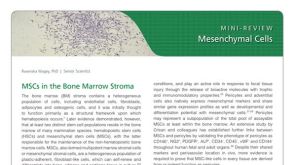 研究综述Mesenchymal Stromal Cells: Markers, Isolation and Culture, Differentiation, and Therapeutic Potential


 沪公网安备31010102008431号