K. B. Langer et al. (APR 2018)
Stem cell reports 10 4 1282--1293
Retinal Ganglion Cell Diversity and Subtype Specification from Human Pluripotent Stem Cells.
Retinal ganglion cells (RGCs) are the projection neurons of the retina and transmit visual information to postsynaptic targets in the brain. While this function is shared among nearly all RGCs,this class of cell is remarkably diverse,comprised of multiple subtypes. Previous efforts have identified numerous RGC subtypes in animal models,but less attention has been paid to human RGCs. Thus,efforts of this study examined the diversity of RGCs differentiated from human pluripotent stem cells (hPSCs) and characterized defined subtypes through the expression of subtype-specific markers. Further investigation of these subtypes was achieved using single-cell transcriptomics,confirming the combinatorial expression of molecular markers associated with these subtypes,and also provided insight into more subtype-specific markers. Thus,the results of this study describe the derivation of RGC subtypes from hPSCs and will support the future exploration of phenotypic and functional diversity within human RGCs.
View Publication
Lu J et al. (APR 2017)
Journal of biomedical materials research. Part A 105 4 1094--1104
Interactions of human embryonic stem cell-derived cardiovascular progenitor cells with immobilized extracellular matrix proteins.
Human embryonic stem cell-derived cardiovascular progenitor cells (hESC-CVPCs) hold great promise for cell-based therapies of heart diseases. However,little is known about their niche microenvironment and in particular the required extracellular matrix (ECM) components. Here we screened combinations of surface-immobilized ECM proteins to identify substrates that support the attachment and survival of hESC-CVPCs. Covalent immobilization of ECM proteins laminin (Lm),fibronectin (Fn),collagen I (CI),collagen III (CIII),and collagen IV (CIV) in multiple combinations and concentrations was achieved by reductive amination on transparent acetaldehyde plasma polymer (AAPP) interlayer coatings. We identified that CI,CIII,CIV,and Fn and their combinations were important for hESC-CVPC attachment and survival,while Lm was dispensable. Moreover,for coatings displaying single ECM proteins,CI and CIII performed better than CIV and Fn,while coatings displaying the combined ECM proteins CIII + CIV and Fn + CIII + CIV at 100 µg/mL were comparable to Matrigel in regard to supporting hESC-CVPC attachment and viability. Our results identify ECM proteins required for hESC-CVPCs and demonstrate that coatings displaying multiple immobilized ECM proteins offer a suitable microenvironment for the attachment and survival of hESC-CVPCs. This knowledge contributes to the development of approaches for maintaining hESC-CVPCs and therefore to advances in cardiovascular regeneration. textcopyright 2017 Wiley Periodicals,Inc. J Biomed Mater Res Part A: 105A: 1094-1104,2017.
View Publication
产品号#:
85850
85857
85870
85875
产品名:
mTeSR™1
mTeSR™1
Gu Y et al. (JAN 2014)
Protein & Cell 5 1 59--68
Global DNA methylation and transcriptional analyses of human ESC-derived cardiomyocytes
With defined culture protocol,human embryonic stem cells (hESCs) are able to generate cardiomyocytes in vitro,therefore providing a great model for human heart development,and holding great potential for cardiac disease therapies. In this study,we successfully generated a highly pure population of human cardiomyocytes (hCMs) (backslashtextgreater95% cTnT+) from hESC line,which enabled us to identify and characterize an hCM-specific signature,at both the gene expression and DNA methylation levels. Gene functional association network and gene-disease network analyses of these hCM-enriched genes provide new insights into the mechanisms of hCM transcriptional regulation,and stand as an informative and rich resource for investigating cardiac gene functions and disease mechanisms. Moreover,we show that cardiac-structural genes and cardiac-transcription factors have distinct epigenetic mechanisms to regulate their gene expression,providing a better understanding of how the epigenetic machinery coordinates to regulate gene expression in different cell types.
View Publication
产品号#:
05850
05857
05870
05875
85850
85857
85870
85875
产品名:
mTeSR™1
mTeSR™1
Bogomazova AN et al. (MAR 2014)
Chromosoma 123 1-2 117--128
Reactivation of Х chromosome upon reprogramming leads to changes in the replication pattern and 5hmC accumulation
Once set,the inactive status of the X chromosome in female somatic cells is preserved throughout subsequent cell divisions. The inactive status of the X chromosome is characterized by many features,including late replication. In contrast to induced pluripotent stem cells (iPSCs) in mice,the X chromosome in human female iPSCs usually remains inactive after reprogramming of somatic cells to the pluripotent state,although recent studies point to the possibility of reactivation of the X chromosome. Here,we demonstrated that,during reprogramming,the inactive X chromosome switches from late to synchronous replication,with restoration of the transcription of previously silenced genes. This process is accompanied by accumulation of a new epigenetic mark or intermediate of the DNA demethylation pathway,5-hydroxymethylcytosine (5hmC),on the activated X chromosome. Our results indicate that the active status of the X chromosome is better confirmed by early replication and the reappearance of 5hmC,rather than by appearance of histone marks of active chromatin,removal of histone marks of inactive chromatin,or an absence of XIST coating.
View Publication
产品号#:
05850
05857
05870
05875
85850
85857
85870
85875
产品名:
mTeSR™1
mTeSR™1
Hwang GH et al. (DEC 2017)
Journal of cellular physiology 232 12 3384--3395
Purification of small molecule-induced cardiomyocytes from human induced pluripotent stem cells using a reporter system.
In order to realize the practical use of human pluripotent stem cell (hPSC)-derived cardiomyocytes for the purpose of clinical use or cardiovascular research,the generation of large numbers of highly purified cardiomyocytes should be achieved. Here,we show an efficient method for cardiac differentiation of human induced pluripotent stem cells (hiPSCs) in chemically defined conditions and purification of hiPSC-derived cardiomyocytes using a reporter system. Regulation of the Wnt/β-catenin signaling pathway is implicated in the induction of the cardiac differentiation of hPSCs. We increased cardiac differentiation efficiency of hiPSCs in chemically defined conditions through combined treatment with XAV939,a tankyrase inhibitor and IWP2,a porcupine inhibitor and optimized concentrations. Although cardiac differentiation efficiency was high (>80%),it was difficult to suppress differentiation into non-cardiac cells,Therefore,we applied a lentiviral reporter system,wherein green fluorescence protein (GFP) and Zeocin-resistant gene are driven by promoter activation of a gene (TNNT2) encoding cardiac troponin T (cTnT),a cardiac-specific protein,to exclude non-cardiomyocytes from differentiated cell populations. We transduced this reporter construct into differentiated cells using a lentiviral vector and then obtained highly purified hiPSC-derived cardiomyocytes by treatment with the lowest effective dose of Zeocin. We significantly increased transgenic efficiency through manipulation of the cells in which the differentiated cells were simultaneously infected with virus and re-plated after single-cell dissociation. Purified cells specifically expressed GFP,cTnT,displayed typical properties of cardiomyocytes. This study provides an efficient strategy for obtaining large quantities of highly purified hPSC-derived cardiomyocytes for application in regenerative medicine and biomedical research.
View Publication
产品号#:
85850
85857
85870
85875
产品名:
mTeSR™1
mTeSR™1
Jackson TC et al. (FEB 2018)
Experimental Neurology 300 232--246
BrainPhys increases neurofilament levels in CNS cultures, and facilitates investigation of axonal damage after a mechanical stretch-injury in vitro
Neurobasal®/B27 is a gold standard culture media used to study primary neurons in vitro. An alternative media (BrainPhys®/SM1) was recently developed which robustly enhances neuronal activity vs. Neurobasal® or DMEM. To the best of our knowledge BrainPhys® has not been explored in the setting of neuronal injury. Here we characterized the utility of BrainPhys® in a model of in vitro mechanical-stretch injury. METHODS/RESULTSPrimary rat cortical neurons were maintained in classic Neurobasal®,or sequentially maintained in Neurocult® followed by BrainPhys® (hereafter simply referred to as BrainPhys® maintained neurons?). The levels of axonal markers and proteins involved in neurotransmission were compared on day in vitro 10 (DIV10). BrainPhys® maintained neurons had higher levels of GluN2B,GluR1,Neurofilament light/heavy chain (NF-L & NF-H),and protein phosphatase 2 A (PP2A) vs. neurons in Neurobasal®. Mechanical stretch-injury (50ms/54% biaxial stretch) to BrainPhys® maintained neurons modestly (albeit significantly) increased 24h lactate dehydrogenase (LDH) levels but markedly decreased axonal NF-L levels post-injury vs. uninjured controls or neurons given a milder 38% stretch-injury. Furthermore,two 54% stretch-injuries (in tandem) exacerbated 24h LDH release,increased α-spectrin breakdown products (SBDPs),and decreased Tau levels. Also,BrainPhys® maintained cultures had decreased markers of cell damage 24h after a single 54% stretch-injury vs. neurons in Neurobasal®. Finally,we tested the hypothesis that lentivirus mediated overexpression of the pro-death protein RBM5 exacerbates neuronal and/or axonal injury in primary CNS cultures. RBM5 overexpression vs. empty-vector controls increased 24h LDH release,and SBDP levels,after a single 54% stretch-injury but did not affect NF-L levels or Tau. CONCLUSIONBrainPhys® is a promising new reagent which facilities the investigation of molecular targets involved in axonal and/or neuronal injury in vitro.
View Publication
产品号#:
05790
05792
05793
05794
05795
产品名:
BrainPhys™神经元培养基
BrainPhys™神经元培养基和SM1试剂盒
BrainPhys™ 神经元培养基N2-A和SM1试剂盒
BrainPhys™原代神经元试剂盒
BrainPhys™ hPSC 神经元试剂盒
Kayama T et al. (JAN 2018)
Biochemical and Biophysical Research Communications 495 1 1028--1033
Temporally coordinated spiking activity of human induced pluripotent stem cell-derived neurons co-cultured with astrocytes
In culture conditions,human induced-pluripotent stem cells (hiPSC)-derived neurons form synaptic connections with other cells and establish neuronal networks,which are expected to be an in vitro model system for drug discovery screening and toxicity testing. While early studies demonstrated effects of co-culture of hiPSC-derived neurons with astroglial cells on survival and maturation of hiPSC-derived neurons,the population spiking patterns of such hiPSC-derived neurons have not been fully characterized. In this study,we analyzed temporal spiking patterns of hiPSC-derived neurons recorded by a multi-electrode array system. We discovered that specific sets of hiPSC-derived neurons co-cultured with astrocytes showed more frequent and highly coherent non-random synchronized spike trains and more dynamic changes in overall spike patterns over time. These temporally coordinated spiking patterns are physiological signs of organized circuits of hiPSC-derived neurons and suggest benefits of co-culture of hiPSC-derived neurons with astrocytes.
View Publication
On-demand optogenetic activation of human stem-cell-derived neurons
The widespread application of human stem-cell-derived neurons for functional studies is impeded by complicated differentiation protocols,immaturity,and deficient optogene expression as stem cells frequently lose transgene expression over time. Here we report a simple but precise Cre-loxP-based strategy for generating conditional,and thereby stable,optogenetic human stem-cell lines. These cells can be easily and efficiently differentiated into functional neurons,and optogene expression can be triggered by administering Cre protein to the cultures. This conditional expression system may be applied to stem-cell-derived neurons whenever timed transgene expression could help to overcome silencing at the stem-cell level.
View Publication
Human Induced Pluripotent Stem Cell-Derived Macrophages Share Ontogeny with MYB-Independent Tissue-Resident Macrophages.
Tissue-resident macrophages,such as microglia,Kupffer cells,and Langerhans cells,derive from Myb-independent yolk sac (YS) progenitors generated before the emergence of hematopoietic stem cells (HSCs). Myb-independent YS-derived resident macrophages self-renew locally,independently of circulating monocytes and HSCs. In contrast,adult blood monocytes,as well as infiltrating,gut,and dermal macrophages,derive from Myb-dependent HSCs. These findings are derived from the mouse,using gene knockouts and lineage tracing,but their applicability to human development has not been formally demonstrated. Here,we use human induced pluripotent stem cells (iPSCs) as a tool to model human hematopoietic development. By using a CRISPR-Cas9 knockout strategy,we show that human iPSC-derived monocytes/macrophages develop in an MYB-independent,RUNX1-,and SPI1 (PU.1)-dependent fashion. This result makes human iPSC-derived macrophages developmentally related to and a good model for MYB-independent tissue-resident macrophages,such as alveolar and kidney macrophages,microglia,Kupffer cells,and Langerhans cells.
View Publication


 EasySep™小鼠TIL(CD45)正选试剂盒




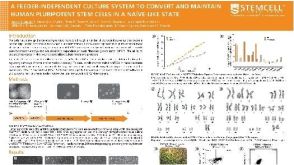 科学海报A Feeder-Independent Culture System to Convert and Maintain Human Pluripotent Stem Cells in a Naïve-Like State

 沪公网安备31010102008431号