Porayette P et al. (DEC 2007)
Biochemical and biophysical research communications 364 3 522--527
Amyloid-?? precursor protein expression and modulation in human embryonic stem cells: A novel role for human chorionic gonadotropin
The amyloid-beta precursor protein (AbetaPP) is a ubiquitously expressed adhesion and neuritogenic protein whose processing has previously been shown to be regulated by reproductive hormones including the gonadotropin luteinizing hormone (LH) in human neuroblastoma cells. We report for the first time the expression of AbetaPP in human embryonic stem (hES) cells at the mRNA and protein levels. Using N- and C-terminal antibodies against AbetaPP,we detected both the mature and immature forms of AbetaPP as well as truncated variants ( approximately 53kDa,47kDa,and 29kDa) by immunoblot analyses. Expression of AbetaPP is regulated by both the stemness of the cells and pregnancy-associated hormones. Addition of human chorionic gonadotropin,the fetal equivalent of LH that is dramatically elevated during pregnancy,markedly increased the expression of all AbetaPP forms. These results indicate a critical molecular signaling link between the hormonal environment of pregnancy and the expression of AbetaPP in hES cells that is suggestive of an important function for this protein during early human embryogenesis prior to the formation of neural precursor cells.
View Publication
Recurrent gain of chromosomes 17q and 12 in cultured human embryonic stem cells.
We have observed karyotypic changes involving the gain of chromosome 17q in three independent human embryonic stem (hES) cell lines on five independent occasions. A gain of chromosome 12 was seen occasionally. This implies that increased dosage of chromosome 17q and 12 gene(s) provides a selective advantage for the propagation of undifferentiated hES cells. These observations are instructive for the future application of hES cells in transplantation therapies in which the use of aneuploid cells could be detrimental.
View Publication
Ephrin receptor, EphB4, regulates ES cell differentiation of primitive mammalian hemangioblasts, blood, cardiomyocytes, and blood vessels.
Differentiation of pluripotent embryonic stem (ES) cells is associated with expression of fate-specifying gene products. Coordinated development,however,must involve modifying factors that enable differentiation and growth to adjust in response to local microenvironmental determinants. We report here that the ephrin receptor,EphB4,known to be spatially restricted in expression and critical for organized vessel formation,modifies the rate and magnitude of ES cells acquiring genotypic and phenotypic characteristics of mesodermal tissues. Hemangioblast,blood cell,cardiomyocyte,and vascular differentiation was impaired in EphB4-/- ES cells in conjunction with decreased expression of mesoderm-associated,but not neuroectoderm-associated,genes. Therefore,EphB4 modulates the response to mesoderm induction signals. These data add differentiation kinetics to the known effects of ephrin receptors on mammalian cell migration and adhesion. We propose that modifying sensitivity to differentiation cues is a further means for ephrin receptors to contribute to tissue patterning and organization.
View Publication
产品号#:
06902
06952
00321
00322
00323
00324
00325
产品名:
Kurita R et al. (SEP 2006)
Stem cells (Dayton,Ohio) 24 9 2014--22
Tal1/Scl gene transduction using a lentiviral vector stimulates highly efficient hematopoietic cell differentiation from common marmoset (Callithrix jacchus) embryonic stem cells.
The development of embryonic stem cell (ESC) therapies requires the establishment of efficient methods to differentiate ESCs into specific cell lineages. Here,we report the in vitro differentiation of common marmoset (CM) (Callithrix jacchus) ESCs into hematopoietic cells after exogenous gene transfer using vesicular stomatitis virus-glycoprotein-pseudotyped lentiviral vectors. We transduced hematopoietic genes,including tal1/scl,gata1,gata2,hoxB4,and lhx2,into CM ESCs. By immunochemical and morphological analyses,we demonstrated that overexpression of tal1/scl,but not the remaining genes,dramatically increased hematopoiesis of CM ESCs,resulting in multiple blood-cell lineages. Furthermore,flow cytometric analysis demonstrated that CD34,a hematopoietic stem/progenitor cell marker,was highly expressed in tal1/scl-overexpressing embryoid body cells. Similar results were obtained from three independent CM ESC lines. These results suggest that transduction of exogenous tal1/scl cDNA into ESCs is a promising method to induce the efficient differentiation of CM ESCs into hematopoietic stem/progenitor cells.
View Publication
产品号#:
03434
03444
04435
04445
产品名:
MethoCult™ GF M3434
MethoCult™ GF M3434
MethoCult™ H4435 Enriched
MethoCult™ H4435 Enriched
T. E. Ludwig et al. (feb 2006)
Nature biotechnology 24 2 185--7
Derivation of human embryonic stem cells in defined conditions.
We have previously reported that high concentrations of basic fibroblast growth factor (bFGF) support feeder-independent growth of human embryonic stem (ES) cells,but those conditions included poorly defined serum and matrix components. Here we report feeder-independent human ES cell culture that includes protein components solely derived from recombinant sources or purified from human material. We describe the derivation of two new human ES cell lines in these defined culture conditions.
View Publication
产品号#:
05850
05857
05870
05875
85850
85857
85870
85875
产品名:
mTeSR™1
mTeSR™1
Lai AY et al. (OCT 2005)
Journal of immunology (Baltimore,Md. : 1950) 175 8 5016--23
Heterogeneity of Flt3-expressing multipotent progenitors in mouse bone marrow.
Mechanisms of lymphoid and myeloid lineage choice by hemopoietic stem cells remain unclear. In this study we show that the multipotent progenitor (MPP) population,which is immediately downstream of hemopoietic stem cells,is heterogeneous and can be subdivided in terms of VCAM-1 expression. VCAM-1(+) MPPs were fully capable of differentiating into both lymphoid and myeloid lineages. In contrast,VCAM-1(-) MPPs gave rise to lymphocytes predominately in vivo. T and B cell development from VCAM-1(-) MPPs was 1 wk faster than that from VCAM-1(+) MPPs. Furthermore,VCAM-1(+) MPPs gave rise to common myeloid progenitors and VCAM-1(-) MPPs in vivo,indicating that VCAM-1(-) MPPs are progenies of VCAM-1(+) MPPs. VCAM-1(-) MPPs,in turn,developed into lymphoid lineage-restricted common lymphoid progenitors. These results establish a hierarchy of developmental relationship between MPP subsets and lymphoid and myeloid progenitors. In addition,VCAM-1(+) MPPs may represent the branching point between the lymphoid and myeloid lineages.
View Publication


 EasySep™小鼠TIL(CD45)正选试剂盒




 挂图Small Molecules, Big Impact in Pluripotent Stem Cell Research Overview of signaling pathways and small molecules in pluripotent stem cell research
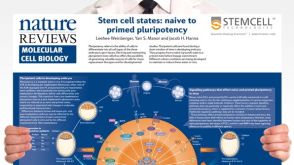 挂图Stem Cell States: Naive to Primed Pluripotency Properties of naive (ground) and primed pluripotent stem cells


 沪公网安备31010102008431号