Mü et al. (NOV 2016)
Molecular systems biology 12 11 889
Single-cell sequencing maps gene expression to mutational phylogenies in PDGF- and EGF-driven gliomas.
Glioblastoma multiforme (GBM) is the most common and aggressive type of primary brain tumor. Epidermal growth factor (EGF) and platelet-derived growth factor (PDGF) receptors are frequently amplified and/or possess gain-of-function mutations in GBM However,clinical trials of tyrosine-kinase inhibitors have shown disappointing efficacy,in part due to intra-tumor heterogeneity. To assess the effect of clonal heterogeneity on gene expression,we derived an approach to map single-cell expression profiles to sequentially acquired mutations identified from exome sequencing. Using 288 single cells,we constructed high-resolution phylogenies of EGF-driven and PDGF-driven GBMs,modeling transcriptional kinetics during tumor evolution. Descending the phylogenetic tree of a PDGF-driven tumor corresponded to a progressive induction of an oligodendrocyte progenitor-like cell type,expressing pro-angiogenic factors. In contrast,phylogenetic analysis of an EGFR-amplified tumor showed an up-regulation of pro-invasive genes. An in-frame deletion in a specific dimerization domain of PDGF receptor correlates with an up-regulation of growth pathways in a proneural GBM and enhances proliferation when ectopically expressed in glioma cell lines. In-frame deletions in this domain are frequent in public GBM data.
View Publication
产品号#:
05750
05751
产品名:
NeuroCult™ NS-A 基础培养基(人)
NeuroCult™ NS-A 扩增试剂盒(人)
Fè et al. ( 2014)
PloS one 9 3 e91519
Comparative expression study of the endo-G protein coupled receptor (GPCR) repertoire in human glioblastoma cancer stem-like cells, U87-MG cells and non malignant cells of neural origin unveils new potential therapeutic targets.
Glioblastomas (GBMs) are highly aggressive,invasive brain tumors with bad prognosis and unmet medical need. These tumors are heterogeneous being constituted by a variety of cells in different states of differentiation. Among these,cells endowed with stem properties,tumor initiating/propagating properties and particularly resistant to chemo- and radiotherapies are designed as the real culprits for tumor maintenance and relapse after treatment. These cells,termed cancer stem-like cells,have been designed as prominent targets for new and more efficient cancer therapies. G-protein coupled receptors (GPCRs),a family of membrane receptors,play a prominent role in cell signaling,cell communication and crosstalk with the microenvironment. Their role in cancer has been highlighted but remains largely unexplored. Here,we report a descriptive study of the differential expression of the endo-GPCR repertoire in human glioblastoma cancer stem-like cells (GSCs),U-87 MG cells,human astrocytes and fetal neural stem cells (f-NSCs). The endo-GPCR transcriptome has been studied using Taqman Low Density Arrays. Of the 356 GPCRs investigated,138 were retained for comparative studies between the different cell types. At the transcriptomic level,eight GPCRs were specifically expressed/overexpressed in GSCs. Seventeen GPCRs appeared specifically expressed in cells with stem properties (GSCs and f-NSCs). Results of GPCR expression at the protein level using mass spectrometry and proteomic analysis are also presented. The comparative GPCR expression study presented here gives clues for new pathways specifically used by GSCs and unveils novel potential therapeutic targets.
View Publication
产品号#:
05750
05751
产品名:
NeuroCult™ NS-A 基础培养基(人)
NeuroCult™ NS-A 扩增试剂盒(人)
Walker TL et al. (JAN 2012)
PloS one 7 9 e44371
Prolactin stimulates precursor cells in the adult mouse hippocampus.
In the search for ways to combat degenerative neurological disorders,neurogenesis-stimulating factors are proving to be a promising area of research. In this study,we show that the hormonal factor prolactin (PRL) can activate a pool of latent precursor cells in the adult mouse hippocampus. Using an in vitro neurosphere assay,we found that the addition of exogenous PRL to primary adult hippocampal cells resulted in an approximate 50% increase in neurosphere number. In addition,direct infusion of PRL into the adult dentate gyrus also resulted in a significant increase in neurosphere number. Together these data indicate that exogenous PRL can increase hippocampal precursor numbers both in vitro and in vivo. Conversely,PRL null mice showed a significant reduction (approximately 80%) in the number of hippocampal-derived neurospheres. Interestingly,no deficit in precursor proliferation was observed in vivo,indicating that in this situation other niche factors can compensate for a loss in PRL. The PRL loss resulted in learning and memory deficits in the PRL null mice,as indicated by significant deficits in the standard behavioral tests requiring input from the hippocampus. This behavioral deficit was rescued by direct infusion of recombinant PRL into the hippocampus,indicating that a lack of PRL in the adult mouse hippocampus can be correlated with impaired learning and memory.
View Publication
产品号#:
05700
05701
05702
产品名:
NeuroCult™ 基础培养基(小鼠和大鼠)
NeuroCult™ 扩增添加物(小鼠和大鼠)
NeuroCult™扩增试剂盒(小鼠和大鼠)
Ehrhardt A et al. (OCT 2015)
BMC neuroscience 16 68
Absence of M-Ras modulates social behavior in mice.
BACKGROUND The molecular mechanisms that determine social behavior are poorly understood. Pheromones play a critical role in social recognition in most animals,including mice,but how these are converted into behavioral responses is largely unknown. Here,we report that the absence of the small GTPase M-Ras affects social behavior in mice. RESULTS In their interactions with other males,Mras(-/-) males exhibited high levels of territorial aggression and social investigations,and increased fear-related behavior. They also showed increased mating behavior with females. Curiously,increased aggression and mating behaviors were only observed when Mras(-/-) males were paired with Mras(-/-) partners,but were significantly reduced when paired with wild-type (WT) mice. Since mice use pheromonal cues to identify other individuals,we explored the possibility that pheromone detection may be altered in Mras(-/-) mice. Unlike WT mice,Mras(-/-) did not show a preference for exploring unfamiliar urinary pheromones or unfamiliar isogenic mice. Although this could indicate that vomeronasal function and/or olfactory learning may be compromised in Mras(-/-) mice,these observations were not fully consistent with the differential behavioral responses to WT and Mras(-/-) interaction partners by Mras(-/-) males. In addition,induction of c-fos upon pheromone exposure or in response to mating was similar in WT and Mras (-/-) mice,as was the ex vivo expansion of neural progenitors with EGF. This indicated that acute pheromone detection and processing was likely intact. However,urinary metabolite profiles differed between Mras(-/-) and WT males. CONCLUSIONS The changes in behaviors displayed by Mras(-/-) mice are likely due to a complex combination of factors that may include an inherent predisposition to increased aggression and sexual behavior,and the production of distinct pheromones that could override the preference for unfamiliar social odors. Olfactory and/or social learning processes may thus be compromised in Mras(-/-) mice.
View Publication
Aberrant Neural Stem Cell Proliferation and Increased Adult Neurogenesis in Mice Lacking Chromatin Protein HMGB2
Neural stem and progenitor cells (NSCs/NPCs) are distinct groups of cells found in the mammalian central nervous system (CNS). Previously we determined that members of the High Mobility Group (HMG) B family of chromatin structural proteins modulate NSC proliferation and self-renewal. Among them HMGB2 was found to be dynamically expressed in proliferating and differentiating NSCs,suggesting that it may regulate NSC maintenance. We report now that Hmgb2(-/-) mice exhibit SVZ hyperproliferation,increased numbers of SVZ NSCs,and a trend towards aberrant increases in newly born neurons in the olfactory bulb (OB) granule cell layer. Increases in the levels of the transcription factor p21 and the Neural cell adhesion molecule (NCAM),along with down-regulation of the transcription/pluripotency factor Oct4 in the Hmgb2-/- SVZ point to a possible pathway for this increased proliferation/differentiation. Our findings suggest that HMGB2 functions as a modulator of neurogenesis in young adult mice through regulation of NSC proliferation,and identify a potential target via which CNS repair could be amplified following trauma or disease-based neuronal degeneration.
View Publication
产品号#:
05700
05701
05702
05715
产品名:
NeuroCult™ 基础培养基(小鼠和大鼠)
NeuroCult™ 扩增添加物(小鼠和大鼠)
NeuroCult™扩增试剂盒(小鼠和大鼠)
NeuroCult™成年中枢神经系统(CNS)组织酶解试剂盒(小鼠和大鼠)
Yamazaki K et al. (DEC 2016)
Journal of Biomolecular Screening 21 10 1054--1064
Functional Comparison of Neuronal Cells Differentiated from Human Induced Pluripotent Stem CellDerived Neural Stem Cells under Different Oxygen and Medium Conditions
Because neurons are difficult to obtain from humans,generating functional neurons from human induced pluripotent stem cells (hiPSCs) is important for establishing physiological or disease-relevant screening systems for drug discovery. To examine the culture conditions leading to efficient differentiation of functional neural cells,we investigated the effects of oxygen stress (2% or 20% O2) and differentiation medium (DMEM/F12:Neurobasal-based [DN] or commercial [PhoenixSongs Biologicals; PS]) on the expression of genes related to neural differentiation,glutamate receptor function,and the formation of networks of neurons differentiated from hiPSCs (201B7) via long-term self-renewing neuroepithelial-like stem (lt-NES) cells. Expression of genes related to neural differentiation occurred more quickly in PS and/or 2% O2 than in DN and/or 20% O2,resulting in high responsiveness of neural cells to glutamate,N-methyl-d-aspartate (NMDA),α-amino-3-hydroxy-5-methyl-4-isoxazolepropionate (AMPA),and (S)-3,5-d...
View Publication


 EasySep™小鼠TIL(CD45)正选试剂盒




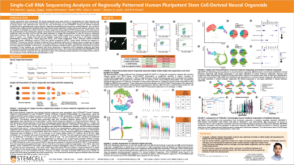 科学海报Single-Cell RNA Sequencing Analysis of Regionally Patterned Human Pluripotent Stem Cell-Derived Neural Organoids


 沪公网安备31010102008431号