Marks BR et al. (OCT 2009)
Nature immunology 10 10 1125--32
Thymic self-reactivity selects natural interleukin 17-producing T cells that can regulate peripheral inflammation.
Interleukin 17 (IL-17)-producing CD4(+) helper T cells (T(H)-17 cells) share a developmental relationship with Foxp3(+) regulatory T cells (T(reg) cells). Here we show that a T(H)-17 population differentiates in the thymus in a manner influenced by recognition of self antigen and by the cytokines IL-6 and transforming growth factor-beta (TGF-beta). Like previously described T(H)-17 cells,the T(H)-17 cells that developed in the thymus expressed the transcription factor RORgamma t and the IL-23 receptor. These cells also expressed alpha(4)beta(1) integrins and the chemokine receptor CCR6 and were recruited to the lung,gut and liver. In the liver,these cells secreted IL-22 in response to self antigen and mediated host protection during inflammation. Thus,T(H)-17 cells,like T(reg) cells,can be selected by self antigens in the thymus.
View Publication
产品号#:
19752
19752RF
产品名:
De Almeida DE et al. (AUG 2010)
Journal of immunology (Baltimore,Md. : 1950) 185 3 1927--34
Immune dysregulation by the rheumatoid arthritis shared epitope.
Rheumatoid arthritis (RA) is closely associated with HLA-DRB1 alleles that code a five-amino acid sequence motif in positions 70-74 of the HLA-DRbeta-chain,called the shared epitope (SE). The mechanistic basis of SE-RA association is unknown. We recently found that the SE functions as an allele-specific signal-transducing ligand that activates an NO-mediated pathway in other cells. To better understand the role of the SE in the immune system,we examined its effect on T cell polarization in mice. In CD11c(+)CD8(+) dendritic cells (DCs),the SE inhibited the enzymatic activity of indoleamine 2,3 dioxygenase,a key enzyme in immune tolerance and T cell regulation,whereas in CD11c(+)CD8(-) DCs,the ligand activated robust production of IL-6. When SE-activated DCs were cocultured with CD4(+) T cells,the differentiation of Foxp3(+) T regulatory cells was suppressed,whereas Th17 cells were expanded. The polarizing effects could be seen with SE(+) synthetic peptides,but even more so when the SE was in its natural tridimensional conformation as part of HLA-DR tetrameric proteins. In vivo administration of the SE ligand resulted in a greater abundance of Th17 cells in the draining lymph nodes and increased IL-17 production by splenocytes. Thus,we conclude that the SE acts as a potent immune-stimulatory ligand that can polarize T cell differentiation toward Th17 cells,a T cell subset that was recently implicated in the pathogenesis of autoimmune diseases,including RA.
View Publication
产品号#:
19752
19752RF
产品名:
Akatsuka A et al. (SEP 2010)
International immunology 22 9 783--90
Tumor cells of non-hematopoietic and hematopoietic origins express activation-induced C-type lectin, the ligand for killer cell lectin-like receptor F1.
Killer cell lectin-like receptor F1 (KLRF1) is an activating C-type lectin-like receptor expressed on human NK cells and subsets of T cells. In this study,we show that activation-induced C-type lectin (AICL) is a unique KLRF1 ligand expressed on tumor cell lines of hematopoietic and non-hematopoietic origins. We screened a panel of human tumor cell lines using the KLRF1 reporter cells and found that several tumor lines expressed KLRF1 ligands. We characterized a putative KLRF1 ligand expressed on the U937 cell line. The molecular mass for the deglycosylated ligand was 28 kDa under non-reducing condition and 17 kDa under reducing condition,suggesting that the KLRF1 ligand is a homodimer. By expression cloning from a U937 cDNA library,we identified AICL as a KLRF1 ligand. We generated mAbs against AICL to identify the KLRF1 ligands on non-hematopoietic tumor lines. The anti-AICL mAbs stained the tumor lines that express the KLRF1 ligands and importantly the interaction of KLRF1 with the KLRF1 ligand on non-hematopoietic tumors was completely blocked by the two anti-AICL mAbs. Moreover,NK cell degranulation triggered by AICL-expressing targets was partially inhibited by the anti-AICL mAb. Finally,we demonstrate that AICL is expressed in human primary liver cancers. These results suggest that AICL is expressed on tumor cells of non-hematopoietic origins and raise the possibility that AICL may contribute to NK cell surveillance of tumor cells.
View Publication
产品号#:
18554
18554RF
18564
18564RF
产品名:
Herrmann A et al. (OCT 2010)
Cancer research 70 19 7455--64
Targeting Stat3 in the myeloid compartment drastically improves the in vivo antitumor functions of adoptively transferred T cells.
Improving effector T-cell functions is highly desirable for preventive or therapeutic interventions of diverse diseases. Signal transducer and activator of transcription 3 (Stat3) in the myeloid compartment constrains Th1-type immunity,dampening natural and induced antitumor immune responses. We have recently developed an in vivo small interfering RNA (siRNA) delivery platform by conjugating a Toll-like receptor 9 agonist with siRNA that efficiently targets myeloid and B cells. Here,we show that either CpG triggering combined with the genetic Stat3 ablation in myeloid/B cell compartments or administration of the CpG-Stat3siRNA drastically augments effector functions of adoptively transferred CD8+ T cells. Specifically,we show that both approaches are capable of increasing dendritic cell and CD8(+) T-cell engagement in tumor-draining lymph nodes. Furthermore,both approaches can significantly activate the transferred CD8(+) T cells in vivo,upregulating effector molecules such as perforin,granzyme B,and IFN-γ. Intravital multiphoton microscopy reveals that Stat3 silencing combined with CpG triggering greatly increases killing activity and tumor infiltration of transferred T cells. These results suggest the use of CpG-Stat3siRNA,and possibly other Stat3 inhibitors,as a potent adjuvant to improve T-cell therapies.
View Publication
产品号#:
19753
19753RF
产品名:
Takeuchi H et al. (NOV 2010)
Journal of immunology (Baltimore,Md. : 1950) 185 9 5289--99
Efficient induction of CCR9 on T cells requires coactivation of retinoic acid receptors and retinoid X receptors (RXRs): exaggerated T Cell homing to the intestine by RXR activation with organotins.
The active vitamin A metabolite retinoic acid (RA) imprints gut-homing specificity on lymphocytes upon activation by inducing the expression of α4β7 integrin and CCR9. RA receptor (RAR) activation is essential for their expression,whereas retinoid X receptor (RXR) activation is not essential for α4β7 expression. However,it remains unclear whether RXR activation affects the RA-dependent CCR9 expression on T cells and their gut homing. The major physiological RA,all-trans-RA,binds to RAR but not to RXR at physiological concentrations. Cell-surface CCR9 expression was often induced on a limited population of murine naive CD4(+) T cells by all-trans-RA or the RAR agonist Am80 alone upon CD3/CD28-mediated activation in vitro,but it was markedly enhanced by adding the RXR agonist PA024 or the RXR-binding environmental chemicals tributyltin and triphenyltin. Accordingly,CD4(+) T cells treated with the combination of all-trans-RA and tributyltin migrated into the small intestine upon adoptive transfer much more efficiently than did those treated with all-trans-RA alone. Furthermore,naive TCR transgenic CD4(+) T cells transferred into wild-type recipients migrated into the small intestinal lamina propria following i.p. injection of Ag,and the migration was enhanced by i.p. injection of PA024. We also show that PA024 markedly enhanced the all-trans-RA-induced CCR9 expression on naturally occurring naive-like regulatory T cells upon activation,resulting in the expression of high levels of α4β7,CCR9,and Foxp3. These results suggest that RXR activation enhances the RAR-dependent expression of CCR9 on T cells and their homing capacity to the small intestine.
View Publication
产品号#:
19752
19752RF
产品名:
Katzman SD et al. (OCT 2010)
Proceedings of the National Academy of Sciences of the United States of America 107 42 18085--90
Duration of antigen receptor signaling determines T-cell tolerance or activation.
The early events that determine the decision between lymphocyte tolerance and activation are not well-understood. Using a model of systemic self-antigen recognition by CD4(+) T cells,we show,using single-cell biochemical analyses,that tolerance is characterized by transient signaling events downstream of T-cell receptor engagement in the mammalian target of rapamycin (mTOR) and NF-κB pathways. Parallel studies done by live cell imaging show that the key difference between tolerance and activation is the duration of the T cell-antigen presenting cell (APC) interaction,as revealed by stable T-cell immobilization on antigen encounter. Brief T cell-APC interactions result in tolerance,and prolonged interactions are associated with activation and the development of effector cells. These studies show that the duration of T cell-APC interactions and magnitude of associated TCR-mediated signaling are key determinants of lymphocyte tolerance vs. activation.
View Publication
产品号#:
19752
19752RF
产品名:
Lebson L et al. (DEC 2010)
Journal of immunology (Baltimore,Md. : 1950) 185 12 7161--4
Cutting edge: The transcription factor Kruppel-like factor 4 regulates the differentiation of Th17 cells independently of RORγt.
Th17 cells play a significant role in inflammatory and autoimmune responses. Although a number of molecular pathways that contribute to the lineage differentiation of T cells have been discovered,the mechanisms by which lineage commitment occurs are not fully understood. Transcription factors play a key role in driving T cells toward specific lineages. We have identified a role for the transcription factor Kruppel-like factor (KLF) 4 in the development of IL-17-producing CD4(+) T cells. KLF4 was required for the production of IL-17,and further,chromatin immunoprecipitation analysis demonstrated binding of KLF4 to the IL-17 promoter,indicating a direct effect on the regulation of IL-17. Further,KLF4-deficient T cells upregulated expression of retinoic acid-related orphan receptor γt similar to wild-type during the polarization process toward Th17,suggesting that these two transcription factors are regulated independently.
View Publication
产品号#:
19752
19752RF
产品名:
Zhang Y et al. ( 2018)
Nature communications 9 1 6
Nanoparticle anchoring targets immune agonists to tumors enabling anti-cancer immunity without systemic toxicity.
Immunostimulatory agents such as agonistic anti-CD137 and interleukin (IL)-2 generate effective anti-tumor immunity but also elicit serious toxicities,hampering their clinical application. Here we show that combination therapy with anti-CD137 and an IL-2-Fc fusion achieves significant initial anti-tumor activity,but also lethal immunotoxicity deriving from stimulation of circulating leukocytes. To overcome this toxicity,we demonstrate that anchoring IL-2 and anti-CD137 on the surface of liposomes allows these immune agonists to rapidly accumulate in tumors while lowering systemic exposure. In multiple tumor models,immunoliposome delivery achieves anti-tumor activity equivalent to free IL-2/anti-CD137 but with the complete absence of systemic toxicity. Immunoliposomes stimulated tumor infiltration by cytotoxic lymphocytes,cytokine production,and granzyme expression,demonstrating equivalent immunostimulatory effects to the free drugs in the local tumor microenvironment. Thus,surface-anchored particle delivery may provide a general approach to exploit the potent stimulatory activity of immune agonists without debilitating systemic toxicities.
View Publication
产品号#:
19753
19753RF
产品名:
Keller G et al. (JAN 1993)
Molecular and cellular biology 13 1 473--86
Hematopoietic commitment during embryonic stem cell differentiation in culture.
We report that embryonic stem cells efficiently undergo differentiation in vitro to mesoderm and hematopoietic cells and that this in vitro system recapitulates days 6.5 to 7.5 of mouse hematopoietic development. Embryonic stem cells differentiated as embryoid bodies (EBs) develop erythroid precursors by day 4 of differentiation,and by day 6,more than 85% of EBs contain such cells. A comparative reverse transcriptase-mediated polymerase chain reaction profile of marker genes for primitive endoderm (collagen alpha IV) and mesoderm (Brachyury) indicates that both cell types are present in the developing EBs as well in normal embryos prior to the onset of hematopoiesis. GATA-1,GATA-3,and vav are expressed in both the EBs and embryos just prior to and/or during the early onset of hematopoiesis,indicating that they could play a role in the early stages of hematopoietic development both in vivo and in vitro. The initial stages of hematopoietic development within the EBs occur in the absence of added growth factors and are not significantly influenced by the addition of a broad spectrum of factors,including interleukin-3 (IL-3),IL-1,IL-6,IL-11,erythropoietin,and Kit ligand. At days 10 and 14 of differentiation,EB hematopoiesis is significantly enhanced by the addition of both Kit ligand and IL-11 to the cultures. Kinetic analysis indicates that hematopoietic precursors develop within the EBs in an ordered pattern. Precursors of the primitive erythroid lineage appear first,approximately 24 h before precursors of the macrophage and definitive erythroid lineages. Bipotential neutrophil/macrophage and multilineage precursors appear next,and precursors of the mast cell lineage develop last. The kinetics of precursor development,as well as the growth factor responsiveness of these early cells,is similar to that found in the yolk sac and early fetal liver,indicating that the onset of hematopoiesis within the EBs parallels that found in the embryo.
View Publication
产品号#:
06902
06952
00321
00322
00323
00324
00325
产品名:
挂图
Human Immune Cytokines
Infographic of key cytokines for expansion, differentiation and characterization of major immune cell types
Gutierrez-Ramos JC and Palacios R (OCT 1992)
Proceedings of the National Academy of Sciences of the United States of America 89 19 9171--5
In vitro differentiation of embryonic stem cells into lymphocyte precursors able to generate T and B lymphocytes in vivo.
Embryonic stem cells can be induced in vitro,by coculture with the stromal line RP.0.10 and a mixture of interleukins 3,6,and 7,to differentiate into T (Joro75+) and B (B-220+) lymphocyte progenitors and other (Thy-1+,PgP-1+,c-kit+,Joro75-,B-220-,F4/80-,Mac-1-) hemopoietic precursors. The progeny of in vitro-induced embryonic stem cells can reconstitute the lymphoid compartments of T- and B-lymphocyte-deficient scid mice and generate mature T and B lymphocytes in sublethally irradiated normal mice. Exogenous cytokines can dramatically alter the developmental fate of embryonic stem cells in culture. The in vitro system described here should facilitate the study of molecular events leading to cell-lineage commitment and to the formation of hemopoietic stem cells and their immediate lymphoid progeny.
View Publication
产品号#:
06902
06952
00321
00322
00323
00324
00325
产品名:
Heinonen KM et al. (MAY 2004)
Blood 103 9 3457--64
T-cell protein tyrosine phosphatase deletion results in progressive systemic inflammatory disease.
The deregulation of the immune response is a critical component in inflammatory disease. Recent in vitro data show that T-cell protein tyrosine phosphatase (TC-PTP) is a negative regulator of cytokine signaling. Furthermore,tc-ptp(-/-) mice display immune defects and die within 5 weeks of birth. We report here that tc-ptp(-/-) mice develop progressive systemic inflammatory disease as shown by chronic myocarditis,gastritis,nephritis,and sialadenitis as well as elevated serum interferon-gamma. The widespread mononuclear cellular infiltrates correlate with exaggerated interferon-gamma,tumor necrosis factor-alpha,interleukin-12,and nitric oxide production in vivo. Macrophages grown from tc-ptp(-/-) mice are inherently hypersensitive to lipopolysaccharide,which can also be detected in vivo as an increased susceptibility to endotoxic shock. These results identify T-cell protein tyrosine phosphatase as a key modulator of inflammatory signals and macrophage function.
View Publication


 EasySep™小鼠TIL(CD45)正选试剂盒




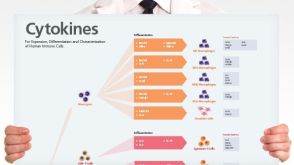 挂图Human Immune Cytokines Infographic of key cytokines for expansion, differentiation and characterization of major immune cell types
 沪公网安备31010102008431号