Nair S et al. (JAN 2007)
Cancer research 67 1 371--80
Vaccination against the forkhead family transcription factor Foxp3 enhances tumor immunity.
Depletion of CD4+CD25+ regulatory T cells (Treg) by treatment with alphaCD25 antibody synergizes with vaccination protocols to engender protective immunity in mice. The effectiveness of targeting CD25 to eliminate Treg is limited by the fact that CD25,the low-affinity interleukin-2 receptor,is up-regulated on conventional T cells. At present,foxp3 is the only product known to be exclusively expressed in Treg of mice. However,foxp3 is not expressed on the cell surface and hence cannot be targeted with antibodies. In this study,we tested the hypothesis that vaccination of mice against foxp3,a self-antigen expressed also in the thymus,is capable of stimulating foxp3-specific CTL that will cause the depletion of Treg and enhanced antitumor immunity. Vaccination of mice with foxp3 mRNA-transfected dendritic cells elicited a robust foxp3-specific CTL response and potentiated vaccine-induced protective immunity comparably with that of alphaCD25 antibody administration. In contrast to alphaCD25 antibody treatment,repeated foxp3 vaccination did not interfere with vaccine-induced protective immunity. Importantly,foxp3 vaccination led to the preferential depletion of foxp3-expressing Treg in the tumor but not in the periphery,whereas alphaCD25 antibody treatment led to depletion of Treg in both the tumor and the periphery. Targeting foxp3 by vaccination offers a specific and simpler protocol for the prolonged control of Treg that may be associated with reduced risk of autoimmunity,introducing an approach whereby specific depletion of cells is not limited to targeting products expressed on the cell surface.
View Publication
产品号#:
19751
19751RF
18554
18554RF
18564
18564RF
产品名:
Balakrishnan K et al. (OCT 2006)
Blood 108 7 2392--8
Forodesine, an inhibitor of purine nucleoside phosphorylase, induces apoptosis in chronic lymphocytic leukemia cells.
Purine nucleoside phosphorylase (PNP) deficiency in humans results in T lymphocytopenia. Forodesine,a potent inhibitor of PNP,was designed based on the transition-state structure stabilized by the enzyme. Previous studies established that forodesine in the presence of deoxyguanosine (dGuo) inhibits the proliferation of T lymphocytes. A phase 1 clinical trial of forodesine in T-cell malignancies demonstrated significant antileukemic activity with an increase in intracellular dGuo triphosphate (dGTP). High accumulation of dGTP in T cells may be dependent on the levels of deoxynucleoside kinases. Because B-cell chronic lymphocytic leukemia (B-CLL) cells have high activity of deoxycytidine kinase (dCK),we hypothesized that these lymphocytes would respond to forodesine. This postulate was tested in primary lymphocytes during in vitro investigations. Lymphocytes from 12 patients with CLL were incubated with forodesine and dGuo. These CLL cells showed a wide variation in the accumulation of intracellular dGTP without any effect on other deoxynucleotides. This was associated with DNA damage-induced p53 stabilization,phosphorylation of p53 at Ser15,and activation of p21. The dGTP accumulation was related to induction of apoptosis measured by caspase activation,changes in mitochondrial membrane potential,and PARP cleavage. Based on these data,a phase 2 clinical trial of forodesine has been initiated for CLL patients.
View Publication
产品号#:
19051
19051RF
19054
19054RF
产品名:
EasySep™人T细胞富集试剂盒
RoboSep™ 人T细胞富集试剂盒含滤芯吸头
EasySep™人B细胞富集试剂盒
RoboSep™ 人B细胞富集试剂盒含滤芯吸头
Peters PJ et al. (JUL 2006)
Journal of virology 80 13 6324--32
Non-macrophage-tropic human immunodeficiency virus type 1 R5 envelopes predominate in blood, lymph nodes, and semen: implications for transmission and pathogenesis.
Human immunodeficiency virus type 1 (HIV-1) R5 isolates that predominantly use CCR5 as a coreceptor are frequently described as macrophage tropic. Here,we compare macrophage tropism conferred by HIV-1 R5 envelopes that were derived directly by PCR from patient tissue. This approach avoids potentially selective culture protocols used in virus isolation. Envelopes were amplified (i) from blood and semen of adult patients and (ii) from plasma of pediatric patients. The phenotypes of these envelopes were compared to those conferred by an extended panel of envelopes derived from brain and lymph node that we reported previously. Our results show that R5 envelopes vary by up to 1,000-fold in their capacity to confer infection of primary macrophages. Highly macrophage-tropic envelopes were predominate in brain but were infrequent in semen,blood,and lymph node samples. We also confirmed that the presence of N283 in the C2 CD4 binding site of gp120 is associated with HIV-1 envelopes from the brain but absent from macrophage-tropic envelopes amplified from blood and semen. Finally,we compared infection of macrophages,CD4(+) T cells,and peripheral blood mononuclear cells (PBMCs) conferred by macrophage-tropic and non-macrophage-tropic envelopes in the context of full-length replication competent viral clones. Non-macrophage-tropic envelopes conferred low-level infection of macrophages yet infected CD4(+) T cells and PBMCs as efficiently as highly macrophage-tropic brain envelopes. The lack of macrophage tropism for the majority of the envelopes amplified from lymph node,blood,and semen is striking and contrasts with the current consensus that R5 primary isolates are generally macrophage tropic. The extensive variation in R5 tropism reported here is likely to have an important impact on pathogenesis and on the capacity of HIV-1 to transmit.
View Publication
产品号#:
19052
19052RF
产品名:
EasySep™人CD4+ T细胞富集试剂盒
RoboSep™ 人CD4+ T细胞富集试剂盒含滤芯吸头
Iwasaki-Arai J et al. (MAY 2003)
The Journal of experimental medicine 197 10 1311--22
Enforced granulocyte/macrophage colony-stimulating factor signals do not support lymphopoiesis, but instruct lymphoid to myelomonocytic lineage conversion.
We evaluated the effects of ectopic granulocyte/macrophage colony-stimulating factor (GM-CSF) signals on hematopoietic commitment and differentiation. Lineage-restricted progenitors purified from mice with the ubiquitous transgenic human GM-CSF receptor (hGM-CSFR) were used for the analysis. In cultures with hGM-CSF alone,hGM-CSFR-expressing (hGM-CSFR+) granulocyte/monocyte progenitors (GMPs) and megakaryocyte/erythrocyte progenitors (MEPs) exclusively gave rise to granulocyte/monocyte (GM) and megakaryocyte/erythroid (MegE) colonies,respectively,providing formal proof that GM-CSF signals support the GM and MegE lineage differentiation without affecting the physiological myeloid fate. hGM-CSFR transgenic mice were crossed with mice deficient in interleukin (IL)-7,an essential cytokine for T and B cell development. Administration of hGM-CSF in these mice could not restore T or B lymphopoiesis,indicating that enforced GM-CSF signals cannot substitute for IL-7 to promote lymphopoiesis. Strikingly,textgreater50% hGM-CSFR+ common lymphoid progenitors (CLPs) and textgreater20% hGM-CSFR+ pro-T cells gave rise to granulocyte,monocyte,and/or myeloid dendritic cells,but not MegE lineage cells in the presence of hGM-CSF. Injection of hGM-CSF into mice transplanted with hGM-CSFR+ CLPs blocked their lymphoid differentiation,but induced development of GM cells in vivo. Thus,hGM-CSF transduces permissive signals for myeloerythroid differentiation,whereas it transmits potent instructive signals for the GM differentiation to CLPs and early T cell progenitors. These data suggest that a majority of CLPs and a fraction of pro-T cells possess plasticity for myelomonocytic differentiation that can be activated by ectopic GM-CSF signals,supporting the hypothesis that the down-regulation of GM-CSFR is a critical event in producing cells with a lymphoid-restricted lineage potential.
View Publication
产品号#:
04100
产品名:
MethoCult™ H4100
Katzman SD et al. (OCT 2010)
Proceedings of the National Academy of Sciences of the United States of America 107 42 18085--90
Duration of antigen receptor signaling determines T-cell tolerance or activation.
The early events that determine the decision between lymphocyte tolerance and activation are not well-understood. Using a model of systemic self-antigen recognition by CD4(+) T cells,we show,using single-cell biochemical analyses,that tolerance is characterized by transient signaling events downstream of T-cell receptor engagement in the mammalian target of rapamycin (mTOR) and NF-κB pathways. Parallel studies done by live cell imaging show that the key difference between tolerance and activation is the duration of the T cell-antigen presenting cell (APC) interaction,as revealed by stable T-cell immobilization on antigen encounter. Brief T cell-APC interactions result in tolerance,and prolonged interactions are associated with activation and the development of effector cells. These studies show that the duration of T cell-APC interactions and magnitude of associated TCR-mediated signaling are key determinants of lymphocyte tolerance vs. activation.
View Publication
产品号#:
19752
19752RF
产品名:
Pahwa R et al. (DEC 2010)
Journal of immunological methods 363 1 67--79
Isolation and expansion of human natural T regulatory cells for cellular therapy.
Natural T regulatory cells (nTregs) play a key role in inducing and maintaining immunological tolerance. Cell-based therapy using purified nTregs is under consideration for several conditions,but procedures employed to date have resulted in cell populations that are contaminated with cytokine secreting effector cells. We have established a method for isolation and ex vivo expansion of human nTregs from healthy blood donors for cellular therapy aimed at preventing allograft rejection in organ transplants. The Robosep instrument was used for initial nTreg isolation and rapamycin was included in the expansion phase of cell cultures. The resulting cell population exhibited a stable CD4(+)CD25(++bright)Foxp3(+) phenotype,had potent functional ability to suppress CD4(+)CD25(negative) T cells without evidence of conversion to effector T cells including TH17 cells,and manifested little to no production of pro-inflammatory cytokines upon in vitro stimulation. Boolean gating analysis of cytokine-expressing cells by flow cytometry for 32 possible profile end points revealed that 96% of expanded nTregs did not express any cytokine. From a single buffy coat,approximately 80 million pure nTregs were harvested after expansion under cGMP conditions; these cell numbers are adequate for infusion of approximately one million cells kg�?�¹ for cell therapy in clinical trials.
View Publication
产品号#:
21000
20119
20155
15862
15862RF
产品名:
RoboSep™- S
RoboSep™ 吸头组件抛光剂
RoboSep™分选管套装(9个塑料管)
Yates F et al. (DEC 2002)
Blood 100 12 3942--9
Gene therapy of RAG-2-/- mice: sustained correction of the immunodeficiency.
Patients with mutations of either RAG-1 or RAG-2 genes suffer from severe combined immunodeficiency (SCID) characterized by the lack of T and B lymphocytes. The only curative treatment today consists of hematopoietic stem cell (HSC) transplantation,which is only partially successful in the absence of an HLA genoidentical donor,thus justifying research to find an alternative therapeutic approach. To this end,RAG-2-deficient mice were used to test whether retrovirally mediated ex vivo gene transfer into HSCs could provide long-term correction of the immunologic deficiency. Murine RAG-2-/-Sca-1(+) selected bone marrow cells were transduced with a modified Moloney leukemia virus (MLV)-based MND (myeloproliferative sarcoma virus enhancer,negative control region deleted,dl587rev primer-binding site substituted) retroviral vector containing the RAG-2 cDNA and transplanted into RAG-2-/- sublethally irradiated mice (3Gy). Two months later,T- and B-cell development was achieved in all mice. Diverse repertoire of T cells as well as proliferative capacity in the presence of mitogens,allogeneic cells,and keyhole limpet hemocyanin (KLH) were shown. B-cell function as shown by serum Ig levels and antibody response to a challenge by KLH also developed. Lymphoid subsets and function were shown to be stable over a one-year period without evidence of any detectable toxicity. Noteworthy,a selective advantage for transduced lymphoid cells was evidenced by comparative provirus quantification in lymphoid and myeloid lineages. Altogether,this study demonstrates the efficiency of ex vivo RAG-2 gene transfer in HSCs to correct the immune deficiency of RAG-2-/- mice,constituting a significant step toward clinical application.
View Publication
产品号#:
09600
09650
产品名:
StemSpan™ SFEM
StemSpan™ SFEM
Esplugues E et al. (MAY 2003)
The Journal of experimental medicine 197 9 1093--106
Enhanced antitumor immunity in mice deficient in CD69.
We investigated the in vivo role of CD69 by analyzing the susceptibility of CD69-/- mice to tumors. CD69-/- mice challenged with MHC class I- tumors (RMA-S and RM-1) showed greatly reduced tumor growth and prolonged survival compared with wild-type (WT) mice. The enhanced anti-tumor response was NK cell and T lymphocyte-mediated,and was due,at least in part,to an increase in local lymphocytes. Resistance of CD69-/- mice to MHC class I- tumor growth was also associated with increased production of the chemokine MCP-1,diminished TGF-beta production,and decreased lymphocyte apoptosis. Moreover,the in vivo blockade of TGF-beta in WT mice resulted in enhanced anti-tumor response. In addition,CD69 engagement induced NK and T cell production of TGF-beta,directly linking CD69 signaling to TGF-beta regulation. Furthermore,anti-CD69 antibody treatment in WT mice induced a specific down-regulation in CD69 expression that resulted in augmented anti-tumor response. These data unmask a novel role for CD69 as a negative regulator of anti-tumor responses and show the possibility of a novel approach for the therapy of tumors.
View Publication
产品号#:
09500
09600
09650
产品名:
BIT 9500血清替代物
StemSpan™ SFEM
StemSpan™ SFEM
Coletta PL et al. (FEB 2004)
Blood 103 3 1050--8
Lymphodepletion in the ApcMin/+ mouse model of intestinal tumorigenesis.
Germ line mutations in the Adenomatous polyposis coli tumor suppressor gene cause a hereditary form of intestinal tumorigenesis in both mice and man. Here we show that in Apc(Min/+) mice,which carry a heterozygous germ line mutation at codon 850 of Apc,there is progressive loss of immature and mature thymocytes from approximately 80 days of age with complete regression of the thymus by 120 days. In addition,Apc(Min/+) mice show parallel depletion of splenic natural killer (NK) cells,immature B cells,and B progenitor cells in bone marrow due to complete loss of interleukin 7 (IL-7)-dependent B-cell progenitors. Using bone marrow transplantation experiments into wild-type recipients,we have shown that the capacity of transplanted Apc(Min/+) bone marrow cells for T- and B-cell development appears normal. In contrast,although the Apc(Min/+) bone marrow microenvironment supported short-term reconstitution with wild-type bone marrow,Apc(Min/+) animals that received transplants subsequently underwent lymphodepletion. Fibroblast colony-forming unit (CFU-F) colony assays revealed a significant reduction in colony-forming mesenchymal progenitor cells in the bone marrow of Apc(Min/+) mice compared with wild-type animals prior to the onset of lymphodepletion. This suggests that an altered bone marrow microenvironment may account for the selective lymphocyte depletion observed in this model of familial adenomatous polyposis.
View Publication
产品号#:
03630
03434
03444
05501
05502
产品名:
MethoCult™ M3630
MethoCult™ GF M3434
MethoCult™ GF M3434
Heinonen KM et al. (MAY 2004)
Blood 103 9 3457--64
T-cell protein tyrosine phosphatase deletion results in progressive systemic inflammatory disease.
The deregulation of the immune response is a critical component in inflammatory disease. Recent in vitro data show that T-cell protein tyrosine phosphatase (TC-PTP) is a negative regulator of cytokine signaling. Furthermore,tc-ptp(-/-) mice display immune defects and die within 5 weeks of birth. We report here that tc-ptp(-/-) mice develop progressive systemic inflammatory disease as shown by chronic myocarditis,gastritis,nephritis,and sialadenitis as well as elevated serum interferon-gamma. The widespread mononuclear cellular infiltrates correlate with exaggerated interferon-gamma,tumor necrosis factor-alpha,interleukin-12,and nitric oxide production in vivo. Macrophages grown from tc-ptp(-/-) mice are inherently hypersensitive to lipopolysaccharide,which can also be detected in vivo as an increased susceptibility to endotoxic shock. These results identify T-cell protein tyrosine phosphatase as a key modulator of inflammatory signals and macrophage function.
View Publication
产品号#:
18752
18752RF
18753
18753RF
产品名:
Tripp A et al. (NOV 2003)
Journal of virology 77 22 12152--64
Human T-cell leukemia virus type 1 tax oncoprotein suppression of multilineage hematopoiesis of CD34+ cells in vitro.
Human T-cell leukemia virus type 1 (HTLV-1) and HTLV-2 are highly related viruses that differ in disease manifestation. HTLV-1 is the etiologic agent of adult T-cell leukemia and lymphoma,an aggressive clonal malignancy of human CD4-bearing T lymphocytes. Infection with HTLV-2 has not been conclusively linked to lymphoproliferative disorders. We previously showed that human hematopoietic progenitor (CD34(+)) cells can be infected by HTLV-1 and that proviral sequences were maintained after differentiation of infected CD34(+) cells in vitro and in vivo. To investigate the role of the Tax oncoprotein of HTLV on hematopoiesis,bicistronic lentiviral vectors were constructed encoding the HTLV-1 or HTLV-2 tax genes (Tax1 and Tax2,respectively) and the green fluorescent protein marker gene. Human hematopoietic progenitor (CD34(+)) cells were infected with lentivirus vectors,and transduced cells were cultured in a semisolid medium permissive for the development of erythroid,myeloid,and primitive progenitor colonies. Tax1-transduced CD34(+) cells displayed a two- to fivefold reduction in the total number of hematopoietic clonogenic colonies that arose in vitro,in contrast to Tax2-transduced cells,which showed no perturbation of hematopoiesis. The ratio of colony types that developed from Tax1-transduced CD34(+) cells remained unaffected,suggesting that Tax1 inhibited the maturation of relatively early,uncommitted hematopoietic stem cells. Since previous reports have linked Tax1 expression with initiation of apoptosis,lentiviral vector-mediated transduction of Tax1 or Tax2 was investigated in CEM and Jurkat T-cell lines. Ectopic expression of either Tax1 or Tax2 failed to induce apoptosis in T-cell lines. These data demonstrate that Tax1 expression perturbs development and maturation of pluripotent hematopoietic progenitor cells,an activity that is not displayed by Tax2,and that the suppression of hematopoiesis is not attributable to induction of apoptosis. Since hematopoietic progenitor cells may serve as a latently infected reservoir for HTLV infection in vivo,the different abilities of HTLV-1 and -2 Tax to suppress hematopoiesis may play a role in the respective clinical outcomes after infection with HTLV-1 or -2.
View Publication


 EasySep™小鼠TIL(CD45)正选试剂盒




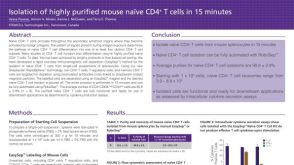 科学海报Immunomagnetic Cell Isolation of Highly Purified Mouse Naïve CD4+ T Cells in 15 Minutes
 沪公网安备31010102008431号