Distinct signals control the hematopoiesis of lymphoid-related dendritic cells.
The molecular and cellular requirements for the development of different populations of human dendritic cells (DC) were studied. Conditions were defined that support DC production from lymphoid progenitors but that fail to induce DC formation from peripheral monocytes. The production of these lymphoid-related DC was severely blocked when hematopoietic progenitors overexpressed Ik7,a mutant dominant-negative Ikaros protein. In contrast,Ik7 did not block the formation of DC in conditions supporting the development of monocyte-derived DC. Furthermore,Ik7 did not block the formation of monocyte/macrophages and enhanced granulopoiesis. One of the molecular mechanisms mediated by Ik7 appears to be down-regulation of the flt3-receptor mRNA. Thus,distinct signals control the formation of DC demonstrating that some aspects of DC diversity are determined in part by distinct molecular cues at the hematopoietic level. (Blood. 2000;95:128-137)
View Publication
产品号#:
04431
产品名:
MethoCult™ H4431
Dadaglio G et al. (MAR 2002)
Journal of immunology (Baltimore,Md. : 1950) 168 5 2219--24
Efficient in vivo priming of specific cytotoxic T cell responses by neonatal dendritic cells.
In early life,a high susceptibility to infectious diseases as well as a poor capacity to respond to vaccines are generally observed as compared with observations in adults. The mechanisms underlying immune immaturity have not been fully elucidated and could be due to the immaturity of the T/B cell responses and/or to a defect in the nature and quality of Ag presentation by the APC. This prompted us to phenotypically and functionally characterize early life murine dendritic cells (DC) purified from spleens of 7-day-old mice. We showed that neonatal CD11c(+) DC express levels of costimulatory molecules and MHC molecules similar to those of adult DC and are able to fully maturate after LPS activation. Furthermore,we demonstrated that neonatal DC can efficiently take up,process,and present Ag to T cells in vitro and induce specific CTL responses in vivo. Although a reduced number of these cells was observed in the spleen of neonatal mice as compared with adults,this study clearly shows that neonatal DC have full functional capacity and may well prime Ag-specific naive T cells in vivo.
View Publication
产品号#:
09600
09650
产品名:
StemSpan™ SFEM
StemSpan™ SFEM
Sø et al. (JUN 2014)
Molecular immunology 59 2 180--7
Natural mannosylation of HIV-1 gp120 imposes no immunoregulatory effects in primary human plasmacytoid dendritic cells.
Plasmacytoid dendritic cells (pDCs) play a vital role in activation of anti-HIV-1 immunity,and suppression of pDCs might mitigate immune responses against HIV-1. HIV-1 gp120 high-mannose has been attributed immunosuppressive roles in human myeloid DCs,but no receptors for high-mannose have so far been reported on human pDCs. Here we show that upon activation with HIV-1 or by a synthetic compound triggering the same receptor in human pDCs as single-stranded RNA,human pDCs upregulate the mannose receptor (MR,CD206). To examine the functional outcome of this upregulation,inactivated intact or viable HIV-1 particles with various degrees of mannosylation were cultured with pDCs. Activation of pDCs was determined by assaying secretion of IFN-alpha,viability,and upregulation of several pDC-activation markers: CD40,CD86,HLA-DR,CCR7,and PD-L1. The level of activation negatively correlated with degree of mannosylation,however,subsequent reduction in the original mannosylation level had no effect on the pDC phenotype. Furthermore,two of the infectious HIV-1 strains induced profound necrosis in pDCs,also in a mannose-independent manner. We therefore conclude that natural mannosylation of HIV-1 is not involved in HIV-1-mediated immune suppression of pDCs.
View Publication
产品号#:
19062
19062RF
产品名:
EasySep™人浆细胞样DC富集试剂盒
RoboSep™ 人浆细胞样DC富集试剂盒含滤芯吸头
Martí et al. (OCT 2014)
Blood 124 15 2411--20
Human blood BDCA-1 dendritic cells differentiate into Langerhans-like cells with thymic stromal lymphopoietin and TGF-β.
The ontogeny of human Langerhans cells (LCs) remains poorly characterized,in particular the nature of LC precursors and the factors that may drive LC differentiation. Here we report that thymic stromal lymphopoietin (TSLP),a keratinocyte-derived cytokine involved in epithelial inflammation,cooperates with transforming growth factor (TGF)-β for the generation of LCs. We show that primary human blood BDCA-1(+),but not BDCA-3(+),dendritic cells (DCs) stimulated with TSLP and TGF-β harbor a typical CD1a(+)Langerin(+) LC phenotype. Electron microscopy established the presence of Birbeck granules,an intracellular organelle specific to LCs. LC differentiation was not observed from tonsil BDCA-1(+) and BDCA-3(+) subsets. TSLP + TGF-β LCs had a mature phenotype with high surface levels of CD80,CD86,and CD40. They induced a potent CD4(+) T-helper (Th) cell expansion and differentiation into Th2 cells with increased production of tumor necrosis factor-α and interleukin-6 compared with CD34-derived LCs. Our findings establish a novel LC differentiation pathway from BDCA-1(+) blood DCs with potential implications in epithelial inflammation. Therapeutic targeting of TSLP may interfere with tissue LC repopulation from circulating precursors.
View Publication


 EasySep™小鼠TIL(CD45)正选试剂盒




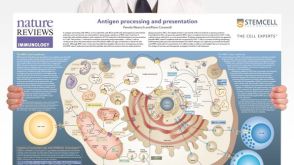 挂图Antigen Processing and Presentation Overview of the mechanisms by which antigens are processed and presented to T cells

 沪公网安备31010102008431号