Lineage-instructive function of C/EBPα in multipotent hematopoietic cells and early thymic progenitors.
Hematopoiesis is tightly controlled by transcription regulatory networks,but how and when specific transcription factors control lineage commitment are still largely unknown. Within the hematopoietic stem cell (Lin(-)Sca-1(+)c-Kit(+)) compartment these lineage-specific transcription factors are expressed at low levels but are up-regulated with the process of lineage specification. CCAAT/enhancer binding protein α (C/EBPα) represents one of these factors and is involved in myeloid development and indispensable for formation of granulocytes. To track the cellular fate of stem and progenitor cells,which express C/EBPα,we developed a mouse model expressing Cre recombinase from the Cebpa promoter and a conditional EYFP allele. We show that Cebpa/EYFP(+) cells represent a significant subset of multipotent hematopoietic progenitors,which predominantly give rise to myeloid cells in steady-state hematopoiesis. C/EBPα induced a strong myeloid gene expression signature and down-regulated E2A-induced regulators of early lymphoid development. In addition,Cebpa/EYFP(+) cells compose a fraction of early thymic progenitors with robust myeloid potential. However,Cebpa/EYFP(+) multipotent hematopoietic progenitors and early thymic progenitors retained the ability to develop into erythroid and T-lymphoid lineages,respectively. These findings support an instructive but argue against a lineage-restrictive role of C/EBPα in multipotent hematopoietic and thymic progenitors.
View Publication
产品号#:
03231
产品名:
MethoCult™ M3231
Liu C et al. (DEC 2010)
Blood 116 25 5518--27
Progenitor cell dose determines the pace and completeness of engraftment in a xenograft model for cord blood transplantation.
Two critical concerns in clinical cord blood transplantation are the initial time to engraftment and the subsequent restoration of immune function. These studies measured the impact of progenitor cell dose on both the pace and strength of hematopoietic reconstitution by transplanting nonobese diabetic/severe combined immunodeficiency/interleukin-2 receptor-gamma-null (NSγ) mice with lineage-depleted aldehyde dehydrogenase-bright CD34(+) human cord blood progenitors. The progress of each transplant was monitored over an extended time course by repeatedly analyzing the peripheral blood for human hematopoietic cells. In vivo human hematopoietic development was complete. After long-term transplantation assays (≥ 19 weeks),human T-cell development was documented within multiple tissues in 16 of 32 NSγ mice. Human T-cell differentiation was active within NSγ thymuses,as documented by the presence of CD4(+) CD8(+) T-cell progenitors as well as T-cell receptor excision circles. It is important to note that although myeloid and B-cell engraftment was detected as early as 4 weeks after transplantation,human T-cell development was exclusively late onset. High progenitor cell doses were associated with a robust human hematopoietic chimerism that accelerated both initial time to engraftment and subsequent T-cell development. At lower progenitor cell doses,the chimerism was weak and the human hematopoietic lineage development was frequently incomplete.
View Publication


 EasySep™小鼠TIL(CD45)正选试剂盒




 技术公告The Basic FACS on ALDEFLUOR™: The Quick Guide to Flow Cytometry
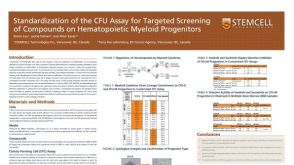
 科学海报Manipulation of the Standard CFU-GM Assay Targeted Screening of Hematopoietic Myeloid Progenitors


 沪公网安备31010102008431号