Costantini C et al. (OCT 2010)
International immunology 22 10 827--38
Neutrophil activation and survival are modulated by interaction with NK cells.
It is increasingly evident that neutrophils are able to cross-talk with other leukocytes to shape ongoing inflammatory and immune responses. In this study,we analyzed whether human NK cells may influence the survival and activation of neutrophils under co-culture conditions. We report that NK cells exposed to either IL-15 or IL-18 alone strongly protect the survival of neutrophils via the release of IFNγ and granulocyte macrophage colony-stimulating factor (GM-CSF) plus IFNγ,respectively,and cause a slight up-regulation of neutrophil CD64 and CD11b expression. In comparison,NK cells exposed to both IL-15 and IL-18 show a lesser ability to increase the survival of neutrophils but can more potently up-regulate CD64 and CD11b expression,as well as induce the de novo surface expression of CD69,in neutrophils. Analysis of the events occurring in neutrophil/NK co-cultures exposed to IL-15 plus IL-18 revealed that (i) neutrophil survival is positively affected by NK-derived GM-CSF but negatively influenced by a CD18-dependent neutrophil/NK contact,(ii) NK-derived IFNγ is almost entirely responsible for the induction of CD64,(iii) both soluble factors (primarily GM-CSF) and direct cell-cell contact up-regulate CD11b and CD69 and (iv) NK-derived GM-CSF induces the expression of biologically active heparin-binding EGF-like growth factor (HB-EGF) in neutrophils. Finally,we demonstrate that NK cells can also express HB-EGF when stimulated with either IL-2 or IL-15,yet independently of endogenous GM-CSF. Altogether,our results define a novel interaction within the innate immune system whereby NK cells,by directly modulating neutrophil functions,might contribute to the pathogenesis of inflammatory diseases.
View Publication
产品号#:
19257
19257RF
19055
19055RF
产品名:
EasySep™人NK细胞富集试剂盒
RoboSep™ 人NK细胞富集试剂盒含滤芯吸头
Magri G et al. (JAN 2011)
Blood 117 3 848--56
NKp46 and DNAM-1 NK-cell receptors drive the response to human cytomegalovirus-infected myeloid dendritic cells overcoming viral immune evasion strategies.
Information on natural killer (NK)-cell receptor-ligand interactions involved in the response to human cytomegalovirus (HCMV) is limited and essentially based on the study of infected fibroblasts. Experimental conditions were set up to characterize the NK response to HCMV-infected myeloid dendritic cells (DCs). Monocyte-derived DCs (moDCs) infected by the TB40/E HCMV strain down-regulated the expression of human leukocyte antigen class I molecules and specifically activated autologous NK-cell populations. NKG2D ligands appeared virtually undetectable in infected moDCs,reflecting the efficiency of immune evasion mechanisms,and explained the lack of antagonistic effects of NKG2D-specific monoclonal antibody. By contrast,DNAM-1 and DNAM-1 ligands (DNAM-1L)-specific monoclonal antibodies inhibited the NK response at 48 hours after infection,although the impact of HCMV-dependent down-regulation of DNAM-1L in infected moDCs was perceived at later stages. moDCs constitutively expressed ligands for NKp46 and NKp30 natural cytotoxicity receptors,which were partially reduced on HCMV infection; yet,only NKp46 appeared involved in the NK response. In contrast to previous reports in fibroblasts,human leukocyte antigen-E expression was not preserved in HCMV-infected moDCs,which triggered CD94/NKG2A(+) NK-cell activation. The results provide an insight on key receptor-ligand interactions involved in the NK-cell response against HCMV-infected moDCs,stressing the importance of the dynamics of viral immune evasion mechanisms.
View Publication
产品号#:
19055
19055RF
产品名:
EasySep™人NK细胞富集试剂盒
RoboSep™ 人NK细胞富集试剂盒含滤芯吸头
Fiedler K et al. (JAN 2011)
Blood 117 4 1329--39
Neutrophil development and function critically depend on Bruton tyrosine kinase in a mouse model of X-linked agammaglobulinemia.
Bruton tyrosine kinase (Btk) is essential for B cell development and function and also appears to be important for myeloid cells. The bone marrow of Btk-deficient mice shows enhanced granulopoiesis compared with that of wild-type mice. In purified granulocyte-monocyte-progenitors (GMP) from Btk-deficient mice,the development of granulocytes is favored at the expense of monocytes. However,Btk-deficient neutrophils are impaired in maturation and function. Using bone marrow chimeras,we show that this defect is cell-intrinsic to neutrophils. In GMP and neutrophils,Btk plays a role in GM-CSF- and Toll-like receptor-induced differentiation. Molecular analyses revealed that expression of the lineage-determining transcription factors C/EBPα,C/EBPβ,and PU.1,depends on Btk. In addition,expression of several granule proteins,including myeloperoxidase,neutrophilic granule protein,gelatinase and neutrophil elastase,is Btk-dependent. In the Arthus reaction,an acute inflammatory response,neutrophil migration into tissues,edema formation,and hemorrhage are significantly reduced in Btk-deficient animals. Together,our findings implicate Btk as an important regulator of neutrophilic granulocyte maturation and function in vivo.
View Publication
E. Giuliani et al. (mar 2019)
Scientific reports 9 1 4373
Hexamethylene bisacetamide impairs NK cell-mediated clearance of acute T lymphoblastic leukemia cells and HIV-1-infected T cells that exit viral latency.
The hexamethylene bisacetamide (HMBA) anticancer drug was dismissed due to limited efficacy in leukemic patients but it may re-enter into the clinics in HIV-1 eradication strategies because of its recently disclosed capacity to reactivate latent virus. Here,we investigated the impact of HMBA on the cytotoxicity of natural killer (NK) cells against acute T lymphoblastic leukemia (T-ALL) cells or HIV-1-infected T cells that exit from latency. We show that in T-ALL cells HMBA upmodulated MICB and ULBP2 ligands for the NKG2D activating receptor. In a primary CD4+ T cell-based latency model,HMBA did not reactivate HIV-1,yet enhanced ULBP2 expression on cells harboring virus reactivated by prostratin (PRO). However,HMBA reduced the expression of NKG2D and its DAP10 adaptor in NK cells,hence impairing NKG2D-mediated cytotoxicity and DAP10-dependent response to IL-15 stimulation. Alongside,HMBA dampened killing of T-ALL targets by IL-15-activated NK cells and impaired NK cell-mediated clearance of PRO-reactivated HIV-1+ cells. Overall,our results demonstrate a dominant detrimental effect of HMBA on the NKG2D pathway that crucially controls NK cell-mediated killing of tumors and virus-infected cells,providing one possible explanation for poor clinical outcome in HMBA-treated cancer patients and raising concerns for future therapeutic application of this drug.
View Publication
产品号#:
19052
19052RF
产品名:
EasySep™人CD4+ T细胞富集试剂盒
RoboSep™ 人CD4+ T细胞富集试剂盒含滤芯吸头
A. Lisco et al. (apr 2019)
JCI insight 4 8
Identification of rare HIV-1-infected patients with extreme CD4+ T cell decline despite ART-mediated viral suppression.
BACKGROUND The goal of antiretroviral therapy (ART) is to suppress HIV-1 replication and reconstitute CD4+ T cells. Here,we report on HIV-infected individuals who had a paradoxical decline in CD4+ T cells despite ART-mediated suppression of plasma HIV-1 load (pVL). We defined such an immunological outcome as extreme immune decline (EXID). METHODS EXID's clinical and immunological characteristics were compared to immunological responders (IRs),immunological nonresponders (INRs),healthy controls (HCs),and idiopathic CD4+ lymphopenia (ICL) patients. T cell immunophenotyping and assembly/activation of inflammasomes were evaluated by flow cytometry. PBMC transcriptome analysis and genetic screening for pathogenic variants were performed. Levels of cytokines/chemokines were measured by electrochemiluminescence. Luciferase immunoprecipitation system and NK-mediated antibody-dependent cellular cytotoxicity (ADCC) assays were used to identify anti-lymphocyte autoantibodies. RESULTS EXIDs were infected with non-B HIV-1 subtypes and after 192 weeks of consistent ART-mediated pVL suppression had a median CD4+ decrease of 157 cells/mul,compared with CD4+ increases of 193 cells/mul and 427 cells/mul in INR and IR,respectively. EXID had reduced naive CD4+ T cells,but similar proportions of cycling CD4+ T cells and HLA-DR+CD38+CD8+ T cells compared with IR and INR. Levels of inflammatory cytokines were also similar in EXID and INR,but the IL-7 axis was profoundly perturbed compared with HC,IR,INR,and ICL. Genes involved in T cell and monocyte/macrophage function,autophagy,and cell migration were differentially expressed in EXID. Two of the 5 EXIDs had autoantibodies causing ADCC,while 2 different EXIDs had an increased inflammasome/caspase-1 activation despite consistently ART-suppressed pVL. CONCLUSIONS EXID is a distinct immunological outcome compared with previously described INR. Anti-CD4+ T cell autoantibodies and aberrant inflammasome/caspase-1 activation despite suppressed HIV-1 viremia are among the mechanisms responsible for EXID.
View Publication
产品号#:
17955
17955RF
100-0960
产品名:
EasySep™人NK细胞分选试剂盒
RoboSep™ 人NK细胞分选试剂盒
EasySep™人NK细胞分离试剂盒
T. A. Mace et al. (mar 2019)
Scientific reports 9 1 5068
Soy isoflavones and their metabolites modulate cytokine-induced natural killer cell function.
Soybeans are a rich source of isoflavones that have been linked with anti-inflammatory processes and various health benefits. However,specific mechanisms whereby soy bioactives impact immune cell subsets are unclear. Isoflavones,such as genistein and daidzein,are metabolized by microbes to bioactive metabolites as O-desmethylangolensin (O-DMA) and equol,whose presence has been linked to health benefits. We examined how soy isoflavones and metabolites impact natural killer (NK) cell signaling and function. We observe no impact of isoflavones on viability of healthy donor peripheral blood mononuclear cells (PBMCs) or NK cells,even at high (25 µM) concentrations. However,pre-treatment of PBMCs with physiologically-relevant concentrations of genistein (p = 0.0023) and equol (p = 0.006) decreases interleukin (IL)-12/IL-18-induced interferon-gamma (IFN-gamma) production versus controls. Detailed cellular analyses indicate genistein and equol decrease IL-12/IL-18-induced IFN-gamma production by human NK cell subsets,but do not consistently alter cytotoxicity. At the level of signal transduction,genistein decreases IL-12/IL-18-induced total phosphorylated tyrosine,and phosphorylation MAPK pathway components. Further,genistein limits IL-12/IL-18-mediated upregulation of IL-18Ralpha expression on NK cells (p = 0.0109). Finally,in vivo studies revealed that C57BL/6 mice fed a soy-enriched diet produce less plasma IFN-gamma following administration of IL-12/IL-18 versus control-fed animals (p {\textless} 0.0001). This study provides insight into how dietary soy modulates NK cell functions.
View Publication


 EasySep™小鼠TIL(CD45)正选试剂盒




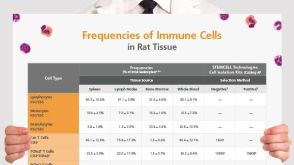 挂图Frequencies of Immune Cells in Rat Tissue Lists the estimated frequencies of more than 15 immune cell types in Sprague Dawley rats

 沪公网安备31010102008431号