Bone Marrow Niches and HSC Fates
A detailed reference on signaling pathways in the bone marrow and how these influence HSC fate decisions; created in partnership with Nature Reviews Immunology and Nature Reviews Molecular Cell Biology
Gao L et al. (APR 2000)
Blood 95 7 2198--203
Selective elimination of leukemic CD34(+) progenitor cells by cytotoxic T lymphocytes specific for WT1.
Hematologic malignancies such as acute and chronic myeloid leukemia are characterized by the malignant transformation of immature CD34(+) progenitor cells. Transformation is associated with elevated expression of the Wilm's tumor gene encoded transcription factor (WT1). Here we demonstrate that WT1 can serve as a target for cytotoxic T lymphocytes (CTL) with exquisite specificity for leukemic progenitor cells. HLA-A0201- restricted CTL specific for WT1 kill leukemia cell lines and inhibit colony formation by transformed CD34(+) progenitor cells isolated from patients with chronic myeloid leukemia (CML),whereas colony formation by normal CD34(+) progenitor cells is unaffected. Thus,the tissue-specific transcription factor WT1 is an ideal target for CTL-mediated purging of leukemic progenitor cells in vitro and for antigen-specific therapy of leukemia and other WT1-expressing malignancies in vivo.
View Publication
产品号#:
04535
04545
产品名:
MethoCult™ H4535 Enriched,不含EPO
MethoCult™ H4535 Enriched,不含EPO
Chan G et al. (APR 2009)
Blood 113 18 4414--24
Leukemogenic Ptpn11 causes fatal myeloproliferative disorder via cell-autonomous effects on multiple stages of hematopoiesis.
PTPN11,which encodes the tyrosine phosphatase SHP2,is mutated in approximately 35% of patients with juvenile myelomonocytic leukemia (JMML) and at a lower incidence in other neoplasms. To model JMML pathogenesis,we generated knockin mice that conditionally express the leukemia-associated mutant Ptpn11(D61Y). Expression of Ptpn11(D61Y) in all hematopoietic cells evokes a fatal myeloproliferative disorder (MPD),featuring leukocytosis,anemia,hepatosplenomegaly,and factor-independent colony formation by bone marrow (BM) and spleen cells. The Lin(-)Sca1(+)cKit(+) (LSK) compartment is expanded and right-shifted�
View Publication
产品号#:
03234
03334
03434
03444
产品名:
MethoCult™ M3234
MethoCult™ M3334
MethoCult™ GF M3434
MethoCult™ GF M3434
Pendino F et al. (APR 2009)
Blood 113 14 3172--81
Functional involvement of RINF, retinoid-inducible nuclear factor (CXXC5), in normal and tumoral human myelopoiesis.
Retinoids triggers differentiation of acute promyelocytic leukemia (APL) blasts by transcriptional regulation of myeloid regulatory genes. Using a microarray approach,we have identified a novel retinoid-responsive gene (CXXC5) encoding a nuclear factor,retinoid-inducible nuclear factor (RINF),that contains a CXXC-type zinc-finger motif. RINF expression correlates with retinoid-induced differentiation of leukemic cells and with cytokine-induced myelopoiesis of normal CD34(+) progenitors. Furthermore,short hairpin RNA (shRNA) interference suggests for this gene a regulatory function in both normal and tumoral myelopoiesis. Interestingly,RINF localizes to 5q31.3,a small region often deleted in myeloid leukemia (acute myeloid leukemia [AML]/myelodysplasia [MDS]) and suspected to harbor one or several tumor suppressor gene.
View Publication
产品号#:
70002
70002.1
70002.2
70002.3
70002.4
70002.5
产品名:
Miyazaki K et al. (MAY 2009)
Blood 113 19 4702--10
Enhanced expression of p210BCR/ABL and aberrant expression of Zfp423/ZNF423 induce blast crisis of chronic myelogenous leukemia.
Chronic myelogenous leukemia (CML) is a hematopoietic disorder originating from p210BCR/ABL-transformed stem cells,which begins as indolent chronic phase (CP) but progresses into fatal blast crisis (BC). To investigate molecular mechanism(s) underlying disease evolution,CML-exhibiting p210BCR/ABL transgenic mice were crossed with BXH2 mice that transmit a replication-competent retrovirus. Whereas nontransgenic mice in the BXH2 background exclusively developed acute myeloid leukemia,p210BCR/ABL transgenic littermates developed nonmyeloid leukemias,in which inverse polymerase chain reaction detected 2 common viral integration sites (CISs). Interestingly,one CIS was transgene's own promoter,which up-regulated p210BCR/ABL expression. The other was the 5' noncoding region of a transcription factor,Zfp423,which induced aberrant Zfp423 expression. The cooperative activities of Zfp423 and p210BCR/ABL were demonstrated as follows: (1) introduction of Zfp423 in p210BCR/ABL transgenic bone marrow (BM) cells increased colony-forming ability,(2) suppression of ZNF423 (human homologue of Zfp423) in ZNF423-expressing,p210BCR/ABL-positive hematopoietic cells retarded cell growth,(3) mice that received a transplant of BM cells transduced with Zfp423 and p210BCR/ABL developed acute leukemia,and (4) expression of ZNF423 was found in human BCR/ABL-positive cell lines and CML BC samples. These results demonstrate that enhanced expression of p210BCR/ABL and deregulated expression of Zfp423/ZNF423 contribute to CML BC.
View Publication
c-Myc is a target of RNA-binding motif protein 15 in the regulation of adult hematopoietic stem cell and megakaryocyte development.
RNA-binding motif protein 15 (RBM15) is involved in the RBM15-megakaryoblastic leukemia 1 fusion in acute megakaryoblastic leukemia. Although Rbm15 has been reported to be required for B-cell differentiation and to inhibit myeloid and megakaryocytic expansion,it is not clear what the normal functions of Rbm15 are in the regulation of hematopoietic stem cell (HSC) and megakaryocyte development. In this study,we report that Rbm15 may function in part through regulation of expression of the proto-oncogene c-Myc. Similar to c-Myc knockout (c-Myc-KO) mice,long-term (LT) HSCs are significantly increased in Rbm15-KO mice due to an apparent LT-HSC to short-term HSC differentiation defect associated with abnormal HSC-niche interactions caused by increased N-cadherin and beta(1) integrin expression on mutant HSCs. Both serial transplantation and competitive reconstitution capabilities of Rbm15-KO LT-HSCs are greatly compromised. Rbm15-KO and c-Myc-KO mice also share related abnormalities in megakaryocyte development,with mutant progenitors producing increased,abnormally small low-ploidy megakaryocytes. Consistent with a possible functional interplay between Rbm15 and c-Myc,the megakaryocyte increase in Rbm15-KO mice could be partially reversed by ectopic c-Myc. Thus,Rbm15 appears to be required for normal HSC-niche interactions,for the ability of HSCs to contribute normally to adult hematopoiesis,and for normal megakaryocyte development; these effects of Rbm15 on hematopoiesis may be mediated at least in part by c-Myc.
View Publication


 EasySep™小鼠TIL(CD45)正选试剂盒





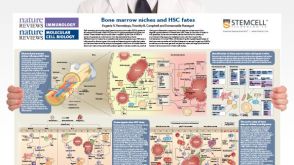 挂图Bone Marrow Niches and HSC Fates A detailed reference on signaling pathways in the bone marrow and how these influence HSC fate decisions; created in partnership with Nature Reviews Immunology and Nature Reviews Molecular Cell Biology

 沪公网安备31010102008431号