Chase JC et al. (JUN 2001)
Diseases of Aquatic Organisms 45 2 121--9
Analysis of Kudoa thyrsites (Myxozoa: Myxosporea) spore antigens using monoclonal antibodies.
A method employing Percoll gradient centrifugation was developed to purify Kudoa thyrsites spores from somatic muscle tissue of Atlantic salmon Salmo salar. Highly purified spores were then used to immunize inbred BALB/c mice for derivation of hybridomas secreting Kudoa-specific monoclonal antibodies (mAbs). Analysis of mAbs by immunofluorescence microscopy and flow cytometry showed that several were specific for antigens on the surface of K. thyrsites spores whereas other mAbs reacted with polar capsules or with polar filaments of spores of K. thyrsites,K. paniformis and K. crumena. Immunoblots on spore lysates using the surface-binding mAbs showed a broad band of 46 to textgreater 220 kDa,whereas mAbs specific for antigens of polar capsules and polar filaments detected sharper bands of various molecular masses,depending on the Kudoa species. The dominant epitope of the K. thyrsites spore surface antigen was shown to be carbohydrate as determined by its sensitivity to treatment with anhydrous trifluoromethane sulfonic acid and by its resistance to treatment with Proteinase K. Immunofluorescence microscopy using the K. thyrsites-specific mAbs on isolated,intact,permeabilized plasmodia and on thin sections of somatic muscle tissue containing plasmodia revealed intense labeling of spores both within the spore-producing plasmodia and in the flesh of infected Atlantic salmon. As few as 100 spores were detected by immunoblotting,indicating that these mAbs have potential for use in developing a field-based diagnostic test.
View Publication
产品号#:
03800
03801
03802
03803
03804
03805
03806
产品名:
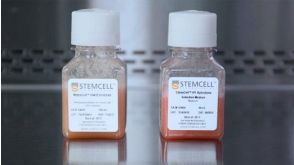
ClonaCell™-HY杂交瘤试剂盒
ClonaCell™-HY培养基A
ClonaCell™-HY 培养基 B
ClonaCell™-HY 培养基 C
ClonaCell™-HY 培养基 D
ClonaCell™-HY 培养基 E
ClonaCell™-HY PEG
Ling SSM et al. (JUN 2015)
PLOS ONE 10 6 e0131460
Instrumental Role of Helicobacter pylori γ-Glutamyl Transpeptidase in VacA-Dependent Vacuolation in Gastric Epithelial Cells
Helicobacter pylori causes cellular vacuolation in host cells,a cytotoxic event attributed to vacuolating cytotoxin (VacA) and the presence of permeant weak bases such as ammonia. We report here the role of γ-glutamyl transpeptidase (GGT),a constitutively expressed secretory enzyme of H. pylori,in potentiating VacA-dependent vacuolation formation in H. pylori-infected AGS and primary gastric cells. The enhancement is brought about by GGT hydrolysing glutamine present in the extracellular medium,thereby releasing ammonia which accentuates the VacA-induced vacuolation. The events of vacuolation in H. pylori wild type (WT)- and Δggt-infected AGS cells were first captured and visualized by real-time phase-contrast microscopy where WT was observed to induce more vacuoles than Δggt. By using semi-quantitative neutral red uptake assay,we next showed that Δggt induced significantly less vacuolation in AGS and primary gastric epithelial cells as compared to the parental strain (Ptextless0.05) indicating that GGT potentiates the vacuolating effect of VacA. Notably,vacuolation induced by WT was significantly reduced in the absence of GGT substrate,glutamine (Ptextless0.05) or in the presence of a competitive GGT inhibitor,serine-borate complex. Furthermore,the vacuolating ability of Δggt was markedly restored when co-incubated with purified recombinant GGT (rGGT),although rGGT itself did not induce vacuolation independently. Similarly,the addition of exogenous ammonium chloride as a source of ammonia also rescued the ability of Δggt to induce vacuolation. Additionally,we also show that monoclonal antibodies against GGT effectively inhibited GGT activity and successfully suppressed H. pylori-induced vacuolation. Collectively,our results clearly demonstrate that generation of ammonia by GGT through glutamine hydrolysis is responsible for enhancing VacA-dependent vacuolation. Our findings provide a new perspective on GGT as an important virulence factor and a promising target in the management of H. pylori-associated gastric diseases.
View Publication
产品号#:
03800
03801
03802
03803
03804
03805
03806
产品名:
ClonaCell™-HY杂交瘤试剂盒
ClonaCell™-HY培养基A
ClonaCell™-HY 培养基 B
ClonaCell™-HY 培养基 C
ClonaCell™-HY 培养基 D
ClonaCell™-HY 培养基 E
ClonaCell™-HY PEG
Wu J et al. (JUL 2014)
PLoS ONE 9 7 e102486
Oxygen transport and stem cell aggregation in stirred-suspension bioreactor cultures
Stirred-suspension bioreactors are a promising modality for large-scale culture of 3D aggregates of pluripotent stem cells and their progeny. Yet,cells within these clusters experience limitations in the transfer of factors and particularly O2 which is characterized by low solubility in aqueous media. Cultured stem cells under different O2 levels may exhibit significantly different proliferation,viability and differentiation potential. Here,a transient diffusion-reaction model was built encompassing the size distribution and ultrastructural characteristics of embryonic stem cell (ESC) aggregates. The model was coupled to experimental data from bioreactor and static cultures for extracting the effective diffusivity and kinetics of consumption of O2 within mouse (mESC) and human ESC (hESC) clusters. Under agitation,mESC aggregates exhibited a higher maximum consumption rate than hESC aggregates. Moreover,the reaction-diffusion model was integrated with a population balance equation (PBE) for the temporal distribution of ESC clusters changing due to aggregation and cell proliferation. Hypoxia was found to be negligible for ESCs with a smaller radius than 100 µm but became appreciable for aggregates larger than 300 µm. The integrated model not only captured the O2 profile both in the bioreactor bulk and inside ESC aggregates but also led to the calculation of the duration that fractions of cells experience a certain range of O2 concentrations. The approach described in this study can be employed for gaining a deeper understanding of the effects of O2 on the physiology of stem cells organized in 3D structures. Such frameworks can be extended to encompass the spatial and temporal availability of nutrients and differentiation factors and facilitate the design and control of relevant bioprocesses for the production of stem cell therapeutics.
View Publication


 EasySep™小鼠TIL(CD45)正选试剂盒








 沪公网安备31010102008431号